
Tolling and MLFF gantries
Overhead gantry reading of vehicles at highway speed across multiple lanes for multi lane free flow tolling, and barrier lane reading at conventional plazas.
UHF RFID integrated reader
TW-UR710 is a long range, all in one UHF RFID reader with a built in circular polarized antenna. It reads tags from up to 30 metres and captures approx 950 tags per second, so it suits vehicle identification at toll lanes, gates and parking entries. RS232, RS485, Wiegand and TCP/IP let it plug straight into access controllers, existing Wiegand systems and your software.
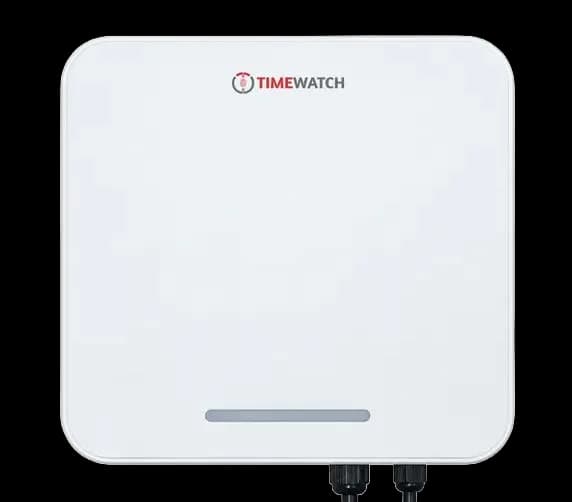
The TimeWatch TW-UR710 is an integrated UHF RFID reader that reads EPC Gen 2 tags at up to 30 metres and approx 950 tags per second. It has a built in circular polarized antenna, up to 33 dBm adjustable output, and RS232, RS485, Wiegand and TCP/IP interfaces, making it suited to MLFF tolling gantries, barrier toll lanes, parking, logistics and warehousing.
In an MLFF toll system there is no barrier and no booth. Vehicles cross an overhead gantry at full highway speed, in any lane, and the gantry has to identify every one of them on the move. That single difference is what makes the reader specification critical, because the time available to read each tag is fixed by the speed of the road.
A vehicle at 100 km/h covers about 27.8 metres every second. The depth of the read zone therefore decides the dwell time, and dwell time decides how many read attempts the system gets before the vehicle is gone.
| Read zone depth | Dwell time | Read attempts at approximately 950 tags per second |
|---|---|---|
| 30 m (TW-UR710) | About 1.08 s | Roughly 1,000 |
| 16 m | About 0.58 s | Roughly 550 |
| 12 m | About 0.43 s | Roughly 410 |
| 5 m | About 0.18 s | Roughly 170 |
Those attempts are not redundant. A moving tag is a hard target: orientation shifts, the signal path changes, and nearby bodywork interferes, so individual attempts fail. Free flow reliability comes from having enough attempts inside the window that a successful read is near certain.
Because the same reader also serves barrier lanes, a plaza running barriers today and converting to free flow later does not need a different identification platform at each stage.
Read the full explanation of how MLFF toll systems work in India.
Dwell figures are derived from speed and read zone depth to explain the engineering requirement. Achieved read performance depends on tag, mounting geometry, RF conditions and vehicle mix, and should be confirmed by site survey.
| Specification | Details |
|---|---|
| Chipset | Impinj E710 |
| Frequency | 865 to 868 MHz / 902 to 928 MHz |
| Protocol | EPC C1 Gen 2 (ISO 18000-6C) |
| Frequency hopping | FHSS or fixed frequency |
| Antenna | Built in circular polarization |
| Output power | Up to 33 dBm, adjustable |
| Receiver sensitivity | -87 dBm |
| Reading range | Up to 30 m |
| Inventory speed | Approx 950 tags per second |
| Working modes | Active mode and answer mode |
| RSSI | Supported |
| Interfaces | RS232, RS485, Wiegand, TCP/IP |
| Optional interfaces | Wi-Fi, Bluetooth, USB, 4G |
| Power supply | 26 V DC |
| Current | Standby 80 mA, 1180 mA at 33 dBm |
| Operating temperature | -20°C to +60°C |
| Storage temperature | -20°C to +70°C |
| Dimensions | 278.5 × 257 × 52 mm |
| Firmware | On site firmware upgrade supported |
The TW-UR710 has a DC power jack, a Wiegand output (D0, D1, GND), two relay outputs (COM and NO), an RS232 port and an RJ45 TCP/IP port. Use Wiegand to connect to an existing access controller, the relay to trigger a barrier directly, and TCP/IP or RS485 to report every read to parking, yard or ERP software.
Overhead gantry reading of vehicles at highway speed across multiple lanes for multi lane free flow tolling, and barrier lane reading at conventional plazas.
Hands free entry for pass holders at malls, offices and societies.
Automatic gate in and gate out for trucks and trailers.
Truck and container tracking at yard and dock gates.
Bulk reading of tagged stock and carts at controlled points.
Bus depots, fleet yards and metro parking.
| Model | Read range | RF power | Interfaces | Best for |
|---|---|---|---|---|
| TW-UR6 / UR6T | Up to 5 m | Up to 26 dBm | Wiegand, RS232 (RS485 optional, TCP/IP on UR6T) | IP65 outdoor reader for single lane gates, societies and door access |
| TW-UR6000 / 6000T | Up to 5 m | Up to 30 dBm | RS232, Wiegand (TCP/IP optional) | All in one reader for parking, short range gates and asset points |
| TW-UR12 / 12T | Up to 12 m | Up to 26 dBm | Wiegand, RS232 (RS485 optional) | IP68 reader for wider gates and campus entries |
| TW-UR8000 | Up to 16 m | Up to 33 dBm | RS232, Wiegand (TCP/IP optional) | Extended range for multi lane gates and factory truck entries |
| TW-UR710 | Up to 30 m | Up to 33 dBm | RS232, RS485, Wiegand, TCP/IP (Wi-Fi, BT, USB, 4G optional) | Longest range, approx 950 tags per second for tolling, ports and logistics yards |
The TW-UR710 reads UHF tags from up to 30 metres. Actual range depends on the tag, mounting position and site conditions.
It captures approx 950 tags per second, with multi tag anti collision, so it handles several vehicles or tagged items in the read zone at once.
RS232, RS485, Wiegand and TCP/IP as standard, with Wi-Fi, Bluetooth, USB and 4G available as options.
865 to 868 MHz for India and Europe, and 902 to 928 MHz for markets that use the US band.
Yes. The reader sends the tag ID to an access controller over Wiegand, or directly to software over TCP/IP or RS485, and the controller opens the boom barrier for approved tags.
Yes. It has a high reliability design for harsh environments and operates from -20°C to +60°C.
Tolling lanes, parking entries, logistics and warehousing yards, ports, retail and transportation depots, wherever long range and fast reading are needed.
The TW-UR710 reads up to 30 m at approx 950 tags per second with TCP/IP and RS485 built in. The TW-UR8000 reads up to 16 m at more than 400 tags per second with TCP/IP as an option.
Yes. Its 30 metre read range and approximately 950 tags per second are the two specifications that matter most in multi lane free flow, because they decide how much read time and how many read attempts are available while a vehicle crosses the gantry at speed. The built in circular polarized antenna, RSSI reporting and adjustable output support the mixed tag orientation and zone shaping that a free flow carriageway requires.
A vehicle at 100 km/h covers about 27.8 metres per second, so a 30 metre read zone gives roughly 1.08 seconds of dwell time. At approximately 950 tags per second that is in the region of a thousand read attempts for that vehicle. The same zone gives about 1.80 seconds at 60 km/h and about 0.90 seconds at 120 km/h, which is why the design speed of the road belongs in the specification.
At a barrier the vehicle is stopped or crawling, so read time is effectively unlimited and a short range reader is sufficient. In free flow the vehicle speed is fixed by the road, so range is the only variable that buys read time. Halving the read zone halves the dwell time and halves the number of attempts available before the vehicle has passed.
Tell us your lane count, mounting option and vehicle volume, and our team will confirm the setup and send a quotation.
Enquire nowCall +91 95999 53923
Pictures are for illustration. Specifications may change without notice; please consult us before ordering.
