
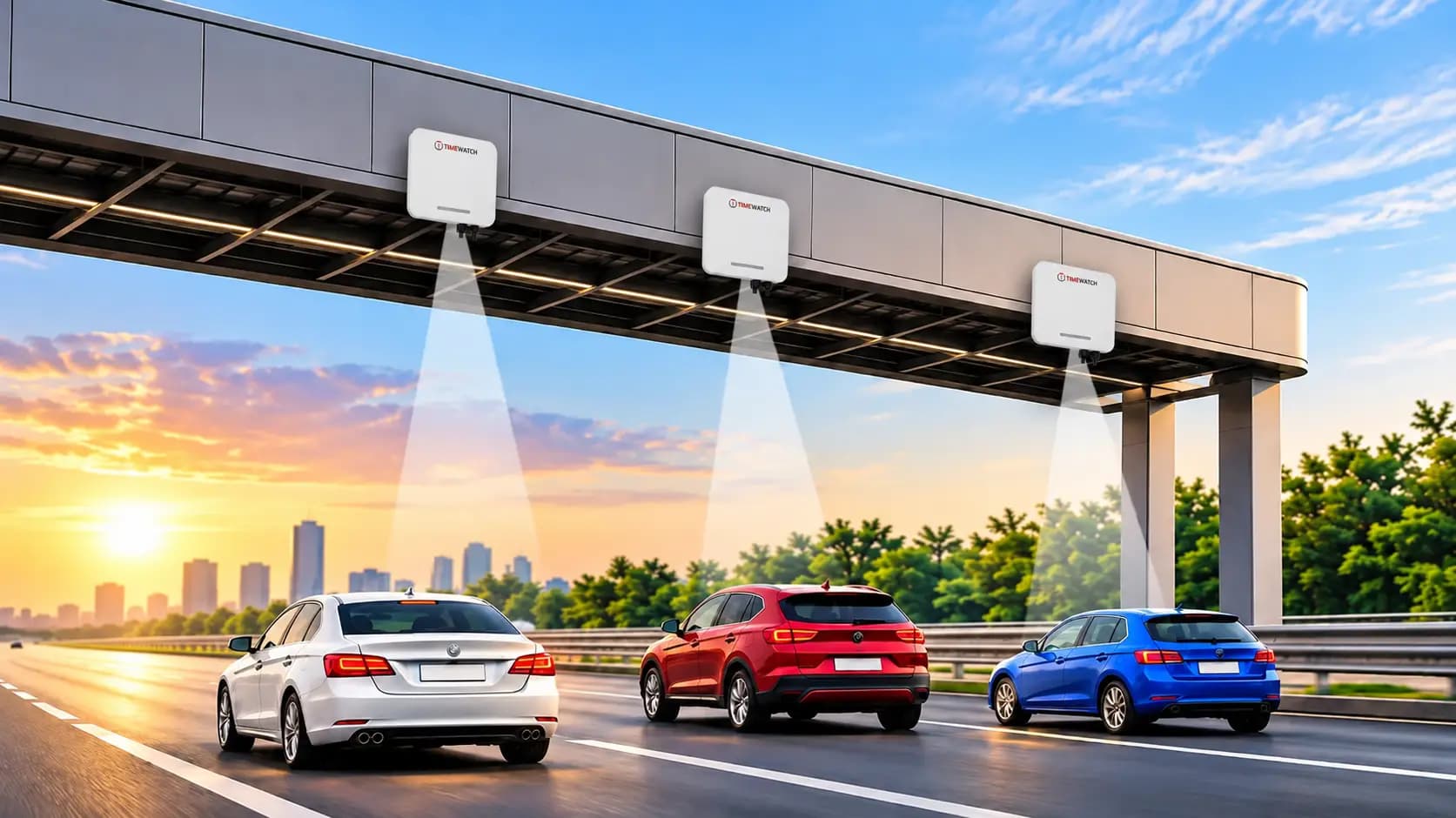
MLFF Toll System in India
MLFF tolling in one paragraph
An MLFF (multi lane free flow) toll system charges vehicles without stopping them. There is no barrier and no booth. An overhead gantry spans the carriageway carrying long range UHF RFID readers and ANPR cameras. As a vehicle passes at normal speed, the reader identifies its windscreen tag and the cameras capture its number plate, and the toll is applied to the linked account afterwards. The design problem is time: at 100 km/h a vehicle is inside a 30 metre read zone for roughly one second, and the gantry may be identifying several vehicles at once across every lane.
- No barrier, so throughput is limited by the road, not the lane
- Any lane, with no need for drivers to line up at a booth
- RFID plus ANPR, identification backed by enforcement capture
- About 1 second of read time per vehicle at highway speed
What is MLFF tolling?
MLFF stands for multi lane free flow. It describes a tolling arrangement in which the charging point imposes nothing on the vehicle at all: no stopping, no slowing, no queueing and no requirement to pick a particular lane. The road continues at its normal cross section and normal speed, and the tolling equipment sits above it on a gantry.
The phrase is worth taking literally, because each word is a design requirement. Free flow means traffic is never interrupted, so there is no barrier to enforce payment and no booth to fall back on. Multi lane means the system cannot assume one vehicle at a time in a known position, so it must identify several vehicles simultaneously and work out where each one was. Together those two words remove every simplification that conventional tolling relies on.
How MLFF differs from the FASTag barrier lanes used today
Most electronic tolling in India today is not free flow. It is electronic payment inside a barrier lane. The vehicle approaches a plaza, slows into a lane, the overhead reader identifies the FASTag on the windscreen, the account is checked, and the boom barrier lifts. The transaction is electronic, but the road discipline is unchanged: one vehicle, one lane, brought almost to a stop.
That barrier is doing more work than it appears to. It is the enforcement mechanism. If the tag does not read, or the account has insufficient balance, the barrier simply does not open and the problem is resolved on the spot by an operator. Remove the barrier and that safety net disappears with it. Everything the barrier was quietly handling has to be solved another way.
| Aspect | Barrier lane (current FASTag plaza) | Multi lane free flow |
|---|---|---|
| Vehicle speed at the point of charge | Stopped or crawling | Normal highway speed |
| Lane discipline | Enforced by plaza islands | None, vehicles may change lanes under the gantry |
| Read window per vehicle | Seconds, effectively unlimited | Around one second or less |
| Vehicles in the field at once | One per lane | Several across the full carriageway |
| Enforcement mechanism | The barrier itself | Plate capture and post transaction recovery |
| Failure handling | Operator resolves at the lane | Exception raised against the plate for later settlement |
| Throughput ceiling | Set by the slowest lane | Set by the capacity of the road |
This is why free flow is a different project rather than an upgrade. The civil layout, the identification accuracy requirement and the back office all change together.
How an MLFF gantry works, step by step
| Step | What happens | How |
|---|---|---|
| 1 | Vehicle approaches the gantry | Detection and classification sensors register that a vehicle is entering the zone and establish its class, which determines the applicable charge. |
| 2 | The tag enters the read field | Long range UHF readers on the gantry radiate across the carriageway. The passive windscreen tag harvests that energy and replies by backscatter with its identifier. |
| 3 | The reader singulates every tag present | Anti collision allows the reader to separate multiple tags responding at the same instant, so several vehicles across several lanes are read within the same window. |
| 4 | Position is inferred | Overlapping antenna coverage and signal strength readings associate each tag with a position on the carriageway, since there is no lane to assume it came from. |
| 5 | Plates are captured in parallel | ANPR cameras photograph every vehicle crossing the gantry regardless of whether its tag read succeeded, building the enforcement record. |
| 6 | Tag and plate are correlated | Local processing matches the tag identifier, the vehicle class and the captured plate into one transaction record with a timestamp. |
| 7 | The transaction is forwarded | The record is sent to the central host over the communications link for charging against the linked account. |
| 8 | Exceptions are raised | Where no valid tag was read, or the account cannot be charged, the plate becomes the basis of a violation or recovery case. |
Steps two, three and four all happen inside the same fraction of a second, which is the part of the problem that decides whether the whole system works.
Why MLFF is harder: the read window problem
Everything difficult about free flow tolling reduces to one number: how long the tag stays inside the read zone. That figure is not a matter of opinion, it falls straight out of speed and distance.
A vehicle travelling at 100 km/h covers about 27.8 metres every second. So the dwell time available to identify it is simply the depth of the read zone divided by that figure.
| Read zone depth | Dwell time at 100 km/h | Read attempts available at approximately 950 tags per second |
|---|---|---|
| 30 m | About 1.08 seconds | Roughly 1,000 |
| 16 m | About 0.58 seconds | Roughly 550 |
| 12 m | About 0.43 seconds | Roughly 410 |
| 5 m | About 0.18 seconds | Roughly 170 |
Those read attempts are not redundant. A moving tag is a difficult target: its orientation shifts, the signal path changes, other vehicles and metal bodywork interfere, and individual attempts fail. Reliability in free flow comes from having enough attempts that a successful read is near certain within the window. Halve the dwell time and you halve the margin.
Speed compounds the same effect. The same 30 metre zone gives about 1.80 seconds at 60 km/h, 1.35 seconds at 80 km/h, 1.08 seconds at 100 km/h and 0.90 seconds at 120 km/h. A gantry specified comfortably for a 60 km/h corridor can be marginal on a high speed expressway, which is why the design speed of the road belongs in the specification from the start.
These figures describe the physics of the read window. Achieved performance on any particular site also depends on the tag, the mounting geometry, the antenna pattern, RF conditions and vehicle mix, and should be confirmed by survey and trial rather than assumed.
What the identification layer has to deliver
Working back from the read window, a reader intended for free flow tolling has a specific set of requirements, and they are different from those of a parking gate.
- Long read range. Range is the only way to buy dwell time, because the vehicle speed is fixed by the road. A reader with a short zone is not simply weaker, it has less time to work in.
- High inventory speed. The reader must complete many read attempts inside that window while also separating several tags present at once. Inventory speed and anti collision are what convert dwell time into a reliable identification.
- Circular polarization. Tag orientation is not consistent across a traffic stream. A car windscreen is steeply raked, a truck windscreen is nearly vertical, and tags are not always applied neatly. Circular polarization tolerates that variation where a linearly polarized antenna would depend on alignment.
- RSSI reporting. With no lane to assume, signal strength is one of the inputs used to work out where a tag was on the carriageway, and to discard weak reads that belong to an adjacent zone.
- Correct frequency and type approval. Indian tolling operates in the 865 to 867 MHz band allocated in India under the EPC Class 1 Gen 2 air interface. Equipment approved for another region's band is not automatically acceptable here.
- Adjustable output power. Read zones on adjacent gantry positions must be shaped so they cover the carriageway without bleeding into each other, which is done with power, antenna angle and placement rather than with maximum settings everywhere.
- Standard interfaces. The reader has to report into gantry controllers and central toll software, so TCP/IP and serial interfaces matter as much as RF performance.
- Outdoor durability. Gantry equipment sits in direct sun, heat, dust, monsoon rain and continuous vibration, and is expensive to reach for service.
The ANPR layer, and why free flow depends on it
In a barrier system the consequence of a failed read is an inconvenience: the arm stays down and somebody sorts it out. In free flow the consequence of a failed read is lost revenue, because the vehicle has already gone.
ANPR closes that gap. Cameras on the gantry photograph every vehicle that crosses, whether or not a tag was read, which means a transaction can still be raised against the plate. It matters for the vehicle with no tag at all, the tag that has been damaged or shielded by metallised glass, the account without funds, and the deliberate evader.
It is worth being precise about the relationship, because it is often described the wrong way round. RFID is the primary identification method: it is fast, light to process and highly accurate when the tag is present and readable. ANPR is the enforcement and reconciliation layer behind it. A free flow scheme that leaned on plate recognition as its main identification route would inherit every weakness of optical reading, including damaged, obscured, non standard and decorative plates, at exactly the moment the vehicle is moving fastest.
Where India stands on free flow tolling
India already has the foundation that free flow depends on. Electronic toll collection is established nationally through FASTag, using passive UHF RFID windscreen tags in the 865 to 867 MHz band under the EPC Class 1 Gen 2 standard, settled centrally. Tag penetration across the highway fleet is high, and road users are accustomed to being identified electronically rather than paying at a window.
What is changing is the removal of the barrier. The direction of travel in Indian highway policy has been towards barrier free charging, with number plate recognition working alongside the existing tag estate, and with satellite based charging discussed as a further step for distance based tolling. Pilots and corridor level deployments have been taken forward under the national highway authority.
Note on currency: the specific corridors, plazas and timelines in this programme change frequently, and announcements are superseded quickly. This page deliberately describes the technology and the engineering requirements rather than listing named projects, so that it stays accurate. For current project status, refer to the latest announcements from the relevant highway authority.
For anyone specifying equipment, the practical consequence is straightforward. The identification layer bought today should be capable of free flow duty even if it is first installed in a barrier lane, because the barrier is the part most likely to be removed during the equipment's service life. A reader chosen only against today's crawl speed requirement may not survive that transition.
Deployment considerations for an MLFF gantry
- Mounting height and angle. Both decide the shape of the read zone and the plate capture angle. They are design decisions, not adjustments to make after commissioning.
- Zone overlap across the carriageway. Coverage must be continuous, with controlled overlap between adjacent positions so no vehicle crosses in a gap and no tag is claimed twice.
- Cross reads from the opposite carriageway. On divided highways the gantry must not read vehicles travelling the other way. This is managed with antenna pattern, orientation, power and physical shielding.
- Cable loss. Separation between reader and antenna wastes transmitted power, so equipment placement on the gantry is an RF decision as well as a civil one.
- Lighting and plate capture. Infrared illumination is required for reliable night capture, and camera exposure has to cope with headlight glare and with low sun angles.
- Power and communications. Gantries need conditioned, backed up power and a reliable link to the central host. Transactions queue locally when the link drops, so local storage sizing matters.
- Earthing and surge protection. Elevated outdoor electronics on long cable runs are exposed, and lightning protection materially affects service life.
- Maintenance access. Every item on a gantry over a live carriageway is difficult and disruptive to reach, which raises the value of reliability and of remote diagnostics and firmware updates.
How TimeWatch supports MLFF projects
TimeWatch supplies the vehicle identification layer: the long range UHF RFID readers and tags that sit on the gantry and establish which vehicle has passed.
The TW-UR710 is built for this duty. It uses the Impinj E710 chipset, reads to 30 metres and captures approximately 950 tags per second, which places it at the top of the dwell time table above rather than the bottom. Its antenna is circularly polarized and built in, so it tolerates the mixed tag orientations of a real traffic stream. It reports RSSI for position inference, offers adjustable output to 33 dBm for zone shaping, works in the 865 to 868 MHz band used in India, and provides TCP/IP, RS485, RS232 and Wiegand so it reports into gantry controllers and toll software without additional conversion. It operates from -20°C to +60°C and supports on site firmware upgrade, which matters on equipment mounted over a live carriageway.
The same reader is used in barrier lanes, parking entries and logistics gates, so a site that is on a barrier today and a free flow gantry later does not need a different identification platform for each stage.
| MLFF requirement | TW-UR710 |
|---|---|
| Read range, to buy dwell time | Up to 30 m |
| Inventory speed, for multi vehicle windows | Approximately 950 tags per second |
| Tag orientation tolerance | Built in circular polarized antenna |
| Position inference | RSSI supported |
| Zone shaping | Output adjustable up to 33 dBm |
| India band and protocol | 865 to 868 MHz, EPC C1 Gen 2 (ISO 18000-6C) |
| Integration | TCP/IP, RS485, RS232, Wiegand; Wi-Fi, Bluetooth, USB and 4G optional |
| Outdoor duty | -20°C to +60°C, high reliability design, on site firmware upgrade |
MLFF tolling: frequently asked questions
What is an MLFF toll system?
MLFF stands for multi lane free flow. It is a tolling method with no barriers and no toll booths. Vehicles pass under an overhead gantry at normal highway speed, in any lane, and the gantry identifies each vehicle using UHF RFID tag reading and number plate recognition. The charge is applied afterwards against the vehicle account, so nothing on the road has to stop.
How is MLFF different from the FASTag lanes used today?
A conventional FASTag lane still has a barrier. The vehicle slows or stops, the reader identifies the tag, and the barrier lifts. The barrier is what enforces payment. In MLFF there is no barrier and no lane discipline: vehicles cross the gantry at speed, possibly changing lanes, and enforcement moves to number plate capture and post transaction recovery instead of a physical arm.
Why is MLFF harder than barrier based tolling?
Because the read window collapses. At a barrier the vehicle is nearly stationary, so the reader has seconds to identify the tag. At 100 km/h a vehicle covers about 27.8 metres every second, so a tag is inside the read zone for roughly a second or less. The system also has to identify several vehicles at once across multiple lanes rather than one vehicle in one lane.
What read range does an MLFF toll gantry reader need?
Range determines how long the tag stays inside the read zone, so it directly sets the number of read attempts available. A 30 metre zone gives about 1.08 seconds of dwell at 100 km/h, while a 16 metre zone gives about 0.58 seconds at the same speed. Longer range buys time, and time is what makes a free flow read reliable.
Why does inventory speed matter in free flow tolling?
Inventory speed is how many tag reads the reader can complete per second. In free flow the gantry may have several tagged vehicles in the field at the same time across multiple lanes, so the reader must singulate them all within the same short window. A reader rated at approximately 950 tags per second has far more read attempts inside a one second dwell than one rated at a few hundred.
What role does ANPR play in an MLFF system?
ANPR is the enforcement and reconciliation layer, not the primary identification method. The RFID read is fast and efficient, but it fails for a vehicle with no tag, a damaged tag or an unfunded account. The camera captures the plate of every vehicle crossing the gantry, so a transaction can still be raised and recovered when the tag read does not succeed.
Does MLFF work if a vehicle changes lanes under the gantry?
It has to, which is one reason free flow gantries are engineered differently. Multiple antennas cover overlapping zones across the carriageway, and signal strength readings help associate a tag with a position rather than assuming a fixed lane. Lane assignment in free flow is inferred from the data, not enforced by road markings.
Which UHF frequency band applies to tolling in India?
Indian electronic toll collection uses passive UHF RFID in the 865 to 867 MHz band allocated in India, working to the EPC Class 1 Gen 2 air interface standard. Readers deployed on Indian gantries must be type approved for that band, and equipment approved for other regional bands is not automatically acceptable.
Can an MLFF gantry be added to an existing toll plaza?
In most cases a free flow gantry is built as new infrastructure rather than retrofitted onto a booth island, because free flow needs an unobstructed cross section, overhead mounting at the right height and angle, and a different civil and power layout. Many operators run a hybrid stage first, keeping barrier lanes while a free flow corridor is proven alongside.
What does an MLFF gantry contain?
A typical gantry carries long range UHF RFID readers and antennas covering each part of the carriageway, ANPR cameras for front and rear plate capture, overview cameras, vehicle detection and classification sensors, lighting for night capture, local processing, a communications link to the central host, and protected power with backup.
How does TimeWatch support MLFF toll projects?
TimeWatch supplies the vehicle identification layer. The TW-UR710 is a long range UHF RFID reader built on the Impinj E710 chipset, reading to 30 metres at approximately 950 tags per second with a built in circular polarized antenna, RSSI reporting and TCP/IP, RS485, RS232 and Wiegand interfaces, so it integrates with gantry controllers and central toll software.
