
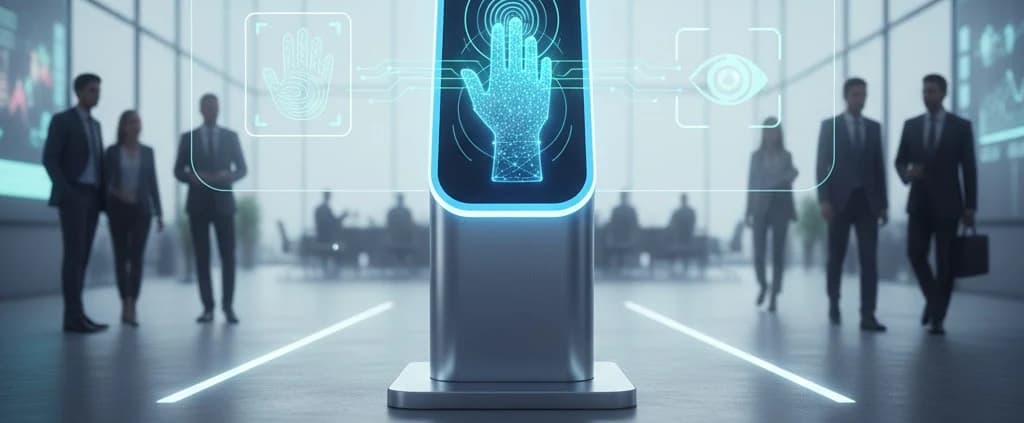
Contactless vascular biometrics
How Does a Palm Vein Scanner Work?
A palm vein scanner identifies a person by the pattern of veins inside their hand, read with near-infrared light and never touched. It sits in the same family of workplace terminals as fingerprint and face readers, and does the same two jobs: recording who was present and when, and deciding who may pass through a door. This page explains the physics it runs on, how it differs from palm print recognition, and what it takes to deploy it well at an Indian site.
Palm vein scanning in one paragraph
A palm vein scanner is a contactless biometric device that identifies a person by the pattern of veins inside their hand. It shines near-infrared light at the palm, captures the pattern that appears because haemoglobin in the blood absorbs that light, converts the pattern into a numeric template, and compares the template against enrolled records. On a match it writes a timestamped attendance event, releases a door, or both. Presentation to decision on a current terminal completes in well under a second, and nothing touches the sensor at any point in the sequence.
- Subsurface pattern, anatomy beneath the skin rather than a surface feature
- Near-infrared light, absorbed by haemoglobin so veins appear dark in the image
- Fully contactless, with no platen to contaminate and no shared touch surface
- Inherent liveness, because the pattern only forms where blood is flowing
What is a palm vein scanner?
The device is also called a palm vein reader, vascular biometric terminal or contactless palm scanner. It belongs to the same family of workplace identification equipment as fingerprint, face and iris terminals, and it is used for the same two jobs: recording who was present and when, and deciding who may pass through a given door. If you are new to the category, our explainer on how an attendance machine works covers the common ground that all of these terminals share.
What separates it from every other modality in common use is where the pattern lives. A fingerprint, a palm print and a face are all surface features. A vein pattern is anatomy beneath the skin, invisible to the naked eye and to an ordinary camera. Almost every practical property of the technology, good and otherwise, follows from that single fact.
In deployment terms it behaves like any other terminal in a biometric attendance system: it enrols users, holds templates locally, writes events and talks to the software over the network. The difference is what happens in the fraction of a second when a hand is presented.
How a palm vein scanner works: the short answer
A palm vein scanner works in five stages. A near-infrared source illuminates the palm held above the reader. An infrared sensitive camera captures an image in which the veins appear dark against lighter surrounding tissue, because the haemoglobin in returning venous blood absorbs near-infrared light more strongly than the tissue around it. An algorithm extracts the branching structure of that pattern and encodes it as a numeric template, discarding the image. The template is matched against enrolled templates to produce a similarity score. If the score passes the configured threshold, the terminal acts: it logs an attendance event, triggers a door relay, or does both at once.
Everything else on this page is detail hanging off those five stages.
Palm vein versus palm print: two different technologies
These two terms are used interchangeably in a great deal of published material, and they should not be. They read different anatomy, using different physics, with different failure modes. A buyer who asks for palm recognition and receives the other one will be disappointed for reasons that have nothing to do with build quality.
Palm print recognition images the surface of the hand: the principal lines, the creases, the ridge and minutiae detail on the palmar skin. It is a close relative of fingerprint sensing, scaled up to a larger area, and it inherits fingerprint behaviour. Wear, dryness, moisture, dirt and surface damage all affect it.
Palm vein recognition ignores the surface completely. It images the vascular structure under the skin using infrared illumination. Surface condition is largely irrelevant to it; what matters instead is hand positioning, the presence of blood flow, and interference from strong infrared in the ambient environment.
| Property | Palm print | Palm vein |
|---|---|---|
| What is read | Lines, creases and ridge detail on the skin surface | Branching vein structure beneath the skin |
| Physical principle | Reflected visible light, or contact imaging of ridge relief | Near-infrared absorption by haemoglobin in venous blood |
| Contact required | Usually, on a platen | No, the hand is held above or in front of the reader |
| Visible to the eye | Yes, the pattern can be seen and photographed | No, the pattern does not appear under visible light |
| Affected by hand condition | Yes, by wear, dryness, moisture, dirt and scarring | Largely not, since the surface is not the subject |
| Liveness | Requires a separate anti-spoofing mechanism | Inherent to a degree, since capture depends on blood flow |
| Main practical constraint | Surface condition and sensor cleanliness | Hand positioning and ambient infrared interference |
Everything that follows on this page describes palm vein. Where a point applies to palm print instead, it is said so explicitly.
Near-infrared illumination and haemoglobin absorption
What the sensor actually sees
Blood returning through the veins carries deoxygenated haemoglobin. Deoxygenated haemoglobin absorbs light in the near-infrared band, roughly in the 700-1000 nanometre region, considerably more strongly than the surrounding muscle, fat and skin tissue does. Illuminate a palm at that wavelength and the tissue scatters and returns a usable amount of light while the veins swallow it. The camera therefore records the vein network as a set of dark branching lines against a lighter field.
Readers are built in two illumination geometries. In reflection, the infrared source and the sensor sit on the same side and the sensor reads light scattered back out of the tissue. In transmission, the source is on the opposite side of the hand and the sensor reads what passes through. Palm readers used in attendance and access control are almost always reflection type, because the user simply holds a hand above a flat unit rather than inserting it into an enclosure.
Why visible light will not do the job
Under visible light, skin, pigment and surface detail dominate the image and the differential absorption that makes veins stand out is not available. An ordinary colour camera pointed at a palm records lines, creases and skin tone, which is palm print territory. This is why a palm vein terminal needs an infrared emitter and a sensor without the infrared cut filter that normal cameras carry, and it is the reason a phone camera cannot capture the pattern.
It also explains the one environmental sensitivity worth planning for. Strong broad-spectrum infrared, from direct sunlight falling on the reader or from a halogen source immediately above it, adds noise to the captured image. Mounting position deals with this, and it is an installation decision rather than a device defect.
Main components of a palm vein terminal
| Component | Function |
|---|---|
| Near-infrared emitter array | Illuminates the palm at the wavelength at which venous haemoglobin absorbs strongly. Emitter layout determines how evenly the hand is lit and how tolerant the device is to small positioning differences. |
| Infrared sensitive camera | Captures the image. Unlike a normal camera it has no infrared cut filter, so it records the band the emitters produce. |
| Ambient light handling | Optical filtering and exposure control that suppress visible light and reduce interference from sunlight or strong artificial sources near the reader. |
| Positioning guide or proximity sensor | Tells the device a hand is present at the right distance, and tells the user where to hold it. May be a physical outline, an illuminated guide or an on-screen target. |
| Processor and matching engine | Runs feature extraction and template comparison on the terminal itself, so identification does not depend on a live server link. |
| Template storage | Encrypted on-device memory holding enrolled templates. Capacity sets how many users one terminal can hold. |
| Transaction log memory | Buffers attendance events locally until they are transferred, so nothing is lost while the network is unavailable. |
| Real-time clock | Timestamps every event. Clock accuracy is the foundation of every downstream shift and overtime calculation. |
| Display and feedback | Confirms identification, guides hand placement, and shows the reason for a rejected attempt so the user knows whether to retry. |
| Communication interface | Ethernet, Wi-Fi, 4G or RS-485, carrying events to the software and configuration back to the terminal. |
| Access control relay and door inputs | Releases an electromagnetic lock, strike or turnstile on a successful match, and accepts request to exit and door monitor inputs where the terminal controls a door. |
How a palm vein scanner works step by step
| Step | What happens | How it works |
|---|---|---|
| 1 | Enrolment (once per person) | The user presents the palm several times. The terminal captures multiple infrared images, extracts the vein structure from each, and builds a reference template that tolerates small differences in presentation. |
| 2 | Hand is presented | The user holds an open palm above or in front of the reader at the indicated distance. No contact with any surface occurs. |
| 3 | Presence is detected | A proximity sensor or the camera itself registers a hand in the capture volume and triggers the illumination sequence. |
| 4 | Near-infrared illumination fires | The emitter array lights the palm at the working wavelength for a brief, controlled exposure. |
| 5 | Image is captured | The infrared sensitive camera records the frame in which veins appear dark because haemoglobin has absorbed the incident light. |
| 6 | Image quality is assessed | The device checks focus, distance, hand coverage and contrast. A poor frame is discarded and the user is prompted to reposition rather than being matched against bad data. |
| 7 | Liveness is considered | Because a usable pattern only forms where blood is flowing, a print, a flat image or a moulded replica does not produce the expected structure. Devices add their own presentation attack checks on top of this, and implementations vary. |
| 8 | Features are extracted | The algorithm isolates the vein network, normalises it for rotation and position, encodes the branching structure numerically, and discards the image. |
| 9 | Template is matched | The new template is compared against the stored template (1:1) or against the enrolled gallery (1:N), producing a similarity score. |
| 10 | Decision against threshold | A score above the configured threshold identifies the person. Below it, the attempt is rejected and a retry is prompted. |
| 11 | Event is written and the door acts | User ID, date, time, direction, device ID and verification method go to the transaction log. If the terminal governs a door, the relay releases the lock for the configured interval. |
| 12 | Event is transferred to software | The terminal pushes the record to the server, or the server polls it. If the link is down, events queue locally and upload when it returns. |
| 13 | Software applies the rules | Shift assignment, grace periods, overtime, leave and access permissions are applied, producing attendance status, audit records and payroll ready output. |
Enrolment, positioning guides and user training
Building the reference template
Enrolment is where a palm vein deployment is made or spoiled. The terminal takes several captures of the same hand and builds a reference from them, so the template reflects a consistent, well-centred presentation. A template built from a hand held at an awkward angle, tilted, or only partly inside the capture area will match poorly for as long as it remains in the system, and no threshold adjustment fixes it properly.
Enrol both hands wherever the deployment allows it. A bandage, a cannula, a plaster cast or a hand occupied with a tool should not lock a person out of their own workplace, and the second enrolment takes very little additional time at the point of onboarding.
Teaching the presentation
Users need to be shown the posture once: palm flat and open, fingers relaxed and slightly apart rather than clenched or splayed hard, hand centred, held at the distance the device indicates. Most terminals provide a physical outline, an illuminated guide or an on-screen target precisely because this is learnable in seconds and then becomes automatic.
Two minutes of coaching at enrolment removes the great majority of day to day read failures. Where a site runs multiple shifts, brief the shift in-charge rather than relying on a notice beside the terminal, because the person who gets asked at 6 am is the supervisor, not the HR department.
Security: a subsurface pattern and inherent liveness
Why the pattern is hard to observe or copy
A fingerprint is left on every glass and door handle its owner touches. A face can be photographed across a room, and in many organisations it is already in a published staff directory. A palm vein pattern has neither property. It is not visible under ordinary light, it is not deposited on surfaces, and it is not recoverable from a photograph taken with a normal camera, because the imaging conditions that reveal it do not occur casually.
To obtain somebody else's vein pattern, an attacker would need deliberate near-infrared imaging of that specific hand, held still, at the right distance, in controlled conditions. That is a substantially different proposition from lifting a latent print from a cup or pulling a photograph from a website, and it is the central security argument for the modality.
Two honest qualifications belong here. First, published research has demonstrated attacks against vein systems under laboratory conditions using purpose-built artefacts and prior access to a captured pattern, so the correct framing is that observation and reproduction are difficult, not that they are impossible. Second, the strength of any biometric deployment also rests on how the template is stored and transmitted, which is covered further down this page.
Inherent liveness and why blood flow matters
Most biometric modalities need an additional subsystem to answer the question of whether the thing presented is a living person: texture analysis on a fingerprint sensor, depth sensing or infrared behaviour on a face terminal. Palm vein carries part of that answer inside the capture physics. The pattern exists in the image because haemoglobin in flowing blood absorbs the incident infrared. Remove the blood flow and the signal the device is looking for does not form in the expected way.
In practical terms, a photograph of a hand, a printed image of a vein pattern, a silicone mould of a palm or a non-living hand does not present the correct subsurface absorption structure. This is the sense in which the modality is described as having inherent liveness, and it is a genuine structural advantage rather than a marketing line.
It should still not be treated as the whole of the anti-spoofing story. Terminals layer their own presentation attack detection over the physics, those implementations differ between devices and firmware versions, and any site with a genuinely high-security door should combine palm vein with a second factor such as a PIN or an RFID card access control credential rather than relying on one credential alone.
Contactless operation and the hygiene case
Nothing touches the reader. The user holds a hand in the capture volume and withdraws it. That matters in three distinct ways, and only the first is usually discussed.
The obvious one is hygiene. In operating theatres, pathology laboratories, pharmaceutical clean areas, hospital wards and food processing halls, a shared contact surface at a doorway is a controlled-environment problem. A contactless credential removes it entirely, which is why palm vein appears so often in exactly those settings. The same reasoning applies at any site where employee resistance to touching a shared sensor is a live issue.
The second is sensor condition. Contact fingerprint platens accumulate oil, dust and residue, and read rates decline gradually as they do, which is why platen cleaning is a standing maintenance item. A palm vein reader has no platen to contaminate, so this particular decay curve does not exist. The optical window still needs occasional wiping, particularly in dusty or greasy environments, but a smudge on a window at imaging distance is far less disruptive than residue sitting directly on the imaged surface.
The third is gloves and protective equipment, which interacts with hand condition rather than hygiene alone and is dealt with in the limitations section below.
Hand condition: where palm vein holds up and fingerprint struggles
Failure to enrol is one of the most persistent practical problems in Indian biometric deployments, and it is overwhelmingly a fingerprint problem. Ridge detail wears down with manual work. Construction, stone and metal work, agriculture, textile handling, chemical exposure, prolonged water contact and simple age all reduce the contrast a fingerprint sensor depends on. When a plant discovers that a visible share of its shop floor cannot be enrolled reliably, the usual sequence is relaxed thresholds, then repeated retries at shift change, then an informal workaround that defeats the point of the system. Our page on how a fingerprint attendance system works sets out what sensor choice can and cannot do about this.
Palm vein sidesteps that chain because it does not read the surface. Calluses, cuts, dryness, cracked skin, minor scarring, henna, ink and light surface soiling sit above the structure being imaged and have little bearing on it. For a workforce in manual trades, this is the argument that carries the most weight, ahead of both hygiene and security.
| Condition | Effect on fingerprint | Effect on palm vein |
|---|---|---|
| Worn ridges from manual work | Major, a common cause of failure to enrol | Minimal, the surface is not imaged |
| Very dry or cracked skin | Significant on optical sensors | Minimal |
| Wet hands or high humidity on the skin | Significant | Minimal, though water on the optical window should be wiped |
| Cuts, bandages and plasters on a finger | Blocks that finger, needs a second enrolled finger | Little effect unless the palm itself is covered |
| Henna, ink, dust or light soiling | Can degrade capture | Little effect |
| Thin disposable gloves | Generally blocks capture | Varies by device and glove, test before committing |
| Thick or multiple gloves | Blocks capture | Blocks capture, the hand must be bare or the glove very thin |
| Hand held at the wrong angle or distance | Not the usual failure mode | The main failure mode, addressed by guides and training |
Palm vein for attendance and for access control
One terminal can serve both functions, which is how most sites specify a combined attendance and access control installation rather than two separate systems on one wall.
The attendance side
The terminal writes a timestamped event: user ID, date, time, direction, device identifier and verification method. Attendance software then converts those raw events into meaning, resolving shifts including night shifts that cross midnight, applying grace periods and late marks, computing overtime against approval rules, reconciling leave, and producing registers and payroll ready output through HRMS and payroll software. Contract labour reconciliation, which matters a great deal on Indian plants and sites, works on exactly the same event stream.
Because matching runs on the terminal, attendance capture continues when the server is unreachable, as the connectivity section below describes.
The access control side
The same identification can drive a door. A relay output on the terminal releases an electromagnetic lock, an electric strike, a turnstile gate or a flap barrier for a configured interval, with door monitor and request to exit inputs completing the door assembly; our guide to how a turnstile system works covers the pedestrian side of that in more detail, and the wider entrance control products range sets out the hardware options. Fail-safe and fail-secure behaviour on power loss and fire alarm is decided by the lock hardware and the interface to the fire system, not by the biometric, and must be specified door by door with the fire consultant.
The two functions share one credential but need separate rule sets, which is the normal way access control systems are configured. A plant records attendance for everyone enrolled while restricting entry to a laboratory, a server room, a finished goods store or a narcotics cupboard to a named group, on defined days and within defined hours. Contractors and visitors on the same estate are usually handled through a visitor management system instead of enrolling them as staff. For genuinely sensitive doors, palm vein should be combined with a card or PIN so that entry needs two factors, while routine attendance at the main gate stays single factor to keep the queue moving.
Where palm vein fits: healthcare, laboratory and food processing
The three environments where the modality earns its place in India share a feature: a shared contact surface at a doorway is unwelcome, and the people passing through it often have hands in poor condition for fingerprint capture, or occupied, or recently scrubbed.
In healthcare, the fit is clinical areas, pharmacies, medical records rooms and pathology laboratories. Kerala, with a dense network of multi-speciality hospitals and diagnostic chains, is a natural setting for contactless staff identification at ward and laboratory entrances, where frequent hand washing and sanitiser use leave skin in a state that fingerprint sensors handle badly. The same logic covers controlled drug stores, where the access record matters as much as the attendance record.
In laboratories and pharmaceutical manufacturing, the driver is contamination control in graded areas, together with gowning procedures that make a contact sensor at a gowning room door impractical. Goa, with a substantial pharmaceutical and formulations manufacturing base, sees this pattern at change room and production corridor entrances, where the terminal is doing access control first and attendance second.
In food processing, including the seafood processing units along the Kerala coast and the food and agro-processing clusters of West Bengal, the combination of hygiene rules, wet working conditions and water-softened hands makes contact fingerprint capture at a production entrance an unhappy choice. A contactless reader mounted outside the wet zone, with the hand presented bare before gloving, works considerably better in practice.
Installation, environment and connectivity at Indian sites
Mounting is the first thing to get right. The reader should sit at a height that suits the range of user heights on that site, with the capture volume clear of obstruction, and it should not face direct sunlight or sit beneath a strong halogen fitting, because broad-spectrum infrared from either adds noise to the captured image. An entrance on a sunlit elevation needs either a shaded position, a recessed mounting or a canopy, decided at survey stage rather than after commissioning.
Environment is the second, and it shapes every specification decision for biometric attendance systems in India. Coastal salt air on both of India's seaboards, including the Kerala and Goa coasts and the deltaic belt of West Bengal, is hard on exposed electronics, so outdoor or semi-outdoor positions want an appropriately rated enclosure and a sheltered location. Monsoon humidity and summer ambient temperatures across much of the country sit at the edge of specified operating ranges for consumer grade equipment, so confirm the declared operating temperature and humidity range against site conditions. Power quality deserves the same attention: surge protection and UPS backing keep both the terminal and the door hardware alive through the brownouts and switching transients that are routine on Indian industrial supplies.
Connectivity is the third, and it is usually simpler than people expect because matching happens on the device. Where a plant, a processing unit or a remote branch runs on an intermittent link, the terminal continues to identify users and buffers every punch in its local transaction log, uploading automatically when the connection returns. The practical limit is log capacity, so a long outage on a high-traffic terminal is worth checking rather than assuming. Push communication, where the device dials out to the server, is generally easier on remote sites than server-side polling, because the terminal does not need to be reachable from outside.
Matching modes, thresholds and throughput
Palm vein terminals support both matching modes. In 1:1 verification, the user first identifies themselves with a card or PIN and the device compares the presented palm against that one stored template, which stays fast and discriminating no matter how many people are enrolled. In 1:N identification, the user presents only the hand and the device searches the enrolled gallery, which is more convenient and is the normal mode for attendance at moderate headcounts.
As with every modality, matching produces a similarity score rather than a verdict, and the threshold decides where the line falls. Raising the threshold lowers the false acceptance rate and raises the false rejection rate; relaxing it does the reverse. The two cannot both be minimised. A restricted laboratory door is tuned towards low false acceptance and accepts occasional repeat presentations; a main gate at shift change is usually tuned the other way, because a queue of several hundred workers cannot absorb retries. Vein recognition is generally regarded as a strong performer on discrimination within its operating conditions, but published accuracy figures always relate to specific test conditions and threshold settings, and real-world results depend on enrolment quality, positioning and the site itself.
Throughput at the door is governed by presentation time, not by matching time. Users who have been shown the posture clear a reader quickly; users who have not will hover, adjust and retry. For a large simultaneous shift change, plan multiple terminals or multiple lanes at design stage, exactly as you would with any other modality.
Templates, consent and retention under Indian data protection law
What the terminal keeps is not a picture of a hand. Feature extraction converts the captured image into a numeric representation of the vein structure and the image is discarded. The transformation is one way: the template holds enough information to recognise the same palm again, and not enough to rebuild the original image from it. Explaining this before deployment rather than after resolves most employee concern, and it is worth doing in plain language at the time of enrolment.
Templates should be stored encrypted at rest on the terminal and on the server, and encrypted in transit between them. Access to view, export or delete biometric and attendance data should be governed by role-based permissions with every change written to an audit trail, so that an administrator deleting or exporting records leaves a trace.
On the legal side, treat the following as context to work through with your own legal team rather than as a compliance position. Biometric templates held for attendance are personal data under the Digital Personal Data Protection Act 2023, which brings notice, consent, purpose limitation, retention limits and the handling of data principal requests into scope. Attendance records interact with the Factories Act 1948, the relevant state Shops and Establishments legislation, and EPFO, ESIC and payroll record keeping obligations. Aadhaar-based attendance, where it applies, runs on UIDAI-registered devices under the Aadhaar Act 2016 and is a separate regime from a standalone palm vein deployment. BIS and STQC certification and GeM listing are frequently relevant to government procurement. Requirements change, and current requirements must be confirmed for the specific project.
Retention deserves an explicit policy rather than a default. Decide at the outset how long attendance records are kept to meet statutory and payroll needs, and set biometric templates to be deleted when a person leaves, on a defined timetable, with the deletion recorded. A template for an employee who left four years ago serves no purpose and is a liability under a purpose limitation regime.
Limitations and when another modality fits better
Positioning is the real constraint. The failure mode is not a damaged hand, it is a badly presented one. Sites that skip user training see avoidable rejections, and the remedy is coaching and a visible guide, not a lower threshold.
Gloves are not solved. Thick or multiple gloves block capture. Thin disposable gloves vary by device and material and must be tested on the actual device with the actual glove before anything is committed. Where staff genuinely cannot bare their hands at the door, iris recognition systems are usually the modality that fits.
Ambient infrared interferes. Direct sunlight or a strong infrared source at the reader degrades the image, which makes some outdoor and heavily glazed positions unsuitable without shading.
Ecosystem breadth is narrower. Fingerprint and face recognition terminals exist in a far wider range of form factors and are more widely deployed across Indian sites, so a mixed estate is more likely to standardise on those with palm vein placed where it earns its keep. For a workforce that spans office staff, shop floor, contract labour and field teams, multi-modal biometric terminals supporting more than one modality, such as the multi-biometric terminals in our range, with card as a third credential, are frequently the more realistic answer than a single technology everywhere. If you are still weighing the options, our guide to choosing a biometric attendance and access control system works through the decision point by point.
Palm vein scanners: frequently asked questions
What is the difference between palm vein and palm print recognition?
Palm print recognition reads the lines, creases and ridge detail on the surface of the hand, in the same family as fingerprint sensing. Palm vein recognition ignores the surface entirely and images the vein pattern beneath the skin using near-infrared light. Because the two read different anatomy, a worn or marked palm surface affects one and not the other, and the templates are not interchangeable between the two technologies.
How does near-infrared light make veins visible?
Haemoglobin in the blood returning through the veins absorbs near-infrared light more strongly than the surrounding tissue does. When the hand is illuminated at that wavelength, the veins appear as a dark pattern against a lighter background in the captured image. Visible light does not produce this contrast, which is why palm vein readers use an infrared source and an infrared sensitive sensor rather than an ordinary camera.
Can a palm vein pattern be copied from a photograph?
An ordinary photograph does not record it. The pattern sits below the skin and does not appear under visible light, so it cannot be observed at a distance, lifted from a surface, or captured by a normal camera the way a face can be photographed or a fingerprint can be left behind. Obtaining it would require deliberate near-infrared imaging of that specific hand under controlled conditions.
Does a palm vein scanner need to touch the hand?
No. The user holds the palm a short distance above or in front of the reader and nothing touches the sensor. Contactless operation suits clinical areas, laboratories and food handling, where a shared contact surface is a hygiene concern, and it also avoids the gradual sensor contamination that degrades read rates on contact fingerprint platens over time.
What is inherent liveness and how does palm vein provide it?
Inherent liveness means the capture itself depends on a living hand rather than relying only on a separate anti-spoofing test. A palm vein image forms because blood is flowing through the veins, so a printed image, a moulded replica or a non-living hand does not produce the expected subsurface pattern. Devices still apply their own presentation attack checks on top of this, and implementations vary between models.
Does palm vein work for people with worn or damaged fingerprints?
Usually yes. Ridge detail worn down by manual work, chemicals, water exposure or age is a surface problem, and palm vein does not read the surface. Cuts, calluses, henna, dryness and minor scarring on the hand therefore have little effect on the vein image. This is the main reason sites with manual trades consider palm vein where fingerprint enrolment keeps failing for part of the workforce.
Can a palm vein scanner control a door as well as record attendance?
Yes. The terminal writes a timestamped attendance event and can drive a relay output that releases an electromagnetic lock, strike or turnstile on a successful match. The two functions share one identification but use separate rules, so a site can record attendance for everyone enrolled while granting entry at a given door only to an authorised group within defined hours.
Does a palm vein terminal store an image of my hand?
No. The captured image is converted into a numeric template describing the vein structure, and the image itself is discarded. The transformation is one way, so the template can recognise the same palm again but cannot be turned back into a picture of the hand. Templates should be held encrypted on the device, on the server and in transit between them.
How should users hold their hand for a reliable read?
Flat and open, fingers relaxed and slightly apart, hand centred over the reader at the distance the device indicates. Most terminals provide an outline, an illuminated guide or an on-screen target to teach this. A couple of minutes of coaching at enrolment removes most day to day read failures, because the pattern captured at enrolment and the pattern presented later must be seen from a similar angle.
Does a palm vein terminal keep working when the network is down?
Yes. Matching runs on the terminal, so identification continues with no server connection. Punches are buffered in local memory and upload automatically when the link returns, which matters on plants and remote sites with intermittent connectivity. The practical limit is the transaction log capacity, so a long outage on a busy terminal is worth checking rather than assuming.
Is palm vein data covered by Indian data protection law?
Biometric templates used for attendance are personal data under the Digital Personal Data Protection Act 2023, which brings notice, consent, purpose limitation and retention into scope. Attendance records also interact with the Factories Act 1948, state Shops and Establishments rules and payroll record keeping. Current requirements must be confirmed for each specific project with your own legal or compliance team.
Planning a contactless attendance or access control deployment?
Tell us the site, the user population, the hand condition of the workforce and the doors involved, and our team will confirm which modality suits each point and how the terminals should be mounted.
Talk to our team about a site surveyCall +91 95999 53923
This page explains how palm vein recognition works as a technology class. Achieved performance at any site depends on enrolment quality, hand presentation, mounting position, ambient infrared conditions and the specific device and firmware in use, and should be confirmed by site survey and trial. Statutory and certification requirements change and must be confirmed for each project. Specifications may change without notice; please consult us before ordering.
