
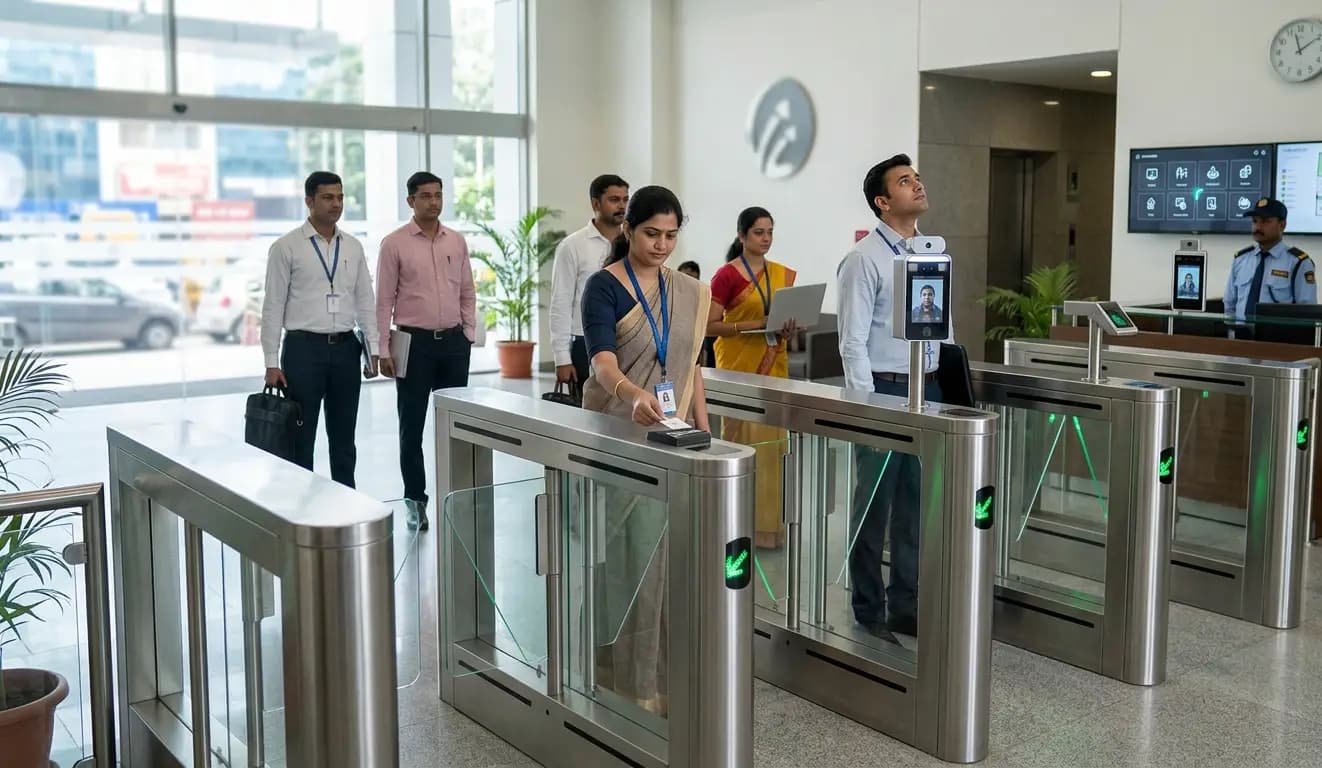
What Is a Turnstile System?
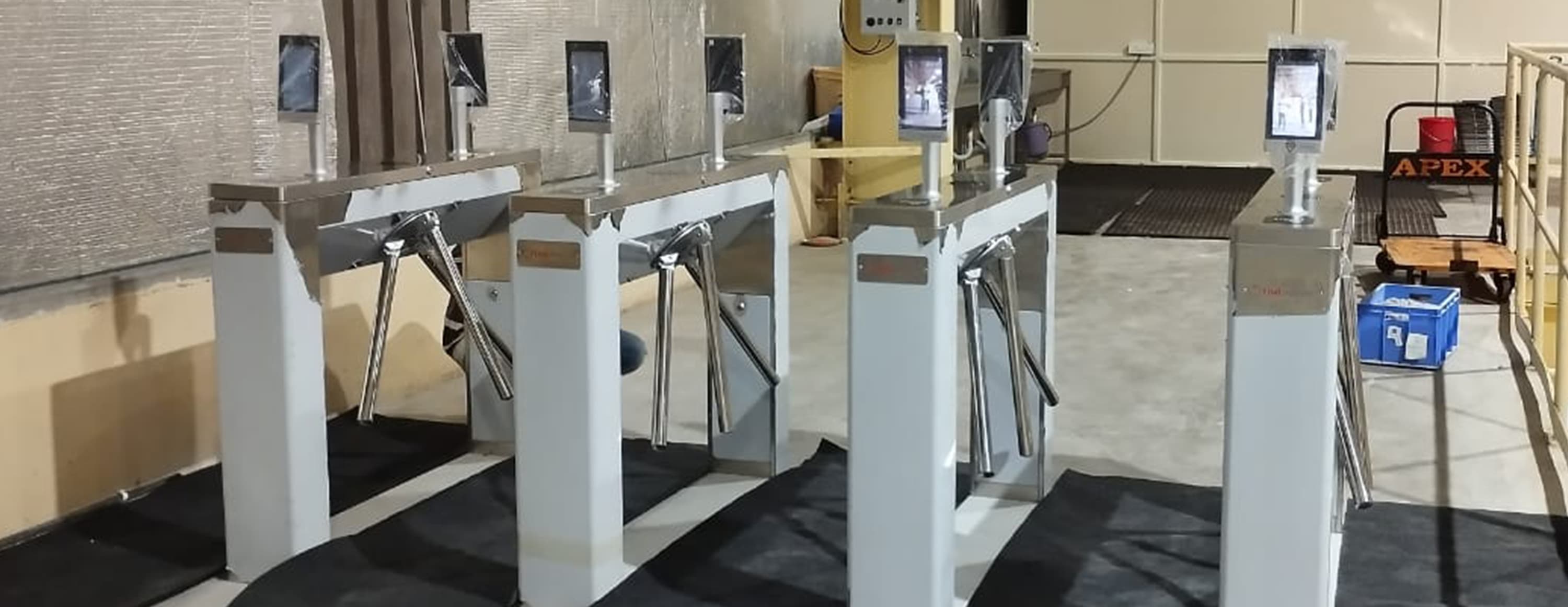
It is worth separating two things that are often talked about as one. A turnstile is a mechanism: a rotating tripod, a pair of retracting flaps, a swinging panel, a full-height rotor. A turnstile system is everything that decides whether the mechanism should move, everything that verifies what happened when it did, and everything that records it afterwards. Two buildings can install identical hardware and end up with entrances that behave completely differently, because almost all of the behaviour lives in the system, not the metal.
This page is about the system. Where the mechanisms differ in detail, we summarise and link to the dedicated pages on how a tripod turnstile works, how a flap barrier gate works and how a swing barrier works.
How Does a Turnstile System Work?
A turnstile system works in five stages. A person presents a credential — a card, a finger or face, a QR pass, a PIN. A reader captures it and passes the identifier on. A controller decides, checking the identifier against the permission set that applies to that lane, in that direction, at that time of day. If the check passes, the controller releases the mechanism. Sensors then confirm that a single authorised passage actually took place, and the event is written to the log with credential, lane, direction and timestamp.
Everything below is detail beneath those five stages: present, capture, decide, release, confirm and record.
The Layers of a Turnstile System
The clearest way to understand a turnstile installation is as a stack of layers, each with one job. A fault at any layer produces a different symptom, which is why describing the stack properly is also the fastest route to diagnosing an entrance that is misbehaving.
The credential layer
The credential is whatever the person carries or is. Four families are in common use, and most working entrances run more than one at a time.
- Card or RFID — a proximity or smart card, a fob, or a UHF tag. Fast, familiar, and the easiest to issue and revoke. Its weakness is that the card is not the person: a card can be handed over.
- Biometric — fingerprint, face, palm vein or iris. Binds the passage to the individual rather than to an object, which is why it is the usual choice where the turnstile event also serves as an attendance record. Read time and tolerance to dust, moisture, masks or strong sunlight vary considerably between reader types.
- QR code or mobile credential — a code on a phone screen or a printed pass, or a Bluetooth or NFC credential held in an app. The dominant method for visitors, because it can be issued remotely before arrival and expires on its own.
- PIN — a keypad entry, normally as a second factor alongside a card rather than on its own, since a PIN shares the card's weakness and is slower to enter.
The reader layer
The reader converts a presented credential into a digital identifier and sends it onward. It is the layer the user experiences, and it sets the practical speed of the lane far more than the mechanism does. Readers mount on the turnstile pedestal, on a separate post, or on the wall ahead of the lane, and they connect to the controller over Wiegand, OSDP, RS-485 or, increasingly, over IP.
Direction matters here. A lane controlled in both directions needs a reader at each end; a lane that is free to exit needs only an entry reader plus an exit sensor or push-to-exit input. Getting this wrong at the design stage is expensive later, because reader mounting on a turnstile pedestal is usually factory-cut rather than field-modified.
The turnstile lane controller
The lane controller is the decision-making board inside the turnstile pedestal. It receives the identifier from the reader, evaluates it, drives the mechanism, watches the passage sensors, raises alarms and reports the outcome upward. Crucially, on most modern systems it holds a cached copy of the permissions relevant to its lane, so it can decide on its own without asking the server. That property is what makes an entrance survive a network failure, and it is covered in its own section below.
The controller also holds the local behaviour settings: how long the mechanism stays released before timing out, what the lane does on a tailgate alarm, whether an unauthorised push triggers a buzzer or a silent alert, and how the lane responds to the emergency input.
The access control panel and server
Above the lane sits the central layer — a panel, a server, or a hosted service depending on the architecture. This is where the authoritative permission database lives: who exists, what credential each person holds, which doors and lanes they may use, on which days and between which hours, and which access groups they belong to. It is also where cross-lane logic that a single controller cannot perform is resolved, anti-passback being the obvious example, since knowing whether someone is currently inside requires a view of every lane at once.
One database governing every route is the point. When a person leaves the organisation, a single revocation closes the office turnstile, the server room door and the vehicle gate together. Where each entrance keeps its own list, revocation is a checklist that someone eventually forgets to complete.
The network and management software
The lanes, panels and server are tied together over the building network, commonly Ethernet with Power over Ethernet feeding readers and controllers, sometimes RS-485 trunks in retrofits, and occasionally a mix of both. On top sits the management software, which is where the system becomes usable: enrolling people and issuing credentials, building access groups and time schedules, monitoring lanes live, receiving alarms, and producing the reports that the installation was actually bought for — muster lists, occupancy counts, attendance extracts, exception reports on denied attempts and forced passages.
How Does a Turnstile System Work Step by Step?
| Step | What happens | How it works |
|---|---|---|
| 1 | Person approaches the lane | Presence sensors in the pedestals register someone in the approach zone. On some configurations this also wakes the reader or triggers a directional indicator on the lane. |
| 2 | Credential is presented | A card is tapped, a finger or face is presented to a biometric reader, a QR pass is held to the scanner, or a PIN is entered. |
| 3 | Reader captures and transmits the identifier | The reader converts the credential into a digital identifier and sends it to the lane controller over Wiegand, OSDP, RS-485 or IP. |
| 4 | Controller evaluates the request | The identifier is checked against the permission set held for that lane: is this credential valid, is it permitted in this direction, at this time, on this day, and does it satisfy any anti-passback state. |
| 5 | Decision is issued | Grant or deny. A denial produces a red indicator, usually a buzzer, and a logged denied-attempt event. A grant proceeds to release. |
| 6 | Mechanism is released | The controller energises the drive or releases the lock: a tripod arm is unlocked to rotate, flaps retract into the pedestals, a swing panel opens, a full-height rotor is freed. Release time is typically well under a second on motorised lanes. |
| 7 | Person passes through | Infrared beam arrays across the lane, or rotation sensing on the mechanism, track the movement through the passage zone. |
| 8 | Passage is validated | The controller interprets the sensor pattern to establish that one person passed, in the authorised direction. Two bodies, a reversal, or an entry with no credential all produce a different pattern and a corresponding alarm. |
| 9 | Mechanism resets | The lane returns to its normal state: flaps or panels close, the tripod locks at the next detent, the rotor locks at the next segment. If no passage occurs within the timeout, the release is cancelled and the credential must be presented again. |
| 10 | Event is written to the log | Credential, person, lane, direction, timestamp and outcome are recorded locally and then uploaded to the server, where they feed reporting, occupancy, attendance and any linked CCTV bookmark. |
Steps 4, 8 and 10 are the ones that make this a system rather than a gate. A mechanism without them is a turnstile you push.
How the Authorisation Decision Is Made
The decision at step 4 is more layered than "is this card on the list". A complete evaluation typically tests several conditions in sequence, and a failure at any one produces a denial.
| Check | What it establishes |
|---|---|
| Credential is known | The identifier exists in the permission set and has not been deleted. |
| Credential is active | It has not been suspended, reported lost, or passed its validity end date — a common control for contractors and temporary staff. |
| Person is permitted at this lane | The access group the person belongs to includes this lane or door. A visitor pass may open the lobby lane but nothing beyond it. |
| Direction is permitted | Some lanes are entry-only or exit-only, and the same credential may be valid one way and not the other. |
| Time schedule allows it | Access groups carry day-and-time windows. A housekeeping group may be valid only between defined hours; a contractor group only on weekdays. |
| Anti-passback state allows it | If the credential is already recorded as inside, a further entry may be refused or flagged, depending on configuration. |
| Additional factors, where configured | A second credential, a supervisor authorisation, an occupancy limit on the zone beyond, or a valid induction or training record held against the person. |
Which of these are enforced is entirely a configuration matter, and it varies by software platform. A small office may enforce only the first three; a manufacturing plant may enforce all of them, including refusing entry to a contractor whose safety induction has expired.
Why Decisions Are Cached on the Lane Controller
A design property worth understanding, because it determines what happens on a bad day: on most systems the lane controller does not ask the server for permission each time. It holds a cached copy of the permission set — the credential list, the access groups and schedules that apply to its lane — and decides locally in milliseconds. The server is told afterwards.
The consequence is that the entrance keeps working when the network does not. If a switch fails, a fibre is cut, the server is rebooting or a software update is running, the lane continues to grant and deny correctly using its cached data, buffering events locally and uploading them once the link returns. Only changes made during the outage — a card issued or revoked in the last few minutes — are unavailable until synchronisation catches up.
This is not automatic on every product or every configuration. Some lightweight or cloud-first architectures make the decision centrally and genuinely stop working when the link drops. It is worth confirming during specification that local caching exists, that it is enabled, that the controller's credential capacity covers the site's population, and that events buffer rather than being discarded. The failure mode reveals itself only on the day the network goes down, which is exactly the day a lobby full of people cannot wait for a diagnosis.
How the System Confirms One Authorised Passage
Granting access is the easy half. Establishing that what followed the grant was a single, authorised, correctly-directed passage is where the sensing layer earns its place.
Two sensing approaches are in use, often together. Infrared beam arrays run across the lane between the pedestals in a vertical column of transmitter and receiver pairs. As a person walks through, the beams break and restore in a sequence, and the controller reads that sequence as a signature: how many beams broke, in what order, at what height, over what interval. One body produces a recognisable pattern; two people close together produce a different one; a person reversing produces another. Mechanical rotation detection applies where the mechanism physically rotates — a tripod head or a full-height rotor — and the controller counts detents to confirm that one segment of rotation occurred.
From that sensing, the controller distinguishes several conditions:
- Normal passage — one authorised person, correct direction. The event is logged and the lane resets.
- Tailgating — a second person follows on one authorisation. Depending on configuration this raises an audible alarm, flags the event, notifies the operator, or, on motorised lanes, closes the mechanism against the second person.
- Wrong-direction entry — someone moves against the permitted direction of the lane. Usually alarmed and logged, since it is a common route past an entry-only lane.
- Forced passage — the mechanism is pushed through without a valid authorisation. Always logged, normally alarmed.
- Timeout — a credential was granted but nobody walked through. The release cancels and the lane resets, so the authorisation cannot be saved up and used later.
The important qualification is that detection sensitivity is a configuration choice with a real trade-off. Set it high and the lane catches close-following reliably but also alarms on parents with small children, people carrying large boxes and visitors walking two abreast. Set it low and the lane is quiet but permits genuine tailgating. Most sites tune this in the first weeks after commissioning, against observed behaviour rather than against a specification.
How Anti-Passback Works
Anti-passback addresses a specific abuse: one credential being used by more than one person. Somebody enters with a card, then passes the card back out to a colleague who enters on the same credential. The mechanism cannot see this — both passages look normal — so the answer has to come from the system's memory rather than its sensors.
The system maintains a state for every credential: in or out of the controlled zone. Entering flips the state to in. Exiting flips it back to out. If a credential already recorded as in attempts another entry without an intervening exit, the system knows the card physically cannot be outside, and acts on that.
Hard and soft anti-passback
| Mode | Behaviour | Typical use |
|---|---|---|
| Hard anti-passback | The second entry is refused outright. The person cannot pass until an exit is recorded, usually requiring an administrator to reset their state. | Sites where duplicate use must be prevented rather than merely observed — secure zones, controlled production areas, sites with occupancy limits. |
| Soft anti-passback | The second entry is allowed, but flagged and logged as a violation for review. | Offices and campuses that want the visibility without the risk of stranding people at the lane. |
| Timed anti-passback | The same credential cannot be reused at the same lane within a set interval, after which the state clears itself. | A lighter control that blocks immediate card-passing without needing complete exit coverage. |
Why anti-passback fails in practice
Anti-passback is defeated by a single uncontrolled exit route, and this is the most common reason it gets switched off within a month of being switched on. If people can leave the building through a fire door, a loading bay, a stair door onto the car park or a side gate that does not register an exit, their credentials never flip back to out. They arrive the next morning already recorded as inside, the lane refuses them, the queue builds, and the administrator disables the feature rather than reset three hundred states by hand.
The implication is that anti-passback is a building design decision as much as a software setting. It works where every route in and out of the controlled zone is read in both directions, and it does not work where one is not. That has to be established by walking the perimeter during design, not discovered during operation. Where full exit coverage is genuinely impossible, timed or soft anti-passback delivers part of the benefit without the operational failure.
Turnstile Mechanism Types Compared
The system layers described above are broadly the same whichever mechanism sits in the lane. What changes is physical control, throughput, appearance and accessibility. This table is deliberately summary-level; each type has a dedicated page with the mechanical detail.
| Type | Mechanism | Anti-tailgating method | Accessibility | Throughput | Typical setting |
|---|---|---|---|---|---|
| Tripod turnstile | Three arms on a rotating head, locked between detents; each authorisation frees one 120-degree rotation | Mechanical — the head physically permits one rotation per authorisation | Not wheelchair accessible; needs a separate accessible route | Moderate | Factories, construction sites, campuses, stadiums, staff entrances |
| Flap barrier / speed gate | Acrylic or polycarbonate flaps retracting into the pedestals | Sensor-based — infrared arrays detect a second body and the flaps can close against it | Wide-lane variants available for wheelchair and luggage access | High | Corporate lobbies, IT parks, metro stations, airports, hotels |
| Swing barrier | A glass or metal panel swinging open on a vertical axis | Sensor-based, with the panel's width and the lane length limiting close-following | Most suitable of the three for wheelchairs, trolleys and luggage; wide lanes are standard | Moderate to high | Hospitals, banks, museums, lobbies needing barrier-free access |
| Full-height turnstile | A floor-to-ceiling rotor in a cage, rotating one segment per authorisation | Physical — the cage geometry makes passing two people together impractical | Not accessible; requires an adjacent accessible gate | Lower | Perimeter fences, unmanned entrances, substations, plants, stadium perimeters |
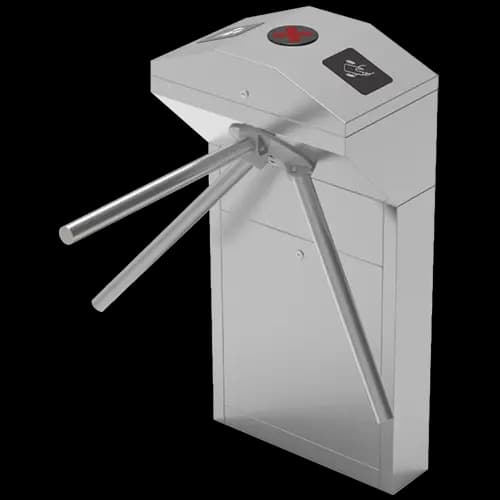
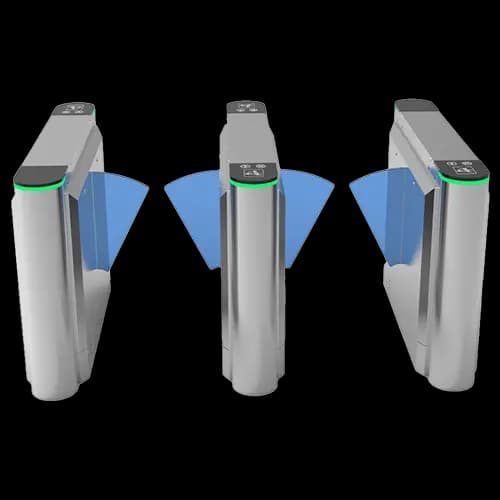
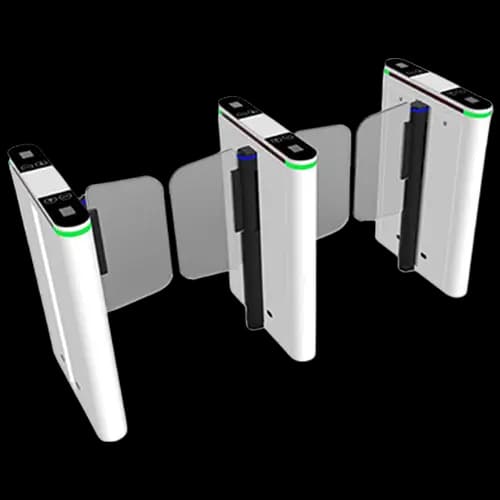

The selection is driven by what the entrance has to do. Where the requirement is to physically restrict passage at an unstaffed perimeter, a full-height unit is the answer. Where the requirement is to move several hundred people through a lobby in twenty minutes while looking like part of the architecture, a speed gate is. A general browse of the entrance control range and the turnstile gate options usually settles it faster than a specification document does.
How Lane Design and Throughput Are Planned
Calculating entrance capacity
Total entrance capacity is straightforward arithmetic: lanes x per-lane rate = people per minute. If a lane handles 25 people per minute and an entrance has four lanes, the entrance handles 100 per minute, or 2,000 in a twenty-minute morning peak. The arithmetic is not where designs go wrong. The per-lane rate is.
Catalogue throughput figures are measured under ideal conditions: a continuous stream of people, each with a credential already in hand, presenting it cleanly and walking through without hesitation. Real lobbies do not behave like that. People arrive in clusters after a lift discharges or a shuttle pulls in. They fish the card out of a bag at the lane rather than before it. They stop to position themselves for a face reader, or present a finger that needs a second attempt because it is wet. They hold a coffee in one hand and a laptop bag in the other. In practice the per-lane rate is set by credential presentation, not by mechanism speed, and the gap between catalogue and observed figures is routinely large.
The right method is to size from observed peak behaviour. Count what actually arrives in the busiest fifteen or twenty minutes, watch how long a real person takes at a real reader with the credential type you intend to use, and calculate from that. On a refurbishment the data is available by standing in the existing lobby with a counter; on a new build it comes from headcount, shift pattern, lift capacity and transport arrival profile. Building around the catalogue number is the commonest design error in entrance control, and it produces the one failure everybody notices — a queue at eight in the morning.
Splitting entry and exit lanes
Entry and exit peaks are rarely symmetrical and rarely simultaneous. Morning arrival is concentrated and sharp; evening departure is spread across a longer window but in the opposite direction. Most entrances therefore use bidirectional lanes whose direction can be reconfigured — some or all lanes set to entry in the morning, flipped to exit in the evening, either by schedule in the software or manually by the security desk.
Where a lane is fixed in one direction, the split needs to reflect the sharper of the two peaks, which is usually arrival. A useful discipline during design is to model the evacuation case as well: in an emergency every lane becomes an exit lane, which is one of the reasons emergency egress behaviour is designed alongside throughput rather than after it.
The accessible wide lane
Every entrance needs at least one lane wide enough for a wheelchair, and in practice that lane also serves anyone with luggage, a trolley, a pram or a delivery. Standard lanes are typically around 550 to 600 mm clear; accessible lanes are typically 900 mm or wider, with exact dimensions varying by model and by the accessibility requirement applying to the building.
Two points are worth making. First, the accessible lane should be part of the main entrance line, not a side gate operated by a guard on request — a route that requires someone to ask for help is a route that gets used reluctantly. Second, because the wide lane is the one everybody with anything in their hands will choose, it should be treated as a working lane in the throughput calculation rather than as a reserve. Designing it as an exception and finding it carries a quarter of the traffic is a familiar outcome.
How Emergency Egress Works
A turnstile sits on an escape route, and its behaviour in an emergency is a life-safety matter rather than a security preference. The core decision is fail-safe versus fail-secure.
| Mode | Behaviour on power loss or emergency signal | Applied where |
|---|---|---|
| Fail-safe | The lane releases and allows free passage. Flaps and swing panels retract or open; tripod arms drop or the head free-wheels. | Escape routes and any lane in an occupied building's egress path. The overwhelming majority of lobby installations. |
| Fail-secure | The lane stays locked and continues to restrict passage. | Perimeter and unoccupied-side applications where an alternative escape route exists and leaving the boundary open is unacceptable. |
The emergency release itself is driven by a dry contact from the fire alarm panel into the turnstile controller or lane power supply, usually supplemented by a manual break-glass or emergency release switch at the security desk. Mechanism behaviour on release varies by type: drop-arm tripods release their arms downward so the head presents no obstruction, retracting-panel flap and swing lanes pull the panels fully into the pedestals or swing them open and hold, and full-height turnstiles typically free the rotor or, where the cage cannot become an exit, rely on an adjacent emergency gate that unlocks on the same signal.
Which behaviour applies, and to which lanes, is settled with the building's fire strategy and the authority having jurisdiction — not chosen from a product list. The practical requirements are that the interface is a genuine hardwired contact rather than a software command over the network, that it is tested as part of scheduled fire drills, and that the lane reverts to normal operation cleanly once the alarm is reset.
Components of a Turnstile System
| Component | Function |
|---|---|
| Credential readers | Card, RFID, biometric, QR or keypad units capturing the credential and passing the identifier to the controller. Mounted on the pedestal, a post or the wall, one per controlled direction. |
| Turnstile units | The pedestals or cages and their mechanism — tripod head, flap assembly, swing panel or full-height rotor — with drive, locking, position sensing and indicators. |
| Lane controller | The board making the local decision, driving the mechanism, reading the passage sensors, generating alarms and buffering events. Holds the cached permission set. |
| Passage sensor array | Infrared transmitter and receiver pairs across the lane, or rotation detection on the mechanism, establishing what physically happened after a grant. |
| Access control panel | The aggregation layer between lanes and server, holding shared logic and distributing permission updates. Some architectures fold this into the lane controller. |
| Server and management software | The authoritative permission database, enrolment, access groups and schedules, live monitoring, alarms, logs, reports and integration interfaces. On premises or hosted. |
| Network infrastructure | Switches, cabling and, where used, Power over Ethernet feeding readers and controllers. RS-485 trunks in some retrofits. The path that carries updates and events. |
| Power supply and backup | Regulated supply for pedestals, readers and controllers, with a UPS or battery sized for the required run time. Determines whether the entrance functions through an outage. |
| Emergency interface | Hardwired fire alarm contact plus manual release, driving lanes to their designated fail-safe or fail-secure state. |
| Ancillary items | Matching end pedestals, glass or railing infill between lanes, floor fixings, directional and status indicators, and the accessible wide-lane assembly. |
Technologies Used in a Turnstile System
- RFID at 13.56 MHz and 125 kHz — proximity and smart card reading for staff credentials, with UHF used where longer-range or hands-free reading is wanted.
- Biometric template matching — fingerprint minutiae, facial geometry or palm vein patterns compared against stored templates, with the template rather than the raw image normally held.
- Optical code reading — QR and barcode scanning for visitor and event passes, including codes displayed on a phone screen.
- Modulated infrared sensing — beam arrays resistant to ambient light, producing the break-and-restore sequence the controller interprets as a passage signature.
- Reader-to-controller protocols — Wiegand in legacy installations, OSDP over RS-485 where supervised and encrypted reader communication is required, and IP readers on newer systems.
- Motor control electronics — brushless or stepper drives with position feedback on motorised lanes, giving controlled acceleration and obstruction response.
- Networking — TCP/IP over Ethernet with Power over Ethernet, plus event buffering and store-and-forward synchronisation between controller and server.
- Software integration interfaces — REST or SOAP APIs, SDKs, database-level links and dry-contact I/O for connecting attendance, visitor, CCTV, lift and screening systems.
Integration With Other Systems
A turnstile system is one of the more heavily integrated elements in a building, because a passage event is useful to several other systems at once.
- Visitor management — a visitor is pre-registered, receives a QR pass by email or message before arrival, and that pass is recognised at the lobby lane for a defined window and location. The host is notified on arrival and the pass expires by itself. A fuller treatment appears on how a visitor management system works.
- Time and attendance — the turnstile passage becomes the attendance event. Because the person had to pass the lane to reach their desk, the record is harder to fabricate than a separate punch at a wall unit, and one presentation serves both purposes.
- CCTV — cameras overlooking the lanes bookmark footage against each event, so any passage can be reviewed from its log entry rather than by scrubbing a timeline. This is what converts a tailgate alarm from a beep into evidence.
- Lift and destination control — the credential read at the turnstile also calls a lift and assigns a car, or restricts the floors the person may select. Common in high-rise offices across Mumbai, Bengaluru and Gurugram.
- Screening equipment — door frame metal detectors and X-ray baggage scanners are positioned ahead of the lane so screening is completed before the credential check, keeping the turnstile as the last point rather than the queue point.
- Parking and vehicle gates — the same credential database governs the access control system at the boom barrier and at the turnstile, so a single revocation closes both the vehicle and pedestrian routes.
- HR and directory systems — automated provisioning from the HR record, so joiners are enrolled and leavers are revoked without a manual step.
- Fire alarm and building management — the hardwired emergency release, plus occupancy data shared with the BMS for muster reporting and, on some sites, for HVAC and lighting control.
Where Turnstile Systems Are Used
- Corporate offices and IT parks — lobby speed gates with card or face readers, feeding attendance and lift control. Dense across the technology corridors of Karnataka and Telangana, and through the commercial districts of Gurugram in Haryana and Noida in Uttar Pradesh.
- Manufacturing plants and warehouses — tripod or full-height lanes at staff and contractor gates, often with induction validity enforced at the lane. Common through the industrial belts of Maharashtra, Gujarat and Tamil Nadu.
- Metro stations and transport hubs — high-throughput flap lanes with fare or pass validation, sized around train discharge peaks rather than average flow.
- Hospitals — swing barrier lanes separating public areas from clinical zones, chosen for trolley and wheelchair movement.
- Educational campuses — student and staff entrances with attendance capture, frequently linked to a parent notification on entry and exit.
- Banks, data centres and secure facilities — multi-factor lanes, hard anti-passback and interlocked arrangements where entry to a zone depends on a recorded exit from another.
- Stadiums and event venues — large banks of tripod lanes validating ticket codes, engineered entirely around a short, extreme arrival peak.
- Residential and mixed-use developments — lobby lanes tied into visitor management, seen increasingly in the larger developments around Mumbai, Pune, Hyderabad, Chennai, Kolkata and Ahmedabad.
TimeWatch India supplies, installs and services turnstile gates and complete pedestrian entrance control systems across India, including projects in West Bengal, Karnataka, Maharashtra, Telangana, Haryana, Tamil Nadu, Uttar Pradesh and Gujarat.
Installation Considerations
Turnstile installations fail for planning reasons far more often than for equipment reasons. The considerations that matter most:
- Queue and dispersal space — the lane needs clear space in front of it for people to form up and clear space behind it for them to disperse. A lane installed too close to a lift lobby or a door simply moves the congestion rather than resolving it.
- Floor preparation and cable routing — pedestals fix to a level floor with conduits arriving in the right position. Retrofitting into a finished granite or marble lobby is a significantly larger job than planning it into the slab, and surface-run conduit in a lobby is rarely acceptable.
- Lane count from observed peaks — sized from counted arrival behaviour and realistic credential presentation times, not catalogue throughput.
- Reader type and mounting height — decided early, because pedestal cut-outs are factory work. Face reader positioning in particular needs to suit the height range of the population and avoid strong backlighting from a glazed facade.
- Direction strategy — which lanes are bidirectional, how the morning and evening configurations are switched, and who has the authority to override.
- Accessible lane placement — in the main line, sized as a working lane.
- Network and power design — switch capacity, PoE budget, cable runs within limits, and a UPS sized for a realistic outage duration. Confirm controller caching behaviour at this stage.
- Emergency interface routing — hardwired from the fire panel, with the release path agreed in the fire strategy and the cable installed to the appropriate standard.
- Exit route survey — walk every route out of the controlled zone before committing to anti-passback, and record which ones are read.
- Enrolment logistics — enrolling several hundred biometric templates takes planning and scheduled time. It is routinely underestimated and it delays go-live.
Maintenance Considerations
- Clean and check alignment of the infrared sensor arrays; dust and knocked-out alignment are the usual cause of false tailgate alarms.
- Clean reader surfaces, particularly optical and biometric windows, which degrade noticeably with fingerprints and dust.
- Test the fire alarm release on every lane as part of scheduled fire drills, and confirm normal operation resumes after reset.
- Verify the UPS and battery condition at the stated interval, and prove the entrance behaves as designed with mains removed.
- Confirm that controllers are synchronising with the server and that no lane is silently running on stale cached data.
- Review denied-attempt, tailgate and forced-passage reports periodically; a sudden change in the pattern usually indicates a misconfigured lane, a failing sensor or a route people have found around the system.
- Audit the credential database for orphaned and expired credentials, especially contractor and visitor records.
- Inspect mechanism operation for smoothness and correct reset, and check pedestal fixings and panel or arm condition for impact damage.
- Keep firmware and software at supported versions, and test updates outside peak hours on one lane before rolling out.
Benefits and Limitations
Benefits
- Every passage is decided against a central permission set and recorded with credential, lane, direction and time, producing an audit trail that manual checking cannot match.
- One database governs every controlled route, so a single revocation closes them all at once.
- Accurate live occupancy, which supports muster reporting in an evacuation and capacity management day to day.
- Attendance capture without a separate device or a second action by the user.
- Reduces the routine burden on reception and security staff, who move from checking everyone to handling the exceptions the system raises.
- Continues to operate correctly through a network or server outage where local caching is properly configured.
Limitations and considerations
- A turnstile manages and records passage; it does not physically restrain a determined person. Waist-height lanes can be climbed or vaulted. The security value comes from the alarm the attempt raises, the CCTV bookmark it creates and the response procedure behind it. An installation where nobody responds to the alarm has bought a queue manager, not a security control.
- Anti-passback depends on complete exit coverage and fails as a feature where any uncontrolled exit route exists.
- Throughput is limited by credential presentation, so the observed rate is normally below the catalogue figure and the design has to allow for that.
- Tailgating detection involves a trade-off between nuisance alarms and missed events, and the setting needs tuning against real behaviour.
- The system depends on power, and the required run time has to be decided and provided for.
- Enrolment and administration are ongoing work. A system whose database is not maintained degrades into a list of credentials nobody can account for.
- Space and structure constrain what is possible, particularly in retrofits into existing lobbies.
Exact behaviour — decision logic, caching capacity, sensor configuration, throughput, emergency release and integration options — depends on the specific mechanism, controller, software platform and site configuration. Figures should always be confirmed against the datasheet and software documentation for the equipment being specified.
Frequently Asked Questions
How does a turnstile know who you are?
It does not, by itself. A reader captures a credential - a card, a fingerprint or face, a QR pass or a PIN - and converts it into a digital identifier. The lane controller checks that identifier against the permission set held for that lane and decides whether to release the mechanism. The identity lives in the access control database, not in the turnstile.
What is anti-passback in a turnstile system?
Anti-passback stops one credential being used by more than one person. The system records whether each credential is currently in or out of the controlled zone, and refuses or flags a second entry when no exit has been recorded in between. Hard anti-passback refuses the entry; soft anti-passback allows it but logs a violation. It only works where every exit route is read.
Do turnstiles work if the network or server goes down?
On most systems, yes. The lane controller holds a cached copy of the permissions for its lane and decides locally, buffering events until the link returns. Only changes made during the outage are unavailable. This is a design property rather than a universal one, so local caching should be confirmed and configured during specification rather than assumed.
How many people per minute can a turnstile lane handle?
It depends on the mechanism and much more on how quickly people present their credential. Catalogue figures assume a continuous stream of prepared users, which real lobbies rarely produce. Size a lane from observed peak behaviour with the credential type you intend to use, not from the published rate.
How many turnstile lanes does an entrance need?
Multiply the number of lanes by the realistic per-lane rate and compare it with the arrival volume in the busiest fifteen to twenty minutes. Count the actual peak where an existing lobby can be observed, or derive it from headcount, shift pattern and transport arrivals on a new building. Include at least one accessible wide lane and treat it as a working lane, because it carries anyone with luggage or a trolley.
How does a turnstile detect tailgating?
Infrared beam arrays across the lane break and restore in a sequence as a person walks through, and the controller reads that sequence as a passage signature. One body produces a recognisable pattern; a second person following on the same authorisation produces a different one. Mechanisms that rotate can also count detents to confirm a single rotation. Sensitivity is configurable and involves a trade-off between nuisance alarms and missed events.
Can someone get past a turnstile without a credential?
A waist-height turnstile can be climbed or vaulted by someone determined to do so. It manages and records passage rather than physically restraining people. The security value comes from the alarm the attempt raises, the CCTV footage bookmarked to the event and the response that follows. Where physical restriction is the requirement, a full-height turnstile in a cage is the appropriate equipment.
What happens to turnstiles during a fire alarm?
Lanes on an escape route are normally configured fail-safe, so a hardwired contact from the fire alarm panel releases them to allow free passage. Drop-arm tripods release their arms, flap and swing lanes retract or open their panels and hold. Lanes on a perimeter may be fail-secure where an alternative escape route exists. Which behaviour applies is decided with the building fire strategy, not chosen from a product list.
What is the difference between a turnstile and a turnstile system?
The turnstile is the mechanism in the lane - a tripod head, a pair of flaps, a swing panel or a full-height rotor. The turnstile system is everything that decides whether it should move and records what happened: the readers, the lane controller, the access control panel and permission database, the network and the management software. Two buildings with identical hardware can behave very differently because the behaviour lives in the system.
Can a turnstile system be used for attendance?
Yes. A passage event carries the person, the lane, the direction and the timestamp, which is exactly what an attendance record needs. Because the person has to pass the lane to reach their workplace, the record is harder to fabricate than a separate punch at a wall unit, and one credential presentation serves both access and attendance.
Which type of turnstile should be used where?
Tripod turnstiles suit factories, campuses and staff entrances where robust mechanical control matters more than appearance. Flap barriers and speed gates suit corporate lobbies, metro stations and airports where throughput and appearance matter. Swing barriers suit hospitals, banks and any entrance needing wide barrier-free access. Full-height turnstiles suit unmanned perimeters where physical restriction is the requirement.
