
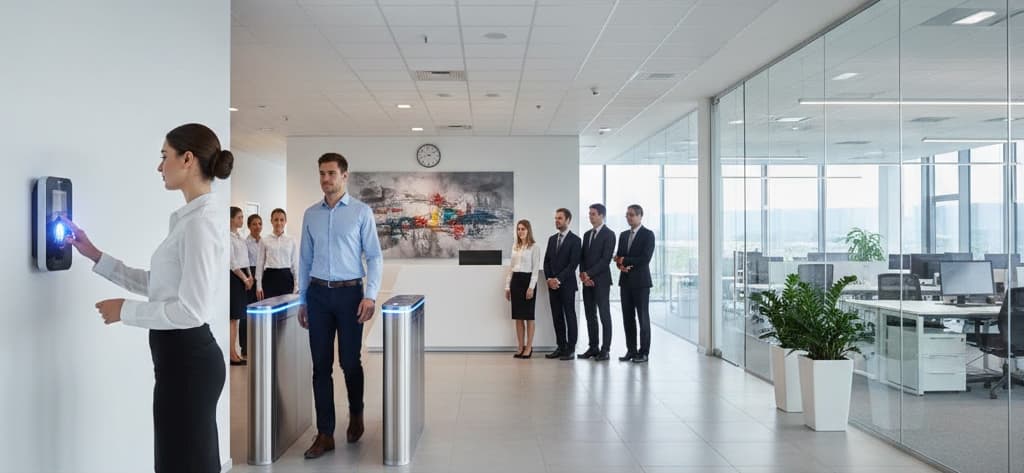
What Is an Attendance Machine?
An attendance machine is often called a biometric attendance system, time attendance device, punching machine or access terminal. The device itself performs one narrow job extremely quickly: establish who this person is, and note the time. Everything that turns those events into payable days happens in software.
That division matters. A terminal that reads a finger in 0.6 seconds is doing the easy part. Whether a 9:07 arrival counts as late, how a night shift crossing midnight is allocated, which leave balance an absence draws from — none of that is decided by the device.
How Does an Attendance Machine Work?
An attendance machine works in five stages. The sensor captures a sample — an image of a fingerprint, a face, a palm's vein pattern. Software extracts the distinctive features from that sample and discards the rest. It compares the resulting template against the templates stored during enrollment. If the similarity score passes the configured threshold, the device records an event containing the user ID, timestamp, direction and device identifier. That event is then transferred to the attendance software over the network.
The whole sequence typically completes in well under a second on modern terminals.
Main Components of an Attendance Machine
| Component | Function |
|---|---|
| Biometric sensor | Captures the raw sample. An optical or capacitive sensor for fingerprints, a camera pair with infrared illumination for face, a near-infrared sensor for palm vein, a specialised camera for iris. |
| Card reader | Reads RFID or Mifare cards, either as the primary credential or as a second factor alongside biometrics. |
| Processor and matching engine | Runs feature extraction and template matching on the device itself, so identification does not depend on a live server connection. |
| Template storage | On-device memory holding enrolled templates and the capacity limit that determines how many users a terminal supports. |
| Transaction log memory | Stores attendance events locally until they are transferred, so punches are not lost if the network is down. |
| Real-time clock | Maintains the timestamp. Accuracy here is the foundation of every downstream calculation, which is why time synchronisation matters. |
| Display and keypad | Confirms the punch to the user, allows PIN entry, and lets the user select an in, out or reason code where configured. |
| Communication interface | TCP/IP Ethernet, Wi-Fi, 4G, RS-485 or USB, carrying events to the software and configuration back to the device. |
| Power supply and backup | Mains adaptor or Power over Ethernet, often with a backup battery so the device survives short outages. |
| Access control relay | An optional output that releases a door lock, allowing one terminal to serve both attendance and access control. |
How Does an Attendance Machine Work Step by Step?
| Step | What happens | How it works |
|---|---|---|
| 1 | Enrollment (once per person) | The user presents the credential several times. The device captures samples, extracts features and builds a reference template, which is stored on the device and usually on the server. |
| 2 | User presents the credential | A finger on the sensor, a face in front of the camera, a palm above the reader, or a card at the reader. |
| 3 | Sample is captured | The sensor produces a raw image or signal. Face devices typically capture both colour and infrared frames so recognition works in poor light. |
| 4 | Liveness is checked | Anti-spoofing logic assesses whether it is a real finger or face rather than a photograph, mask or lifted print. Implementation varies by device. |
| 5 | Features are extracted | The algorithm locates the distinctive characteristics — ridge endings and bifurcations for fingerprints, geometric relationships for faces — and encodes them as a numeric template. The original image is discarded. |
| 6 | Template is matched | The extracted template is compared against stored templates and a similarity score is produced. |
| 7 | Decision against threshold | If the score exceeds the configured threshold, the person is identified. If not, the device rejects the attempt and prompts a retry. |
| 8 | Attendance event is written | User ID, date, time, direction (in or out), device ID and verification method are recorded in the device's transaction log. |
| 9 | Feedback is given | The display shows the name or ID, a beep or voice prompt confirms, and any linked door relay is released. |
| 10 | Event is transferred to software | The device pushes the record to the server, or the server polls the device. If the link is down, events queue in local memory and upload when it returns. |
| 11 | Software applies the rules | Shift assignment, grace periods, late marks, half-day thresholds, overtime and leave are applied to convert raw punches into an attendance status. |
| 12 | Reports and payroll output | Registers, exception lists and payroll-ready payable-day data are produced for the pay cycle. |
How Biometric Identification Actually Works
Enrollment: creating the template
Enrollment is the single most important step in the life of a biometric deployment, and the one most often rushed. The device takes multiple samples of the same finger or face and builds a reference template from them. A template built from poor samples — a partially placed finger, a face captured against a bright window — produces a user who is rejected repeatedly for months afterwards. Good practice is to enrol two fingers per person, so a cut or bandage on one does not lock the person out.
Why your fingerprint image is not stored
This is the most common misunderstanding about biometric attendance, and the answer is worth stating plainly: the device does not keep a picture of your fingerprint.
During feature extraction, the algorithm identifies specific characteristics — for fingerprints, the minutiae points where ridges end or split, along with their relative positions and orientations. These are encoded as a set of numbers. That numeric template is what gets stored. The original image is discarded.
The process is deliberately one-way. A template contains enough information to recognise the same finger again, but not enough to reconstruct the original fingerprint image from it. The same principle applies to face and palm recognition. On TimeWatch devices these templates are secured with AES-128 encryption, both on the device and in transit, so the stored data is encrypted as well as non-reversible.
Matching: verification vs identification
There are two distinct matching modes, and they perform differently at scale:
- 1:1 verification — the user first identifies themselves with a card or a PIN, then presents the biometric. The device compares against one stored template only. Fast and accurate regardless of how many people are enrolled.
- 1:N identification — the user simply presents the biometric and the device searches every enrolled template for a match. More convenient, since nothing else is needed, but the search space grows with headcount.
For large populations, sites commonly move to 1:1 or split users across multiple terminals, because 1:N matching slows down and becomes less discriminating as the enrolled database grows.
Thresholds, false accepts and false rejects
Biometric matching produces a similarity score, not a yes or no. The threshold decides where the line falls, and moving it trades one error against the other:
- False Acceptance Rate (FAR) — how often the wrong person is accepted. Lowering this means raising the threshold.
- False Rejection Rate (FRR) — how often the right person is rejected. Lowering this means relaxing the threshold.
The two move in opposite directions and cannot both be minimised. A high-security door is tuned for low FAR and accepts that legitimate users will occasionally need a second attempt. A high-throughput factory gate at shift change is usually tuned the other way, because a queue of 400 workers cannot absorb repeated retries. This tuning is a site decision, not a product specification.
Types of Attendance Machines
| Type | How it identifies | Typically suited to |
|---|---|---|
| Fingerprint | Optical or capacitive sensor reads ridge patterns and extracts minutiae points | Offices, retail, general-purpose use where hands are clean and uncovered |
| Face recognition | Camera pair with infrared captures facial geometry; works contactless and in low light | Contactless environments, higher-footfall entrances, hygiene-sensitive settings |
| Palm vein | Near-infrared reads the subsurface vein pattern of the palm | Settings where surface fingerprints are unreliable — manual labour, chemical exposure |
| Iris | Specialised camera reads the iris pattern at short range, fully contactless | Clinical and high-security areas, and staff wearing gloves, masks and protective equipment |
| Card / RFID | Reads an identifier from a Mifare or proximity card | Large temporary or contractor populations; also used as a second factor |
| Multi-modal | Combines several of the above in one terminal | Mixed workforces where no single method suits everyone |
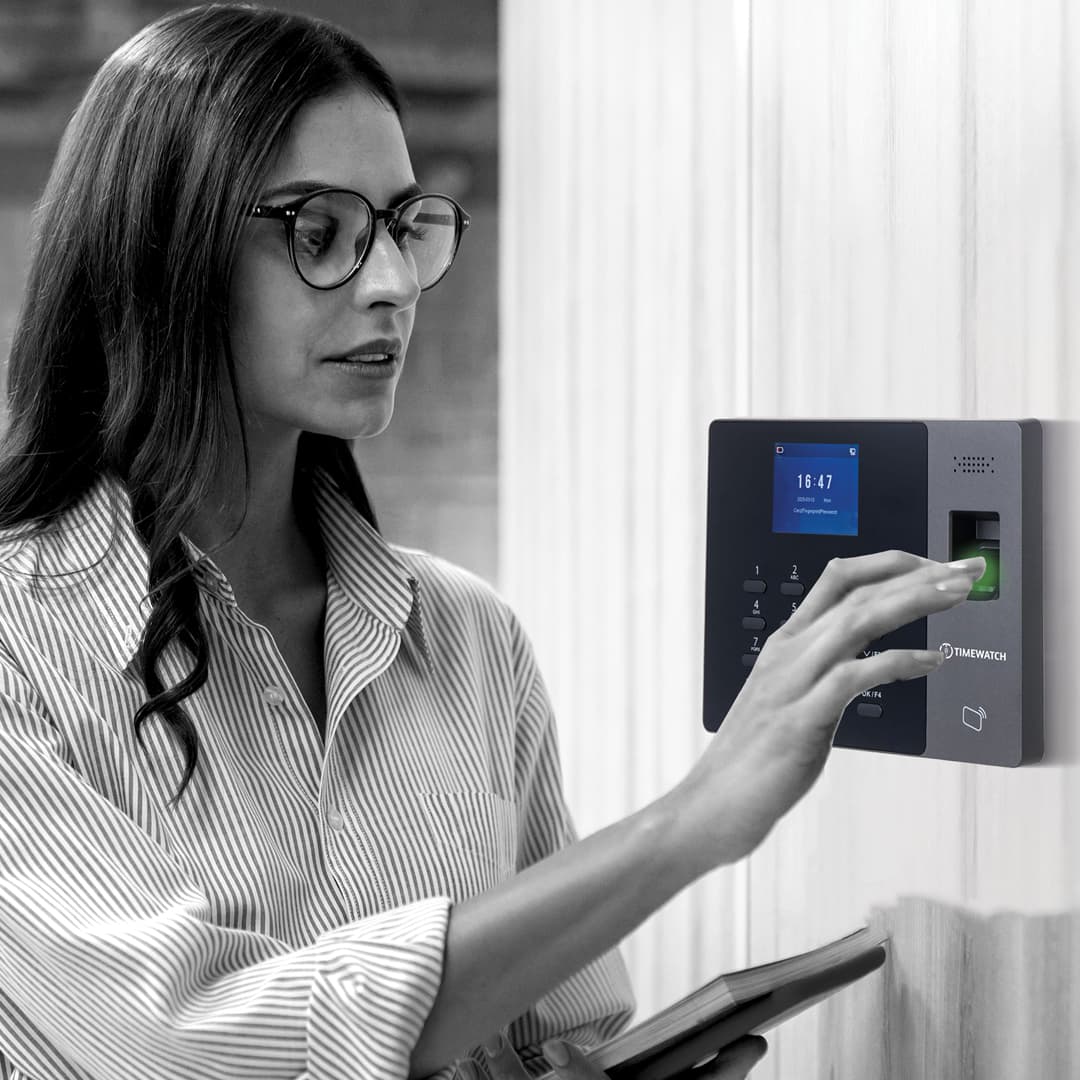
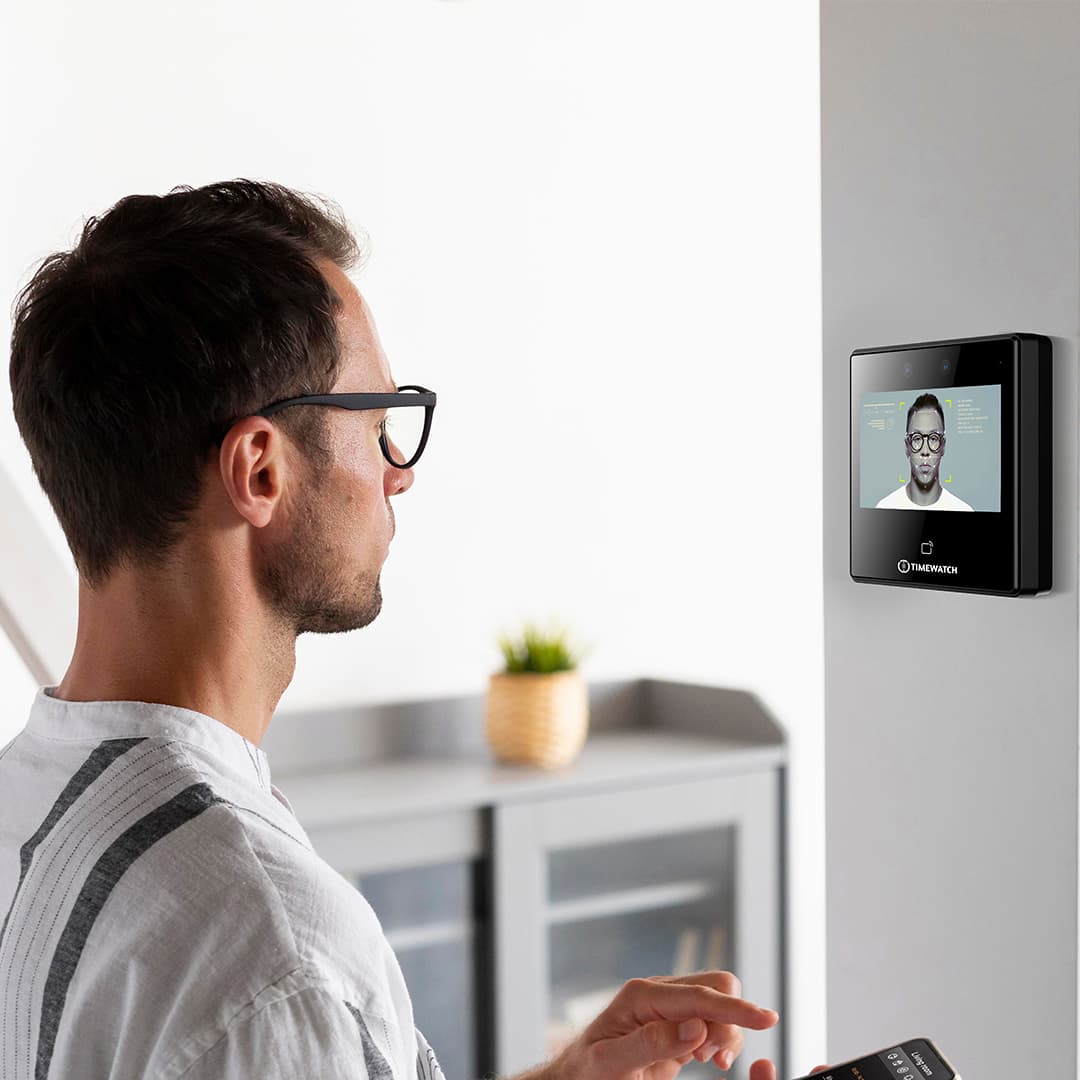
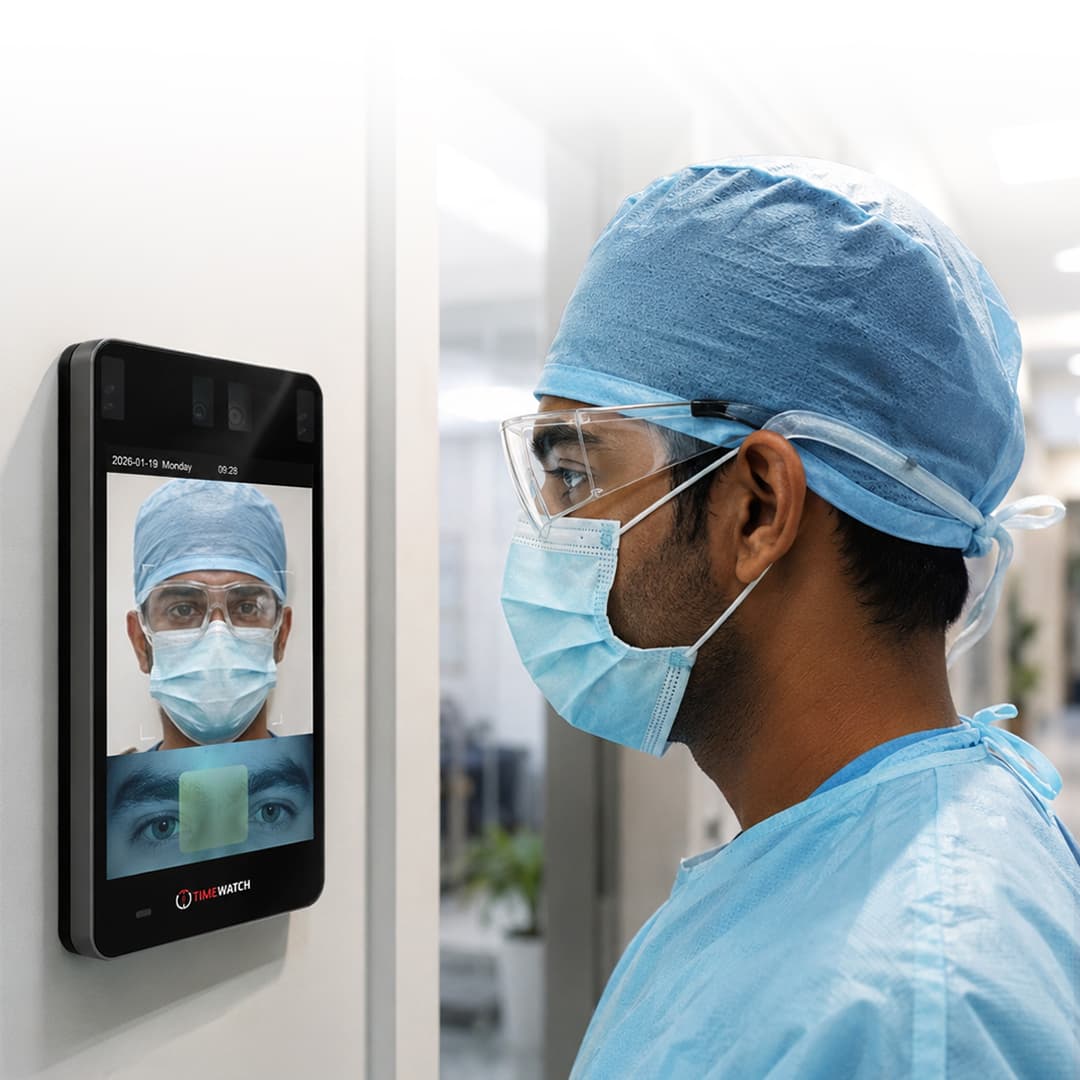
No single method suits every workforce, which is why multi-modal terminals are common. A manufacturing site may find that fingerprint recognition fails for a proportion of shop-floor staff whose finger ridges are genuinely worn from the work — a real and well-documented limitation, not a device fault. Those users are better served by face, palm or card.
How Attendance Data Reaches the Software
Once an event is recorded, it has to reach the server. There are two models:
- Push — the device initiates the connection and sends each event to the server as it happens, or in short batches. This gives near real-time data and works when devices sit behind routers on remote sites, since the device dials out rather than waiting to be reached.
- Pull — the server polls each device on a schedule and downloads accumulated events. Simpler to manage on a single flat network, but data is only as current as the last poll.
Physical connectivity is typically Ethernet, Wi-Fi, 4G for sites without structured cabling, or RS-485 for multi-device runs within a building. USB export remains a fallback for locations with no network at all.
Critically, terminals hold events in local memory when the connection drops. Punches continue to be recorded during an outage and upload when the link returns, so a network failure delays the data rather than losing it. The practical limit is the device's log capacity, which is why a long outage on a high-traffic terminal warrants checking.
What the Software Does With the Data
The raw event is just an ID and a timestamp. The software turns it into meaning:
- Shift resolution — matching each punch to the correct shift, including night shifts that cross midnight and rotating rosters.
- Policy application — grace periods, late marks, early-out rules and half-day thresholds applied as configured policy rather than case-by-case judgement.
- Overtime calculation — hours beyond the assigned shift, computed at the applicable rate and subject to pre-approval rules.
- Leave reconciliation — approved leave matched against absences so the register and the leave ledger agree.
- Exception handling — missed punches and anomalies raised as a review queue, with every correction logged and attributed.
- Reporting and payroll output — statutory registers, management dashboards, and payable-day data exported to payroll or HRMS.
TimeWatch attendance terminals are managed through Biomanager, which performs these functions and holds one rule set across every branch and entity.
Technologies Used in Attendance Machines
- Optical and capacitive fingerprint sensing — light-based imaging, or measurement of capacitance differences between ridges and valleys.
- Infrared and visible-light imaging — dual-camera face recognition that continues to work in darkness and uneven lighting.
- Near-infrared vein imaging — palm vein readers exploiting the fact that deoxygenated haemoglobin absorbs near-infrared light.
- Minutiae-based and neural-network matching algorithms — feature extraction and template comparison running on the device.
- Liveness detection — distinguishing a live presentation from a photograph, video or artificial replica.
- AES-128 encryption — protecting stored templates and data in transit.
- NTP time synchronisation — keeping device clocks aligned so timestamps across sites remain comparable.
- TCP/IP, Wi-Fi, 4G and RS-485 communication — moving events to the server.
Where Attendance Machines Are Used
- Corporate offices and IT services — attendance linked directly to payroll and HRMS.
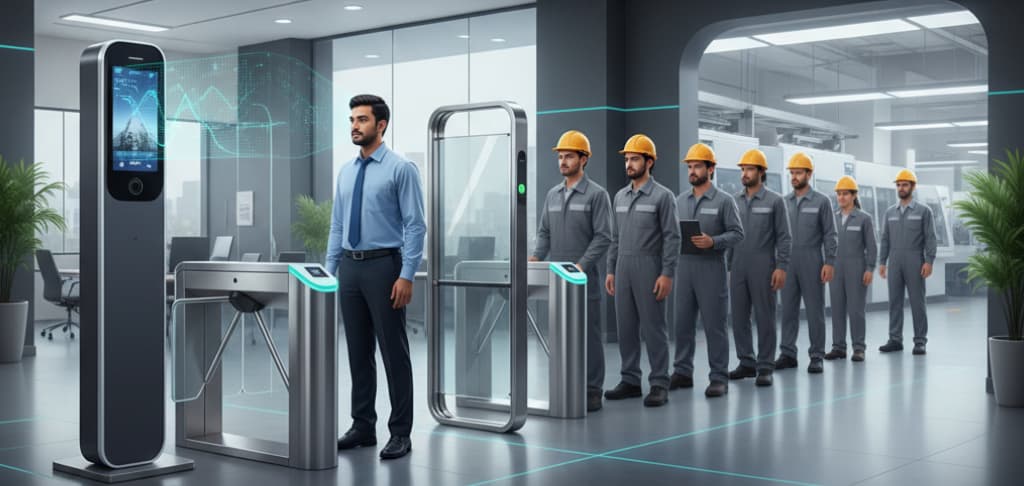
- Manufacturing and industrial plants — high-volume shift-change throughput across the industrial belts of Punjab, Haryana and Gujarat, where device selection has to account for worn fingerprints and dusty conditions.
- Schools, colleges and universities — staff and student attendance, widely deployed across Uttar Pradesh, Bihar and Odisha.
- Hospitals and clinical facilities — contactless iris or face recognition for staff working in gloves and protective equipment.
- Government departments and public sector undertakings — auditable attendance records, including in hill-state administrations across Himachal Pradesh and Uttarakhand where offices are geographically dispersed.
- Construction and project sites — portable or 4G-connected terminals for workforces that move between locations.
- Retail chains and hospitality — multi-outlet attendance consolidated centrally, common in Goa's hospitality sector and in retail networks across Jharkhand and Chhattisgarh.
- Logistics and warehousing — contractor and shift workforce tracking at distribution hubs.
TimeWatch India supplies and supports biometric attendance systems nationwide, with installations in Delhi, Mumbai, Bengaluru, Hyderabad, Chennai, Pune, Ahmedabad, Kolkata, Jaipur, Lucknow, Chandigarh, Indore and Bhubaneswar among many other locations.
Integration Possibilities
- Payroll and HRMS — attendance data exported as payable days, overtime hours and leave adjustments.
- Access control — the same terminal releasing a door lock, so one credential governs both time and entry.
- Canteen management — the same identity used at the meal counter, with entitlement rules applied automatically.
- Visitor management — staff and visitor movement recorded against one system for a complete on-site picture.
- ERP systems — labour hours booked against projects, jobs or departmental codes.
- CCTV and video analytics — footage bookmarked against punch events for verification where required.
- Mobile and geo-fenced attendance — field staff marking attendance from a phone within a permitted location boundary.
Installation Considerations
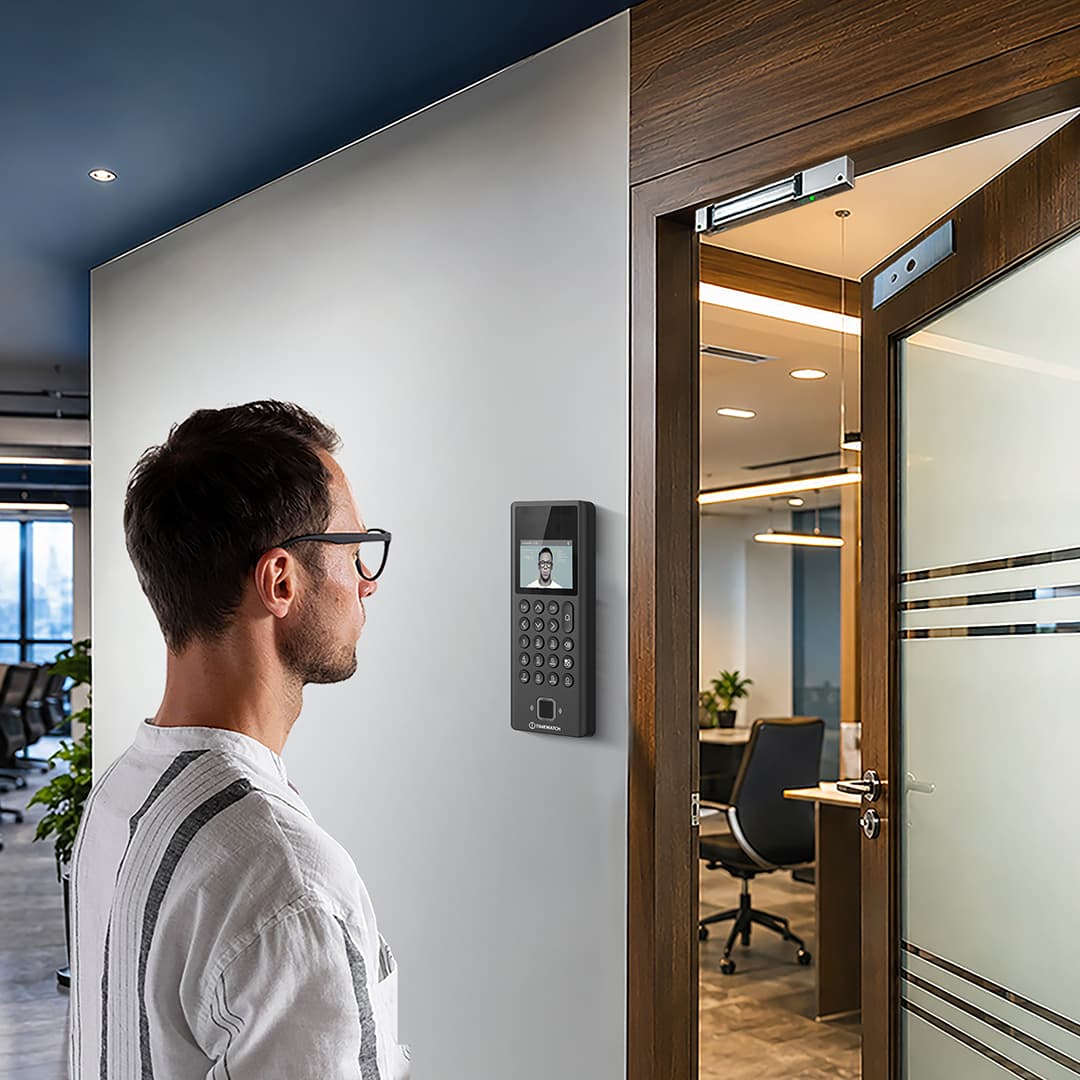
- Mounting height — typically around 1.2 metres for fingerprint devices. Face terminals need a height and angle suited to the range of user heights at that site.
- Lighting — face recognition devices should not face a window or direct sunlight. Strong backlighting is the most common cause of poor face recognition performance, and it is an installation problem rather than a device problem.
- Throughput planning — one terminal handles a certain number of punches per minute. A 500-person shift change through a single device will queue; the fix is more terminals or more lanes, decided at design stage.
- Network and power — Ethernet or PoE where available, 4G where not, with backup power if attendance must continue through outages.
- Environmental protection — outdoor or dusty locations need appropriately rated enclosures; direct rain exposure and temperature extremes shorten sensor life.
- Enrollment planning — allocate proper time and a quiet space. Enrollment done badly at go-live generates support calls for the following year.
Maintenance Considerations
- Clean the sensor surface regularly. Oil and dust on a fingerprint platen is the leading cause of gradually worsening read rates.
- Re-enrol users who fail repeatedly rather than lowering the threshold for everyone.
- Keep firmware current for algorithm and anti-spoofing improvements.
- Verify time synchronisation. A device whose clock has drifted produces subtly wrong attendance for everyone using it.
- Monitor transaction log capacity and confirm events are uploading, particularly after any network change.
- Back up the template database, and confirm the restore process works before it is needed.
- Check door relay and backup battery function where the terminal also controls access.
Benefits and Limitations
Benefits
- Eliminates buddy punching — a biometric credential cannot be handed to a colleague, which a card can.
- Accurate, timestamped records that remove disputes over arrival and departure times.
- Removes manual register entry and the reconciliation effort that follows it.
- Feeds payroll directly, so payable days trace back to the individual punch behind them.
- Consolidates multi-site and multi-shift data into one view.
- Supports statutory record-keeping and audit requirements.
Limitations and considerations
- No biometric method works for everyone. Worn fingerprints from manual work, gloves in clinical or food-handling settings, and facial coverings each defeat specific methods. Plan a fallback.
- Enrollment quality determines everything downstream. Poor initial capture cannot be corrected by configuration.
- Throughput is finite. Large simultaneous shift changes need multiple terminals.
- Environment affects performance — dust, moisture, extreme temperature and harsh lighting all degrade capture.
- Privacy expectations must be managed. Explaining that only an encrypted template is stored, not an image, resolves most employee concern and is worth doing before deployment rather than after.
- Accuracy figures are configuration-dependent. Published FAR and FRR figures relate to specific test conditions and thresholds; real-world performance depends on the device, algorithm, threshold setting and site conditions.
Biometric vs Card Attendance: What Is the Difference?
| Aspect | Biometric attendance | Card-based attendance |
|---|---|---|
| What it verifies | The person | The card |
| Buddy punching | Prevented — the credential cannot be transferred | Possible — a card can be handed to a colleague |
| Lost credential | Not applicable | Cards are lost, forgotten and need reissuing |
| Speed per user | Typically under a second; 1:N slows as the database grows | Very fast and constant regardless of population size |
| Works for everyone | No — some users are unsuitable for a given method | Yes, for anyone issued a card |
| Typically suited to | Permanent staff where attendance accuracy drives payroll | Large contractor or temporary populations, or as a second factor |
Many sites run both: biometrics for permanent staff, cards for contractors and visitors, with both feeding the same attendance database.
How Biometric Attendance Data Is Protected
Three properties together determine how safe the data is:
- The template is not the biometric. What is stored is a numeric representation, generated one-way. The original fingerprint, face or palm image cannot be rebuilt from it.
- The template is encrypted. TimeWatch devices secure templates with AES-128 encryption at rest on the device and in transit to the server.
- Access is controlled. Who can view, export or delete attendance and biometric data is governed by role-based permissions in the software, with changes recorded in an audit trail.
Organisations deploying biometric attendance should also confirm their own obligations on employee data handling with their legal or compliance team, since requirements vary by sector and by the nature of the employment relationship.
Frequently Asked Questions
Does an attendance machine store my fingerprint?
No. The device converts your fingerprint into a numeric template describing distinctive features such as ridge endings and their positions, then discards the original image. The template is a one-way representation — it can recognise the same finger again but cannot be used to reconstruct your fingerprint. On TimeWatch devices, templates are additionally secured with AES-128 encryption.
How does a biometric machine recognise you?
It captures a sample, extracts the distinctive features into a numeric template, and compares that template against the templates created when you were enrolled. The comparison produces a similarity score. If the score exceeds the configured threshold, you are identified and an attendance event is recorded with your ID and the exact time.
What happens if the fingerprint does not read?
The device rejects the attempt and prompts a retry. Repeated failures usually indicate a poor enrollment, a dirty sensor, or a finger that is wet, dry, cut or worn. The remedies are cleaning the sensor, re-enrolling the user, or switching that person to a different method such as face, palm or card. Enrolling two fingers per person at the outset avoids most of these situations.
Can an attendance machine work without an internet connection?
Yes. Matching happens on the device itself, so identification continues to work with no network at all. Attendance events are stored in the terminal's local memory and upload automatically when the connection returns. The constraint is the device's log capacity, so a very long outage on a busy terminal should be checked.
What is the difference between 1:1 and 1:N matching?
In 1:1 verification, the user first identifies themselves with a card or PIN and the device compares against that one stored template. In 1:N identification, the user presents only the biometric and the device searches every enrolled template for a match. 1:N is more convenient; 1:1 stays fast and accurate regardless of how many people are enrolled, which is why large sites often prefer it.
What is buddy punching and how does biometric attendance stop it?
Buddy punching is one employee marking attendance on behalf of an absent colleague. It is possible with cards and PINs because those can be handed over. A biometric credential cannot be transferred, so the person must be physically present to be recorded.
How accurate are face recognition attendance machines?
Accuracy depends on the device, the algorithm, the matching threshold and site conditions rather than being a single fixed figure. Modern dual-camera terminals with infrared perform reliably in low light and with normal changes in appearance. The most common cause of poor real-world performance is installation — a terminal facing a window or direct sunlight will underperform regardless of its specification.
Can one machine handle attendance and door access together?
Yes. Most terminals include a relay output that releases an electromagnetic lock or strike on a successful match, so the same device records the attendance event and opens the door. The software can apply different rules to each function, for example recording attendance for all staff but granting door access only to authorised groups.
How does attendance data reach payroll software?
The device transfers events to the attendance software, which applies shift, leave and overtime rules to convert punches into payable days. That output is exported to payroll or HRMS in the format the payroll system expects, or processed within the attendance platform where it handles payroll directly. Because the input is the attendance record itself, any payroll figure can be traced back to the punch behind it.
How many people can one attendance machine handle?
Two separate limits apply. Template storage capacity sets how many users can be enrolled on the device, and varies by model. Throughput sets how many punches per minute the terminal can process, which determines queue length at shift change. A site with a large simultaneous shift change usually needs multiple terminals regardless of storage capacity.
Do attendance machines work for people with worn or damaged fingerprints?
Often not reliably. Manual work, chemical exposure and age can genuinely wear down the ridge detail a fingerprint sensor depends on, and this is a recognised limitation rather than a device fault. Affected users are better served by face recognition, palm vein or iris, or by a card credential. Multi-modal terminals exist specifically so one site can accommodate different users on different methods.
