
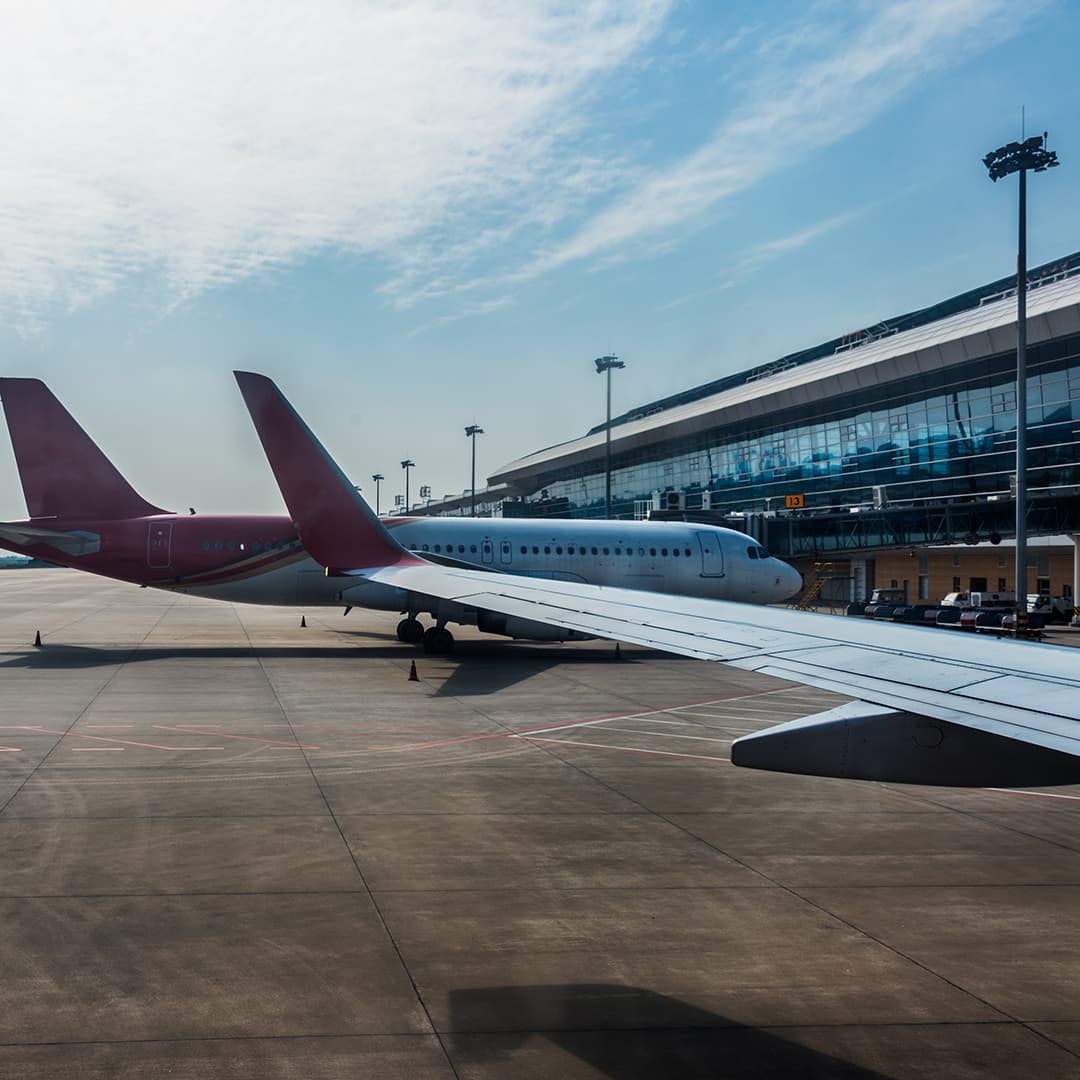
What Is a Complete Airport Security Solution?
Airport security is often described as a list of equipment — so many walk-through detectors, so many X-ray machines, so many cameras. That description is accurate and almost useless, because it says nothing about why any of it is placed where it is.
The useful description is architectural. An airport is a large public site with a small, tightly restricted core. Tens of thousands of people enter the public part each day with no credential at all; a far smaller number — passengers who have been screened and staff who have been cleared — are permitted into the restricted part. The whole design exists to manage that transition, at every point where it can occur, for people, vehicles, baggage, cargo and supplies. Once that is clear, the placement of every system follows: screening where passengers cross, access control where staff cross, vehicle screening where vehicles approach, perimeter detection where someone might cross without using a door at all, and a command centre where all of it has to be seen at once.
How Does Airport Security Work?
Airport security works by arranging independent systems into layers that must be defeated in sequence, each positioned to cover a weakness in another. Working inward: the perimeter is fenced, monitored and detected; the vehicle approach is controlled by plate recognition, barriers and under-vehicle screening; terminal entry screens passengers and cabin baggage; checked baggage is screened separately on the conveyor system; staff and airside doors are controlled by credential and biometric access control; visitors and contractors are registered, verified and escorted; and surveillance and a command centre observe all of it, with alarms from every subsystem surfacing in one place.
The layers are not alternatives. They are chosen so that the blind spot of one is covered by the capability of another, and joined by integration so that an operator sees a single picture rather than a dozen separate screens.
The Landside/Airside Boundary: The Organising Principle
What landside and airside actually mean
Landside is the part of the airport the general public can reach without being screened: approach roads, car parks, forecourt, kerbside, and the public concourses. No credential is required to be there.
Airside is the restricted part: departure gates, aprons, taxiways, runways, baggage handling areas, fuel farms, catering and cargo facilities. Access is limited to screened passengers and cleared staff, and the restriction is enforced physically rather than by signage.
The line between them is not a single wall. It runs through the terminal building, along the site perimeter, through service corridors, past cargo gates and around every plant room that opens onto the apron. In a large terminal it can involve several hundred doors. Understanding that the boundary is a continuous line with many crossing points — not a checkpoint — is the single most important thing to grasp about airport security design.
Why the direction of travel matters
Controls are not symmetrical. Movement from landside to airside carries the risk and is heavily controlled: screening for passengers, credential and biometric verification for staff, escort requirements for contractors. Movement in the opposite direction is usually permitted with far lighter control, because a person leaving the restricted area is not introducing anything into it.
This asymmetry is why one-way flows appear throughout terminal design. It is also why any point where the two flows could mix is treated as significant: a door allowing free passage both ways, or a corridor where arriving and departing passengers can meet, undoes the screening applied upstream by creating a route into the restricted area that bypasses the checkpoint. Where such routes are unavoidable in an existing building, they are managed with one-way gates, monitored doors or staffed supervision.
Every crossing point is a controlled crossing point
The design rule that follows is simple to state and demanding to implement: every point at which the boundary can be crossed must be controlled, and the control must suit what crosses there.
- Passengers cross at the screening checkpoint, through screening equipment.
- Staff cross at controlled doors and staff channels, through access control and identity verification.
- Vehicles cross at service and cargo gates, through plate recognition, barrier control and under-vehicle screening.
- Checked baggage crosses on the conveyor system, through inline hold baggage screening.
- Cargo and supplies cross at dedicated gates and docks, through their own screening and documentation process.
- Anyone attempting to cross where no crossing point exists meets the perimeter layer.
This is the list an airport design is reviewed against. The question is never "do we have enough cameras" — it is "has every crossing point been identified, and does each one have a control that matches what crosses there".
The Seven Layers of an Airport Security Solution
The layers work inward from the site boundary. The numbering describes position, not importance.
| # | Layer | What it controls | Technologies typically used |
|---|---|---|---|
| 1 | Perimeter | The outer boundary — everything that is not a designated entrance | Fencing, perimeter intrusion detection, CCTV with video analytics, patrol roads and lighting, crash-rated bollards and road blockers at vulnerable approaches |
| 2 | Vehicle approach and frontage | Vehicles entering the site and reaching the terminal | ANPR plate recognition against permitted lists, boom barriers for traffic control, under vehicle surveillance at service and cargo gates, crash-rated barriers at the terminal frontage |
| 3 | Terminal entry | Passengers and cabin baggage crossing to airside | Walk-through metal detectors, X-ray baggage scanners, body scanners for selective or enhanced screening, handheld detectors, explosive trace detection |
| 4 | Hold baggage screening | Checked baggage moving from check-in to the aircraft | Inline screening machines in the baggage conveyor system, image review positions, reconciliation with the baggage handling system |
| 5 | Staff and airside access | Every door and channel between landside and airside used by staff | Access control on each door, biometric staff identification, turnstiles and e-gates, anti-passback, time-based and zone-based permissions, door monitoring |
| 6 | Visitor and contractor | Non-staff needing temporary access beyond public areas | Registration and identity capture, document and clearance verification, escorted access, time-limited zone-restricted passes |
| 7 | Surveillance and command | Visibility and response across all of the above | CCTV across all zones, video analytics, a command platform receiving alarms from every subsystem, event-to-footage linking |
Layer 1 — Perimeter Protection
The perimeter is the outer edge of the site, typically several kilometres of fence line enclosing runways, aprons and support facilities. Its job is to ensure the only way in is through a designated, controlled crossing point.
Fencing alone delays rather than detects. What turns it into a security layer is detection and observation on top of it: perimeter intrusion detection sensing disturbance along the fence line, CCTV covering that line, and video analytics raising an alarm on a defined behaviour — a person crossing a virtual line, a vehicle stopping where vehicles do not stop, movement in a sterile zone. Patrol roads give a response team a route to any point of the line, and lighting determines whether cameras see anything after dark.
Crash-rated bollards and road blockers belong here wherever a road runs towards the boundary at a speed that matters. These are structural products rated to arrest a vehicle of a defined mass at a defined speed, and their placement is a civil engineering exercise as much as a security one, because the rating depends on the foundation as well as the product.
The characteristic weakness of this layer is alarm volume. A long fence line in an open environment generates events from weather, vegetation, animals and passing traffic, and a perimeter system whose alarms are ignored has failed while appearing to function. Detection technology choice and analytics tuning matter more here than sensor count.
Layer 2 — Vehicle Approach and Terminal Frontage
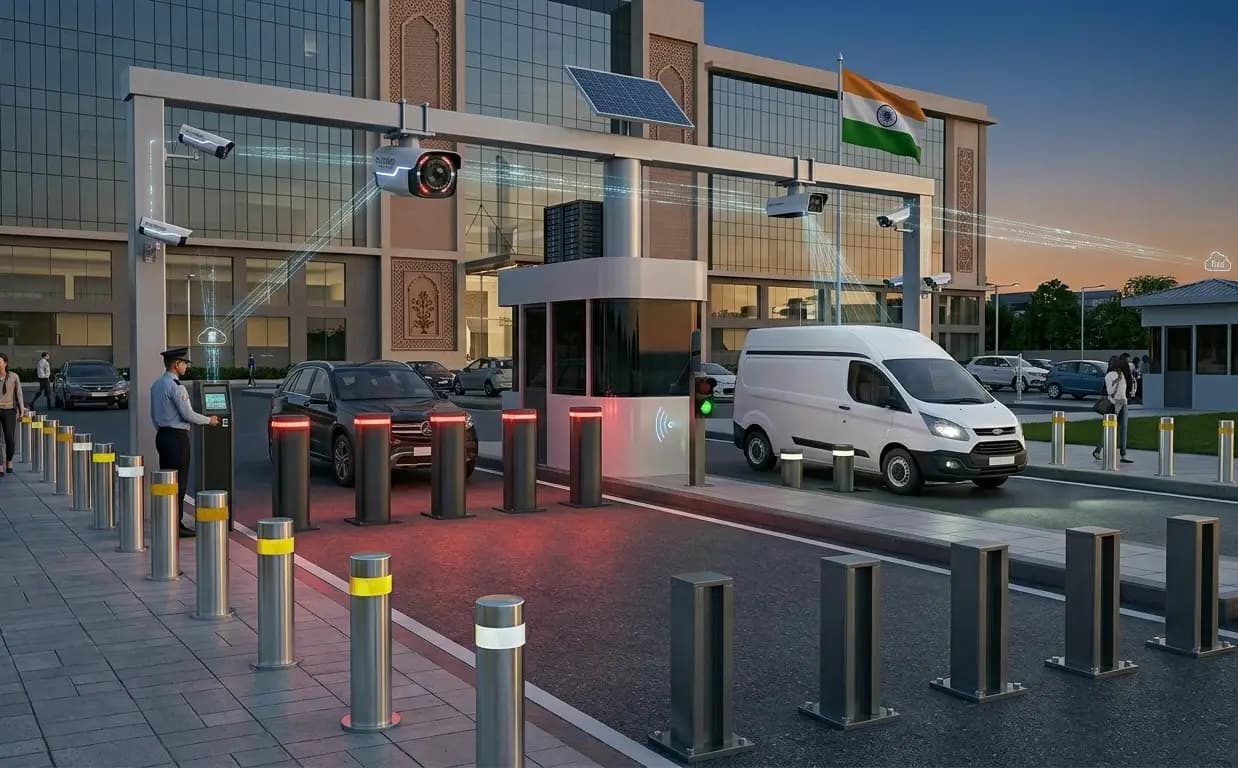
Vehicles arrive in different categories: private cars and taxis heading for the kerbside, staff vehicles heading for employee parking, and service, catering, fuel and cargo vehicles heading for gates that lead directly airside. Each needs different treatment, and good design separates them early.
ANPR reads the number plate on approach and checks it against a permitted list. On a match the barrier raises without the driver stopping for manual verification; on no match the vehicle is directed to a manned lane. This is a traffic-flow measure as much as a security one, since a gate requiring every driver to be checked by hand becomes a queue on a public road.
Boom barriers perform traffic control: they define lanes, stop vehicles at the verification point and sequence movement. They are not vehicle-arrest devices. Where the requirement is to physically stop a vehicle rather than to order traffic, that is a crash-rated bollard or road blocker, and the two are often installed together.
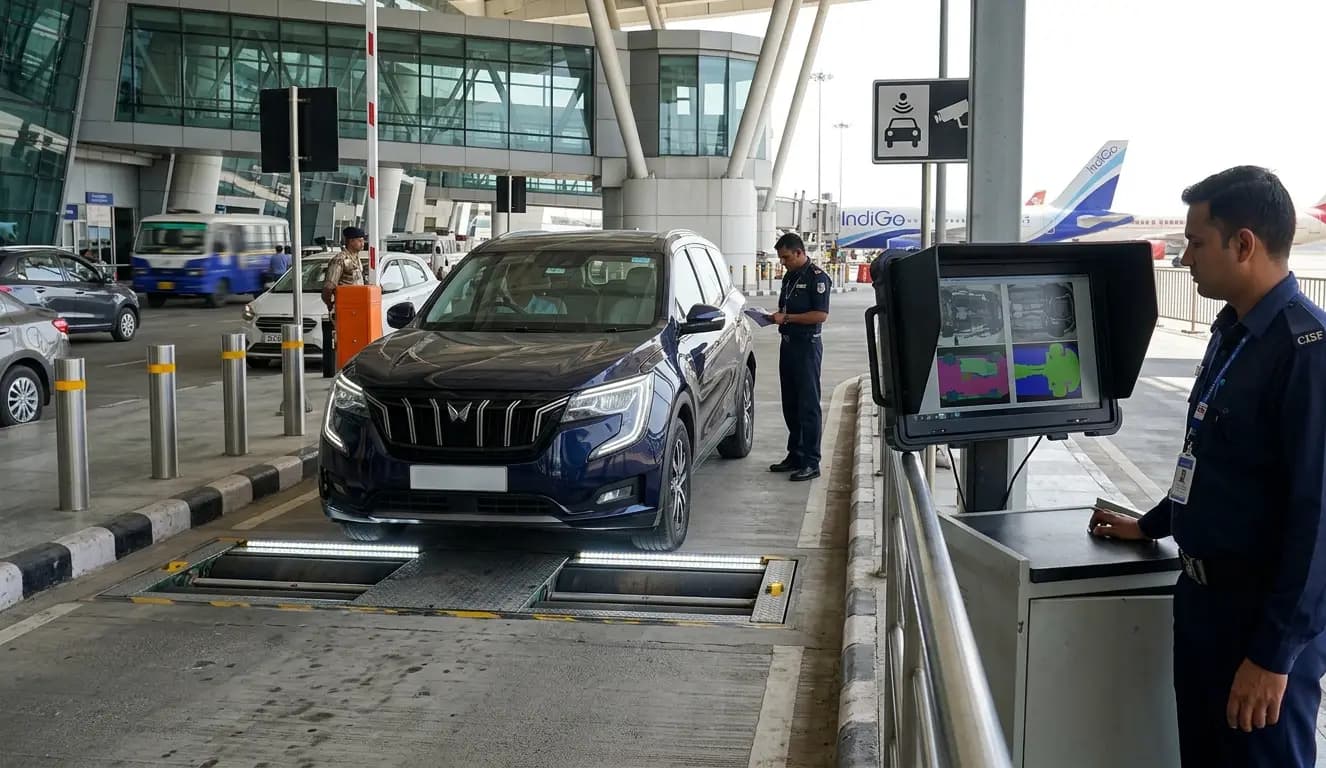
Under vehicle surveillance systems scan the underside of a vehicle as it drives slowly over a scanning unit, producing an image of an area a guard cannot see with a mirror. At airports these concentrate at service and cargo gates, where vehicles cross directly into the restricted area with a driver who may be a contractor rather than an employee. Capability varies considerably between systems — image quality, whether previous scans of the same plate are stored and compared, and how the unit integrates with ANPR all differ by product and should be confirmed against the specification of the equipment concerned.
The terminal frontage is a separate problem: a public road running alongside a densely occupied glazed building. Crash-rated bollards provide physical stand-off, selected for rating and placed to a designed line rather than distributed decoratively. Where the frontage must remain openable for service access, rated retractable bollards or road blockers are used instead of fixed ones.
Layer 3 — Terminal Entry and Passenger Screening
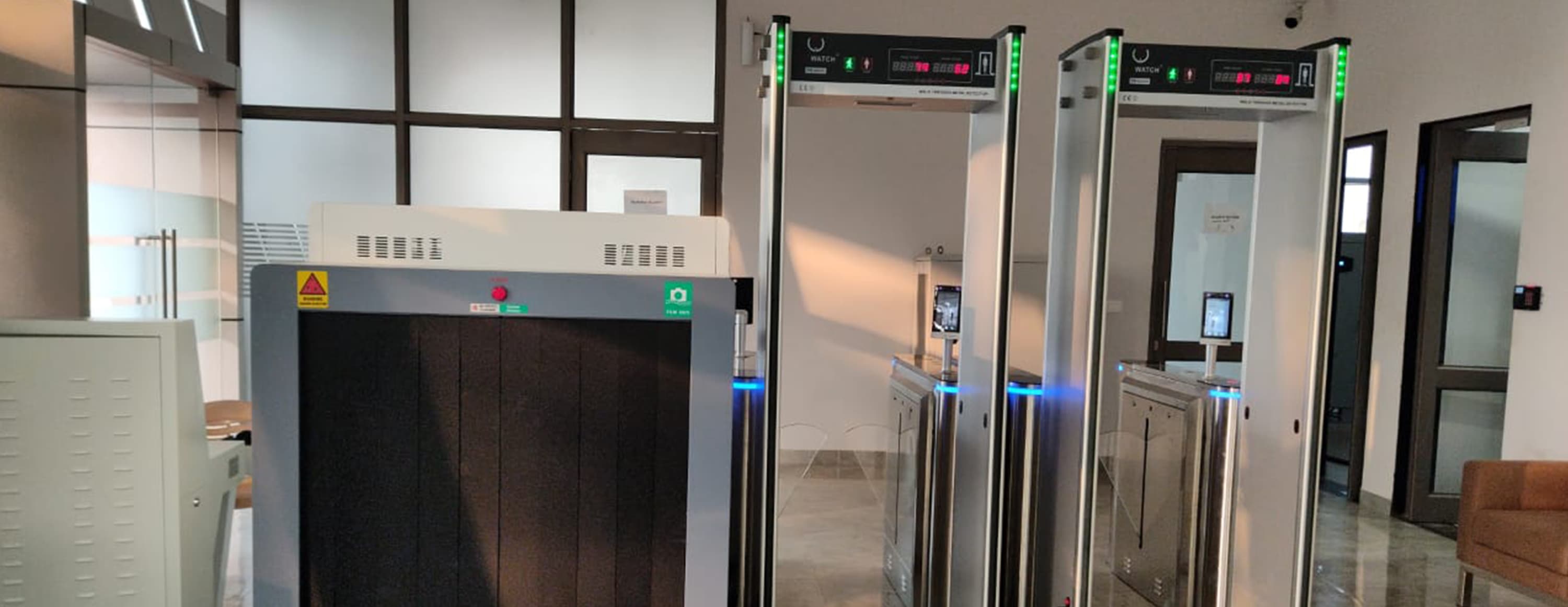
This is the layer the public sees. It screens passengers and their cabin baggage as they cross to airside, and it screens the person and the bag separately because no single technology does both.
- Walk-through metal detectors screen the person for metal carried on the body at walking pace, with multi-zone units indicating roughly where a detection occurred so secondary screening can be targeted.
- X-ray baggage scanners screen cabin baggage, distinguishing material type by colour and density so an operator can assess contents without opening the bag.
- Body scanners are used for selective or enhanced screening where the threat assessment supports it. Their role in the architecture is that they respond to non-metallic items concealed on the body, which a metal detector by definition cannot.
- Handheld metal detectors resolve archway alarms with a targeted check at the indicated zone rather than a full manual search.
- Explosive trace detection samples a surface and analyses it for residue, covering a category neither metal detection nor X-ray imaging addresses directly.
The checkpoint is where throughput and detection pull hardest against one another. Each lane has a capacity set by divestment space, belt speed, the archway, the secondary search area and the number of operators. Adding equipment without adding lane length or staff usually reduces throughput, because the constraint moves rather than disappearing.
Each of these devices is covered in detail elsewhere in this series. What matters here is the arrangement: a person and their belongings are separated, screened by different technologies at the same time, and reunited beyond the point where either could be passed back across the line.
Layer 4 — Hold Baggage Screening
Checked baggage is screened separately from cabin baggage, on a different system, usually out of public view. After check-in, bags enter the baggage handling system and pass through screening machines built into the conveyor line rather than a machine an operator loads by hand.
- It is inline, not manual. Screening sits in the conveyor path, so every bag is screened without separate handling. Capacity is matched to the baggage system, because a screening stage slower than the conveyor becomes the constraint on the whole terminal.
- It is separate from the passenger checkpoint. The two are frequently confused. The checkpoint screens the passenger and what they carry into the cabin; hold baggage screening handles what travels in the aircraft hold, and the passenger is not present when it happens.
- It is multi-stage by design. Bags that clear at the first stage continue; those that do not are routed to a review position, and only a small proportion require manual involvement. The staged structure is what allows high automatic clearance rates without reducing scrutiny of the bags that need it.
- It is reconciled with the baggage handling system, so screening status is tied to the bag record and a bag cannot be routed onward outside the process.
Configuration, stage count and machine type vary considerably between airports and between terminals of different sizes, and depend on the baggage system they are built into.
Layer 5 — Staff and Airside Access Control
This layer is larger, busier and less visible than the passenger checkpoint, and it deserves more attention than it usually gets.
Airside operation requires a substantial workforce: airline staff, ground handlers, engineers, cleaners, caterers, retail employees, fuel operators, security personnel and authority staff. They cross the boundary continuously, on every shift, at a great many doors, and in most cases without anyone watching them do it. Control at those doors is what makes the restricted area restricted.
- Access control on every boundary door, with monitoring so that a door forced or held open raises an alarm rather than simply staying open.
- Biometric identification. A card establishes that a credential is present; a biometric establishes that the holder is present. On boundary doors that distinction is the whole point, because a card can be lent, lost or taken.
- Turnstiles and e-gates at staff channels, where one authorised person per authorisation has to be physically enforced rather than assumed.
- Anti-passback, preventing a credential being used to enter twice without an intervening exit.
- Zone-based permissions, so a credential grants only the areas the role requires. A single undifferentiated "airside" permission grants everyone everything.
- Time-based permissions, so access is valid during rostered hours. A credential that works at any hour is one whose misuse is much harder to notice.
- Audit trail of every read, grant, denial and door alarm, which is what makes investigation possible afterwards and patterns visible before.
Day to day this is a larger risk surface than the checkpoint, and it is worth being explicit about why. The checkpoint operates at known times, in a supervised space, with staff present and a queue of witnesses. Staff access operates around the clock, at doors spread across a large site, with nobody watching. The mitigation is not more equipment but tighter administration: permissions that match roles, prompt revocation when someone leaves, and review of the exceptions the system logs.
Layer 6 — Visitor and Contractor Management
Airports host a continuous flow of people who are neither passengers nor staff: maintenance contractors, equipment engineers, delivery drivers, auditors, tenant representatives and construction workers. They need access beyond the public areas, often to sensitive locations and frequently at short notice.
- Pre-registration by a sponsoring department, with purpose, area and duration recorded before arrival.
- Identity capture and verification on arrival, with the document recorded against the visit.
- Clearance verification where the area requires it, checked before a pass is issued rather than afterwards.
- A time-limited, zone-restricted pass granting only the areas the visit requires, expiring automatically.
- Escort requirements recorded and enforced where unaccompanied access is not appropriate.
- Return and closure, so an unreturned pass is visible as an exception rather than disappearing quietly.
The recurring failure here is the long-term contractor treated as a visitor for months, accumulating routine access without ever being subject to the controls that apply to staff. The gap is administrative rather than technical, and deciding when a repeat contractor moves onto the staff access regime is a policy decision the system can enforce but cannot make.
Layer 7 — Surveillance and the Command Centre
Surveillance runs across every layer rather than sitting at one point in the sequence. Cameras cover the perimeter, approach roads, forecourt, check-in hall, checkpoint lanes, baggage areas, boundary doors, staff channels, aprons and concourses. Video analytics raise alarms on defined conditions — line crossing, loitering in a sterile area, a vehicle stopped where stopping is not expected, a door held open, movement against the flow in a one-way corridor.
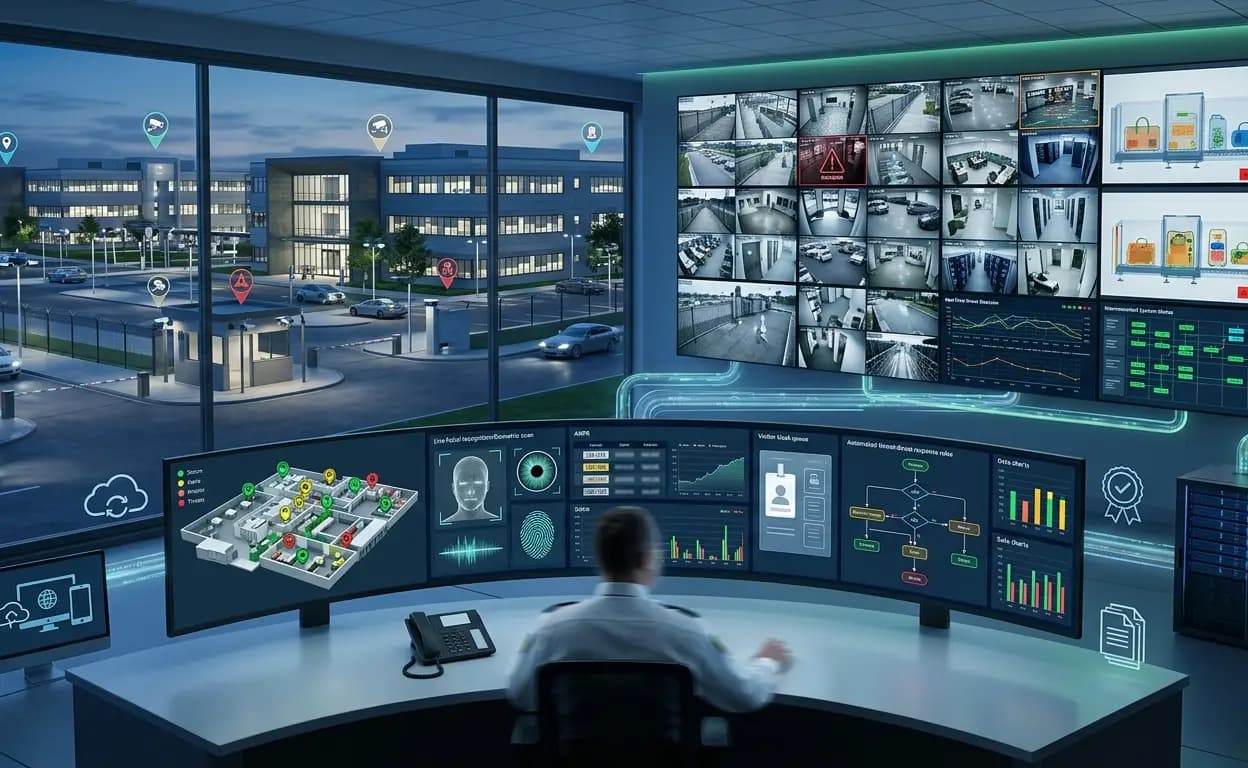
The command centre is where the architecture becomes a system. It receives perimeter intrusion alarms with the camera view of that section; checkpoint alarms and equipment status; access control events such as denials, forced doors and anti-passback violations; ANPR reads and non-matches; under vehicle scan results; analytics alerts from across the site; and the health and communication status of each subsystem.
The value is in aggregation, not in any one feed. An operator who has to watch six applications will, under load, watch one. An operator with a single event list, where each event carries the associated camera view and location, can act on what arrives. The practical test of an airport integration is simple: when an alarm occurs, how many actions does it take to see the relevant footage? If the answer is more than one, the integration is incomplete regardless of how the subsystems were specified.
Why Layered Defence Works: Covering Each Layer's Blind Spot
Layering is not redundancy for its own sake, and it is not doing the same thing several times. Each layer exists because another has a known and specific limitation.
A walk-through metal detector detects conductive metal; it cannot see a non-metallic item, and was never designed to — which is why body scanners exist as a distinct capability rather than as a better metal detector. An X-ray baggage scanner produces an excellent image of what is inside a bag and tells you nothing about the person carrying it; the archway covers that. Trace detection responds to residue neither of the other two addresses directly. Access control verifies that a valid credential was presented but cannot verify intention, so supervision, surveillance and audit cover what the reader cannot. Perimeter detection reports that the fence line was disturbed but not by whom, so cameras and a response capability complete it. ANPR confirms which vehicle arrived, not what is underneath it, so under vehicle screening sits alongside it.
This is why removing a layer that looks redundant is a consequential decision rather than an efficiency measure. A layer that appears to duplicate another almost always covers a case the other does not, and it is usually the case nobody has had to deal with recently. Before a layer is removed to save time or space, the question worth answering is which capability disappears with it and what is left covering that case. If the answer is "nothing", the layer was not redundant.
How the Layers Are Integrated in Practice
The genuinely difficult part of an airport security project is not the equipment. Each subsystem, taken alone, is a mature product that works as specified. The difficulty is making alarms and events from a dozen different manufacturers' products arrive in one command centre, in a consistent form, with enough context for an operator to act — and this is where airport projects overrun far more often than they overrun on hardware.
| Integration element | What it means in practice |
|---|---|
| Common event model | Every subsystem's alarms translated into one structure — what, where, when, how serious — so operators are not learning a different vocabulary per vendor. |
| Event-to-camera association | Each alarm point mapped to the cameras covering it, so an alarm presents its own footage. Site-specific manual work, and where schedules are usually underestimated. |
| Single operator interface | One list, one map, one workflow. Multiple client applications on multiple screens is co-location, not integration. |
| Interface definition per subsystem | Each product exposes events differently. What each interface can and cannot deliver must be established before the design is fixed, not discovered at commissioning. |
| Time synchronisation | All subsystems on a common time source, without which correlating an access event with footage and an ANPR read becomes guesswork. |
| Alarm handling procedure | Defined actions and escalation per alarm type, built into the platform rather than left to operator memory. |
| Health monitoring | The platform reports when a subsystem stops communicating. A reader or camera offline unnoticed is a gap nobody knows about. |
Two consequences follow. The integration requirement belongs in the specification from the outset, with each subsystem's event interface stated rather than assumed. And integration testing needs scheduling as real work with real duration, because every interface behaves slightly differently from its documentation and the differences only appear once the systems are connected.
Designing for Peak Hour, Not Average Flow
Airport traffic is not evenly distributed. Departures cluster into waves set by airline schedules, and a terminal that handles a comfortable average can queue badly for two or three hours a day.
Every element with a throughput characteristic must therefore be sized against peak-hour flow rather than daily average: screening lanes, staff channels, e-gates, vehicle entry lanes and the operators available to run them. A design based on averages looks adequate in the model and fails in operation — a particularly unforgiving failure, because screening capacity is the hardest thing to add later.
The reason is spatial. A lane is not just a machine: it needs divestment space upstream, an archway, an X-ray position with an operator, a re-composure area downstream and a secondary search area to one side. That footprint has to come from somewhere in a terminal laid out for a particular number of lanes, so adding one later usually means taking space from retail, circulation or check-in. Adding a lane at design stage requires a line on a drawing. Reserving space for future lanes, even unfitted, is one of the few decisions here that is straightforwardly easier to take early than late — and the same applies to power, data and containment routes at boundary doors.
Regulatory Context in India
Civil aviation security in India is overseen by the Bureau of Civil Aviation Security (BCAS), which sets the framework within which airports operate. Airport operators, airlines and service providers work within that framework, and it shapes how screening, access control and the landside/airside boundary are handled at Indian airports.
This page describes how the systems work as an architecture. It does not state regulatory requirements, and nothing here should be read as a statement of what any regulation requires or as a claim of approval, certification or compliance for any product or design. Anyone specifying equipment for an airport environment should work from the applicable framework and the airport operator's own requirements, and should confirm the specification of any particular equipment against its own documentation.
Security Layers Compared
| Layer | What it protects against | Primary technologies | Typical location |
|---|---|---|---|
| Perimeter | Entry to the site away from designated crossing points; vehicle approach at speed | Fencing, intrusion detection, CCTV analytics, crash-rated bollards and road blockers | Site boundary fence line, patrol roads, approach roads |
| Vehicle approach | Unauthorised vehicles; items concealed under a vehicle; impact on the terminal | ANPR, boom barriers, under vehicle surveillance, crash-rated bollards | Site entry roads, staff and service gates, cargo gates, terminal frontage |
| Terminal entry | Prohibited items carried on the person or in cabin baggage | Walk-through metal detectors, X-ray baggage scanners, body scanners, handheld detectors, trace detection | Passenger checkpoint between the public concourse and departures |
| Hold baggage | Prohibited items in checked baggage entering the aircraft hold | Inline screening machines, image review positions, baggage reconciliation | Baggage handling hall, out of public view |
| Staff and airside access | Crossing the boundary through doors and staff channels; credential misuse | Access control, biometrics, turnstiles and e-gates, anti-passback, zone and time permissions | Every boundary door; staff channels and crew routes |
| Visitor and contractor | Unverified or unsupervised non-staff access to restricted areas | Visitor management, identity and clearance verification, time-limited zone-restricted passes | Reception points, contractor gates, tenant and works entrances |
| Surveillance and command | Events going unseen, unlinked or unanswered across the other layers | CCTV, video analytics, integrated command platform, event-to-footage linking | Cameras throughout the site; a central command and control room |
Where Complete Airport Security Solutions Are Deployed in India
The architecture scales across very different airport types, and the way it is applied changes with the site.
The high-traffic metro airports — Delhi and the wider Delhi region, Mumbai in Maharashtra, Bengaluru in Karnataka, Hyderabad in Telangana, Chennai, and Kolkata in West Bengal — operate the full model at scale, with multiple terminals, long perimeters, large staff populations and command centres running continuously. Here the design problem is throughput and integration: many lanes, several hundred boundary doors, thousands of credential holders, and a command platform that has to make all of it legible to a shift team. Kochi in Kerala shows the same architecture on a site whose layout and operating pattern differ, where the perimeter and staff access layers present their own conditions.
Regional airports change the emphasis rather than the architecture. Guwahati in Assam functions as the connecting point for much of the north-east, and its design carries both origin-destination passengers and a substantial transfer flow. Smaller regional airports serve populations that depend heavily on air connectivity because surface routes are long and slow. Itanagar in Arunachal Pradesh and Imphal in Manipur connect dispersed populations across difficult terrain, where a flight is the practical link between a region and the rest of the country rather than a convenience. Passenger numbers are lower, but the landside/airside boundary exists in exactly the same form, the staff access problem is structurally identical, and the perimeter may be harder to monitor because of terrain and weather.
What varies between a metro airport and a regional one is scale and staffing, not the model. A smaller airport still has a perimeter to detect, vehicles to screen at its service gate, passengers to screen at its checkpoint, checked baggage to screen, staff crossing the boundary on every shift and contractors arriving for work. TimeWatch India manufactures and supplies security and screening equipment across these categories — inspection and screening systems, entrance control, access control, visitor management, vehicle barriers and under vehicle surveillance — and works with integrators and consultants on how such systems are specified and connected.
Benefits and Limitations of the Layered Approach
Benefits
- No single point of failure. One layer degraded does not leave the site open, because the others still cover part of the same ground.
- Complementary capabilities. Each layer addresses cases the others cannot, so combined coverage is wider than any device alone.
- Depth in time. An outer layer that detects early gives a response team time to act before inner layers are reached.
- Proportionate control. Controls sit where they are needed, so public areas stay usable while the restricted core stays restricted.
- Auditability. Access events, screening alarms, vehicle reads and video are recorded and correlated, making investigation and pattern analysis possible.
- Room to evolve. A layer can be upgraded without redesigning the architecture, provided the integration interfaces were defined properly.
Limitations and considerations
- Integration complexity is the main project risk. The subsystems work; connecting them into one coherent picture is the part that overruns.
- Operational discipline determines effectiveness. Permissions never reviewed, passes never returned and alarms never answered defeat a sound architecture without any technical failure occurring.
- Alarm volume degrades response. If tuning is neglected, operators learn to dismiss events, and the layer stops functioning while appearing to function.
- Throughput constrains design. Measures that make peak-hour flow unworkable come under pressure to be relaxed, so capacity must be designed in rather than bolted on.
- Capability varies by equipment. What a given detector, scanner, analytics package or barrier can do differs between products and configurations, and should be confirmed against the documentation for the specific equipment rather than assumed from the category.
- No architecture removes the need for people. Screening decisions, alarm assessment and response remain human judgements. The systems present information; they do not decide.
Common Design and Implementation Mistakes
- Specifying equipment before defining the boundary. If the landside/airside line and every crossing point on it are not documented, the equipment schedule is a guess.
- Treating integration as a commissioning task. Integration requirements belong in the specification. Discovered at commissioning, they become change requests.
- Sizing on average throughput. Lanes, channels and gates must be sized for peak, with space reserved for lanes not fitted initially.
- Under-treating the staff access layer. Attention concentrates on the visible checkpoint while hundreds of boundary doors run on generic access control with permissions nobody reviews.
- Leaving contractors on visitor passes indefinitely. A repeat contractor with months of routine access needs the staff regime.
- Bollards placed without engineering. A crash rating depends on installation and foundation as well as the product; frontage placement is a designed line, not a decorative one.
- Confusing traffic control with vehicle arrest. Boom barriers sequence traffic; rated bollards and road blockers stop vehicles. Each is the wrong answer to the other's problem.
- Cameras without an operational purpose. A camera no analytic uses, no alarm references and nobody watches records history rather than providing security.
- No revocation process. Credentials belonging to people who have left are a common and entirely avoidable weakness.
Maintenance and Operational Assurance
An airport security architecture degrades quietly. Nothing announces that a detector zone has stopped responding, that a camera has been looking at a wall since a works package moved one, or that a permission group has accumulated members who no longer need it.
- Daily operational checks on screening equipment — the only way to catch a device that runs normally but detects nothing.
- Periodic access permission review — confirming credential holders, zone groups and time profiles still match current roles. The highest-value recurring task in the architecture, and the one most often deferred.
- Door alarm review — repeated forced or held-open alarms at one door usually indicate an operational problem or a hardware fault, and both need resolving.
- Camera coverage verification — checking each camera still sees what its alarm mapping assumes, particularly after construction work.
- Analytics and perimeter tuning — reviewing alarm rates by zone so operators continue to treat alarms as meaningful.
- Integration health checks — confirming every subsystem still reports into the command platform, since an interface can fail silently.
- Time synchronisation checks — keeping all systems on a common source so correlated evidence stays usable.
- Pass reconciliation — closing out visitor and contractor passes and investigating those never returned.
- Response exercises — testing that an alarm produces the intended action within the intended time, which is the only measure of whether the architecture works as a system.
Frequently Asked Questions
How does airport security work?
Airport security works as a set of layers arranged around the boundary between the public landside area and the restricted airside area. Working inward, the perimeter is fenced and monitored; vehicles are checked at controlled entries using plate recognition, barriers and under vehicle screening; passengers and cabin baggage are screened at the terminal checkpoint; checked baggage is screened separately on the conveyor system; staff cross at doors controlled by access control and biometric identification; visitors and contractors are registered and escorted; and CCTV with a central command centre provides visibility across all of it. Each layer covers a limitation in another, and integration brings their alarms into one place.
What is the difference between landside and airside at an airport?
Landside is the part of the airport the general public can reach without being screened, such as approach roads, car parks, the forecourt and public concourses. Airside is the restricted part, including departure gates, aprons, taxiways, runways and baggage handling areas, where access is limited to screened passengers and cleared staff. The boundary between them runs through the terminal building and around the whole site, and it can involve several hundred doors in a large terminal. Controlling every point where that line can be crossed is the organising principle of the entire security design.
Why does an airport need so many layers of security?
Because every individual measure has a known limitation. A metal detector cannot detect non-metallic items. An X-ray scanner images a bag but tells you nothing about the person carrying it. Access control confirms that a valid credential was presented but cannot confirm intention. Perimeter detection reports that the fence line was disturbed but not by whom. The layers are chosen so that each one's weakness is covered by another's strength, which is why removing a layer that looks redundant usually removes a specific capability that nothing else provides.
What happens to checked baggage after check-in?
Checked baggage enters the baggage handling system and passes through screening machines built into the conveyor line, separately from the passenger checkpoint and usually out of public view. Screening is staged: bags that clear at the first stage continue towards the aircraft, and bags that do not are routed for further examination at a review position. Screening status is reconciled with the baggage handling system so that each bag's status is recorded. The exact configuration, number of stages and machine types vary between airports and terminals.
How do airport staff get access to restricted areas?
Through access control on the doors and channels between landside and airside, rather than through the passenger checkpoint. A staff credential is read at the door, commonly combined with a biometric so that the system verifies the person rather than only the card. Permissions are usually restricted by zone, so a credential grants only the areas the role requires, and by time, so it is valid during rostered hours. Turnstiles or e-gates are used where one authorised person per authorisation has to be physically enforced, and anti-passback prevents a credential being used to admit several people in succession.
Which is the bigger day-to-day risk, the passenger checkpoint or staff access?
Staff and contractor access across the landside/airside boundary is generally the larger day-to-day risk surface. The checkpoint operates at known times, in a supervised space, with staff present and a queue of people watching. Staff access operates continuously, across a great many doors distributed around a large site, with very little visible supervision. The mitigation is mostly administrative rather than technical: permissions that match roles, prompt revocation when someone leaves, and regular review of the exceptions the access control system logs.
What technology is used in airport security?
Perimeter fencing with intrusion detection and CCTV analytics; plate recognition, boom barriers and under vehicle surveillance systems at vehicle entries; crash-rated bollards and road blockers where a physical vehicle stop is required; walk-through metal detectors, X-ray baggage scanners, body scanners, handheld detectors and explosive trace detection at the passenger checkpoint; inline screening machines in the baggage handling system; access control with biometric identification, turnstiles and e-gates on boundary doors; visitor management for contractors; and an integrated command platform that receives alarms from all of these with the associated camera footage.
Who regulates airport security in India?
Civil aviation security in India is overseen by the Bureau of Civil Aviation Security, known as BCAS, which sets the framework within which airports, airlines and service providers operate. This page describes how security systems work as an architecture and does not state regulatory requirements or imply approval, certification or compliance for any product. Anyone specifying equipment for an airport environment should work from the applicable framework and the airport operator's own requirements.
What is the hardest part of an airport security project?
Integration, not equipment. Each subsystem taken alone is a mature product that works as specified. The difficulty is making alarms from a dozen different manufacturers' products arrive in one command centre in a consistent form, with each event linked to the camera covering it and enough context for an operator to act. Interface definitions, event-to-camera mapping, time synchronisation and alarm workflow are site-specific work, and underestimating them is the commonest reason airport projects overrun.
How are screening lanes sized at an airport?
Against peak-hour flow rather than daily average. Departures cluster into waves set by airline schedules, so a terminal sized on averages will queue badly for several hours a day. Screening lanes are also the hardest element to add later, because a lane needs divestment space, an archway, an X-ray position, a re-composure area and a secondary search area, and that footprint has to be taken from somewhere in a completed terminal. Reserving space for additional lanes at design stage is far easier than creating it afterwards.
Are vehicles screened before entering an airport?
At controlled entries, yes, though the treatment depends on the category of vehicle and the gate. Plate recognition reads the number plate and checks it against a permitted list, with boom barriers sequencing traffic at the verification point. At service and cargo gates, where vehicles cross directly into the restricted area, under vehicle surveillance systems scan the underside to produce an image of an area a guard cannot see with a mirror. Crash-rated bollards or road blockers provide the physical stop where one is required, since boom barriers control traffic rather than arrest vehicles.
Does the same security architecture apply to smaller regional airports?
Yes, at a different scale. A smaller airport has fewer screening lanes, fewer boundary doors and a smaller command function, but it still has a perimeter to detect, vehicles to screen at its service gate, passengers and cabin baggage to screen at its checkpoint, checked baggage to screen, staff crossing the boundary on every shift and contractors arriving for work. The layers are the same layers, and at some regional sites the perimeter is harder to monitor because of terrain and weather. What changes is scale and staffing, not the model.
