Bollards represent the frontline defense for vehicle access control, consisting of rigid metal posts strategically installed to create protective perimeters around sensitive facilities, preventing unauthorized vehicular intrusion while permitting authorized pedestrian and vehicle passage. Modern bollards provide both fixed and retractable configurations, offering flexible security solutions suitable for government buildings, corporate campuses, critical infrastructure, airports, and high-security zones across India.
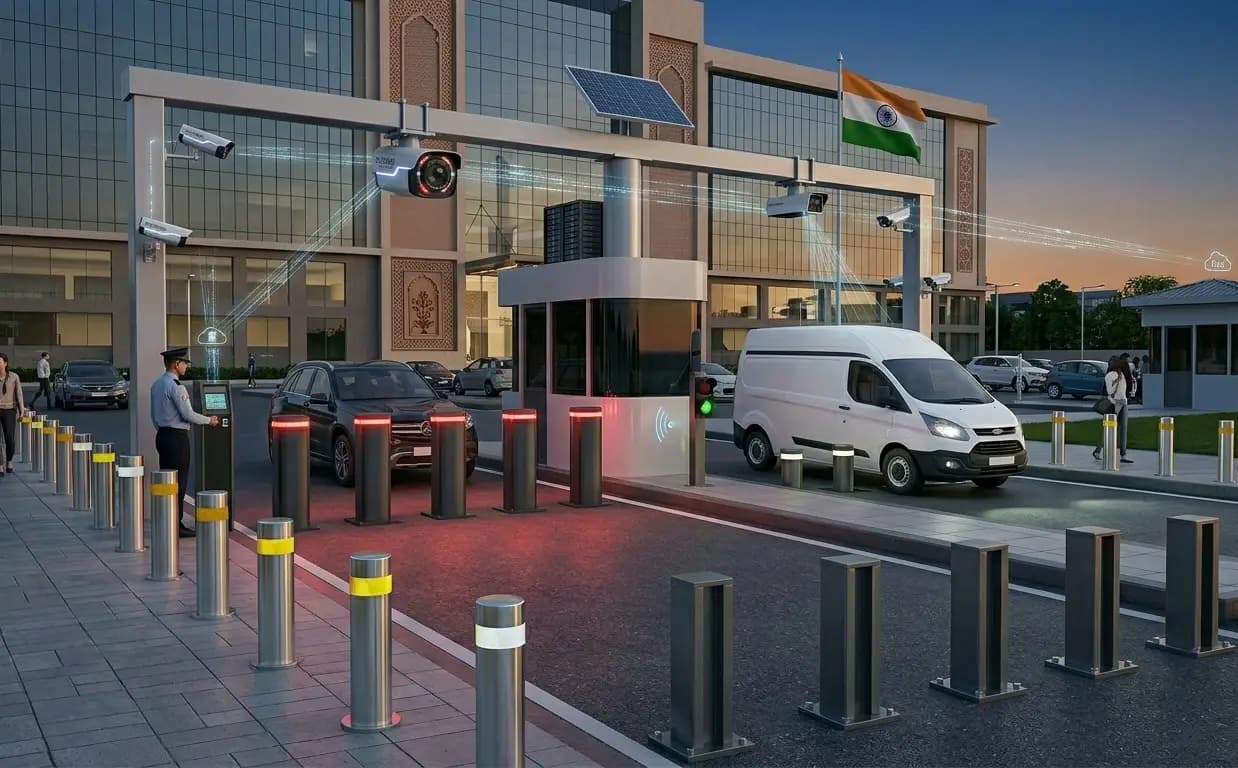
Perimeter Vehicle Check
Bollard Lowering · Authorized Vehicle
Fixed bollards create permanent vehicle barriers preventing high-speed ramming attacks with reinforced steel construction rated for 50+ ton impact resistance. Retractable bollards enable controlled vehicle access, allowing emergency vehicles, authorized deliveries, and approved personnel vehicles to pass through designated gates while preventing public access.
Automatic bollard systems detect vehicle proximity and lower into the ground within 3-5 seconds, returning to full height within the same timeframe. Fail-safe mechanisms prevent accidental lowering, ensuring bollards remain elevated during occupied pedestrian areas, with LED warning lights and reflective markings for nighttime visibility.
Integrated design allows bollards to connect with parking lot management systems, perimeter security networks, and vehicle access control platforms for comprehensive facility protection. Installation on concrete, asphalt, or paved surfaces requires professional assessment of load-bearing capacity and underground utilities, with bollards supporting 24/7 operation across extreme weather conditions (0°C to 50°C) without corrosion.
Facilities without perimeter vehicle barriers experience vulnerability to ramming attacks where vehicles breach security perimeters at high speeds, causing property damage, personal injury, and security breaches. Fixed bollards rated for 50+ ton impact absorb collision energy and prevent vehicle penetration regardless of speed or vehicle size. Reinforced steel construction with deep ground anchoring provides immovable barrier preventing vehicle bypass. Modern facilities require bollard protection to comply with security standards and protect occupants from vehicle-based threats.
Fixed-only barriers prevent emergency vehicle access during medical emergencies, fire situations, and urgent evacuations. Retractable bollard systems enable authorized vehicle passage for ambulances, fire trucks, and emergency response vehicles while maintaining security against unauthorized intrusion. Automatic detection systems recognize emergency vehicle signals and lower bollards within 3-5 seconds. Manual override capability allows security personnel to operate bollards during system malfunction or emergency situations requiring manual control.
Large perimeter walls and crash barriers create fortress-like appearance unsuitable for premium facilities, corporate campuses, and government buildings where aesthetic appeal matters. Low-profile bollards create discrete perimeter protection without dominating facility appearance. Modern bollard designs integrate with landscaping providing security without institutional appearance. Customizable finishes (stainless steel, powder coating, custom colors) allow bollards to complement facility architecture.
Facilities require regular delivery vehicle access for mail, parcels, supplies, and equipment without creating security vulnerabilities. Manual bollard operation requires security personnel intervention for each authorized vehicle creating operational burden. Automatic bollard systems recognize authorized delivery vehicles via vehicle identification or remote activation allowing uninterrupted delivery operations. Time-scheduled automation allows delivery windows without requiring security personnel intervention.
Facilities in coastal regions, industrial areas, and high-humidity zones experience rapid deterioration of metal barriers due to corrosion. Advanced bollards feature stainless steel construction and protective coatings resisting salt spray, humidity, and chemical exposure. Galvanized finishes provide additional corrosion resistance in harsh environments. Maintenance-free designs minimize service requirements in challenging environmental conditions.
Legacy facilities lack integration between vehicle barriers and existing parking management systems, access control platforms, and security networks. Modern bollards integrate via standard communication protocols (RFID, license plate recognition, mobile apps) with centralized control systems. Real-time status reporting provides security teams visibility into bollard status and perimeter security. Automated logs document all bollard operations for security audits and incident investigation.
Vehicle approaches bollard-protected area. Proximity sensors detect vehicle approach.
Vehicle identification system reads license plate using automated number plate recognition or communicates via RFID tag.
Security software queries access database verifying vehicle authorization status and vehicle owner credentials.
Authorized vehicle confirmation triggers automated bollard lowering command.
Hydraulic or pneumatic actuators receive power.
Bollards lower into ground cavity within 3-5 seconds.
Vehicle drives through opened passage zone at safe speed (typically 10-15 km/h).
Vehicle clears passage zone with trailing sensor confirming vehicle exit.
Automated system commands bollard raising sequence.
Bollards rise to full height within 3-5 seconds.
Full height limit switches confirm bollards locked in fully elevated position.
System logs transaction documenting vehicle identity, timestamp, authorization status, entry and exit times, and anomalies.
Emergency override buttons allow manual operation during power failure or system malfunction.
Bollards provide superior flexibility compared to permanent walls (no flexibility for authorized access), crash barriers (large footprint, aesthetic impact), and swinging gates (mechanical complexity, slower operation). Retractable bollards offer rapid operation (3-5 seconds) compared to sliding gates (10-15 seconds). Electronic integration with access systems exceeds manual gate operation capabilities. Modular bollard installations accommodate existing infrastructure without major construction. Stainless steel bollards resist corrosion superior to painted steel alternatives.
New Delhi government offices, state secretariats, and ministry headquarters protect sensitive administrative areas using fixed and retractable bollards controlling vehicular access to entrances and service areas. Integration with visitor management systems allows authorized vehicle access for official functions.
Major airports in Delhi, Mumbai, Bangalore implement comprehensive bollard networks protecting runways, taxiways, cargo areas, and service zones from unauthorized vehicular intrusion. Retractable systems allow authorized service vehicle access while preventing general vehicle penetration.
Fortune 500 company headquarters in Mumbai, Bangalore use bollards to control parking lot access, separate pedestrian zones from vehicle areas, and protect building perimeters from vehicle-based threats.
Major bank headquarters and financial centers protect vault areas and secure zones using bollards controlling service vehicle access while preventing unauthorized vehicles from accessing restricted areas.
Power plants, water treatment facilities, telecommunications centers, and infrastructure installations use bollards to protect sensitive equipment areas from vehicle-based sabotage or accidental damage.
Major railway terminals and metro stations use bollards to control vehicle access around passenger areas, preventing vehicles from entering pedestrian zones while allowing authorized service vehicles.
Industrial facilities protect perimeters using bollards controlling truck access to loading docks and delivery areas while preventing unauthorized vehicles from entering manufacturing zones.
Vehicle intrusion prevention with 50+ ton impact resistance provides comprehensive ramming attack protection exceeding fence or wall barriers.
Rapid automated operation (3-5 seconds) enables high-volume vehicle traffic without security delays.
Emergency vehicle recognition allows ambulances and fire trucks immediate access reducing emergency response delays.
Integration with access control systems eliminates manual security personnel intervention for authorized vehicle passage.
Modular design accommodates phased installation reducing capital expense compared to comprehensive perimeter walls.
Stainless steel construction provides 25+ year lifespan without major maintenance.
Nighttime visibility with LED lighting and reflective markings prevents accidental vehicle collision.
Remote monitoring provides security teams real-time perimeter status without physical patrols.
Automated logging enables incident investigation and security breach detection.
Weather-resistant design operates reliably in extreme temperatures (0°C to 50°C), heavy rainfall, salt spray, and UV exposure.
150-200mm (standard)
800-1200mm above ground level
50+ tons at specified speed
Stainless steel or galvanized steel
Powder coating, custom colors available
Hydraulic or pneumatic
3-5 seconds
3-5 seconds
0°C to 50°C
220V AC, 3-phase
RFID, license plate recognition, mobile app, manual override
Concrete or asphalt with professional assessment
1.2-1.5 meters minimum between bollards
BIS standards, security specifications, traffic regulations
Hydraulic and pneumatic systems lower bollards into ground cavity within 3-5 seconds and return to full height within same timeframe. This rapid operation enables high-volume authorized vehicle passage without significant traffic delays.
Yes, fixed bollards rated for 50+ ton impact resistance prevent vehicle penetration regardless of speed or vehicle size. Impact testing certifies bollards withstand high-speed ramming attacks without structural failure.
Bollards remain in last known position (raised or lowered). Emergency manual override buttons allow security personnel to manually operate bollards. Backup power systems maintain operation during short-term power interruptions.
Yes, bollard systems integrate via standard protocols with parking management, access control, and security monitoring platforms. RFID readers, license plate recognition, and mobile app authorization enable seamless integration.
Quarterly inspection of actuators and control systems maintains optimal performance. Twice-yearly lubrication prevents friction degradation. Stainless steel construction minimizes corrosion-related maintenance compared to painted steel alternatives.
Bollard spacing (1.2-1.5 meters minimum) allows emergency vehicles to navigate between posts while preventing unauthorized vehicle passage. Multiple authorization methods (RFID, license plate, mobile) enable rapid sequential vehicle access.
Stainless steel bollards with proper maintenance provide 25+ year operational lifespan. Replacement parts availability and component upgrades extend system functionality beyond original installation.
TimeWatch India's bollard systems combine proven impact resistance with automated access control, preferred by India's government agencies, critical infrastructure operators, and major corporations requiring comprehensive perimeter protection. Our systems provide 50+ ton impact rating, rapid 3-5 second operation, and seamless integration with existing security platforms. Proven reliability across India's most demanding security-critical environments ensures maximum uptime and facility protection.
Request Bollard Assessment TodayPremium glass and steel pedestrian gates with multi-factor authentication for upscale, high-security entrances.
ExploreMechanical and full-height turnstiles for high-throughput, industrial-grade pedestrian access control.
ExploreAutomatic vehicle barrier gates with ANPR integration for high-traffic entry and exit checkpoints.
Explore
