

What Is a Door Frame Metal Detector?
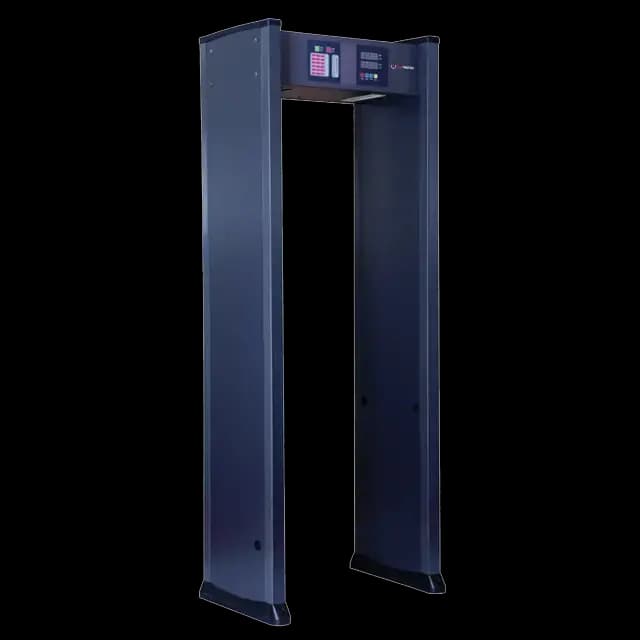
A DFMD is also called a walk-through metal detector or an archway metal detector. It is the screening device people pass through at airports, metro stations, courts, stadiums and government buildings — a person walks through at a normal pace, without stopping, and the system either stays silent or alarms.
It is worth being precise about what it does: a DFMD detects metal. It does not detect weapons as such, and it cannot identify what an object is. It reports that a conductive metallic mass of a certain size passed through, and roughly where on the body it was. Deciding what that means is the operator's job, which is why a DFMD is always part of a screening procedure rather than a device left to work alone.
How Does a Door Frame Metal Detector Work?
A DFMD works by generating an alternating electromagnetic field across the archway from transmitter coils on one side. When a person carrying metal walks through, the changing field induces circulating eddy currents within the conductive object. Those eddy currents generate their own opposing secondary field. Receiver coils on the opposite panel detect this secondary field as a disturbance in the expected signal. The control unit analyses the strength of the disturbance and which coil pairs registered it, then alarms if the signal exceeds the configured sensitivity threshold, lighting the zone indicator corresponding to that height on the body.
The entire detection happens in the fraction of a second the person takes to pass through the archway.
The Detection Principle: Electromagnetic Induction
How the transmit and receive coils interact
Inside the two vertical panels of the archway are coils of wire. One panel carries transmitter coils driven with an alternating current, producing a magnetic field that fills the opening. The opposite panel carries receiver coils, positioned to sense that field.
With nothing in the archway, the receivers see a stable, known signal. The control electronics treat this as the baseline. Detection is not the measurement of a field — it is the measurement of a departure from the expected field.
Why metal disturbs the field
When a conductive object enters a changing magnetic field, the field induces circulating currents inside it. These are eddy currents, and they arise because a changing magnetic field induces a voltage in any conductor, which in a solid object drives current in closed loops.
Those eddy currents in turn generate their own magnetic field, oriented to oppose the change that created it. The receiver coils see the sum of the original field and this secondary field — a perturbation the control unit detects and measures.
The size of the disturbance depends on the object's conductivity, its size and shape, its orientation as it passes through, and its distance from the coils. This is why the same object can produce a slightly different response on two passes: a metal item lying flat presents a different loop area to the field than the same item held edge-on.
Ferrous vs non-ferrous detection
Two distinct effects allow a detector to respond to different metals:
- Ferrous metals — iron and steel are ferromagnetic. They concentrate and distort the magnetic field in addition to supporting eddy currents, so they generally produce a strong response.
- Non-ferrous metals — aluminium, copper, brass and stainless steel are not ferromagnetic but are good conductors, so they support eddy currents well and are detected through that effect.
Because the two produce differently characterised signals, the control unit's signal processing can, to a degree, distinguish between them. This is the basis of the discrimination settings discussed below — it is what allows a detector to be set to respond to a weapon-sized ferrous mass while ignoring a small non-ferrous item such as a coin.
Main Components of a DFMD
| Component | Function |
|---|---|
| Transmitter panel | One side column containing the transmit coils that generate the electromagnetic field across the opening. |
| Receiver panel | The opposite column containing receive coils that sense disturbance in that field. In multi-zone units, coil pairs are stacked vertically along the panel height. |
| Control unit | The processing head, usually mounted on the crossbar. Drives the transmitters, digitises receiver signals, runs the detection algorithm, applies sensitivity settings and triggers alarms. |
| Zone indicator bar | A vertical LED bar on one or both panels showing which detection zone alarmed, so the operator knows roughly where on the body to search. |
| Audio-visual alarm | Tone and lamp indicating a detection. Volume and tone are usually adjustable for the acoustic environment. |
| Counters | Traffic count and alarm count, used to measure throughput and monitor the alarm rate — a rising alarm rate usually means the sensitivity needs review. |
| Control panel or remote | Interface for selecting sensitivity programs, adjusting zone-wise sensitivity and setting operating parameters, usually password-protected. |
| Power supply | Mains input with conditioning. Battery backup is available on many units so screening continues through a power cut. |
| Frame and side panels | The physical archway. Construction material and finish matter for durability in high-traffic or outdoor-adjacent locations. |
How Does a DFMD Work Step by Step?
| Step | What happens | How it works |
|---|---|---|
| 1 | System establishes its baseline | On power-up and continuously thereafter, the control unit measures the received signal with the archway empty and treats this as the reference state. |
| 2 | Field is generated across the opening | Transmit coils are driven with alternating current, producing an electromagnetic field filling the archway. |
| 3 | Person walks through | Screening is designed for normal walking pace. Stopping inside the archway or walking through unusually slowly can affect the response. |
| 4 | Eddy currents are induced in any metal | The changing field induces circulating currents within conductive objects carried on the body. |
| 5 | A secondary field is produced | Those eddy currents generate their own magnetic field, opposing the original. |
| 6 | Receiver coils register the disturbance | The received signal departs from the baseline. Each coil pair along the panel height reports independently. |
| 7 | Signal is processed and characterised | The control unit filters noise, measures signal amplitude and characteristics, and assesses whether the response indicates ferrous or non-ferrous material. |
| 8 | Threshold comparison | The processed signal is compared against the sensitivity threshold for the active program. Below threshold, nothing happens; above it, an alarm is raised. |
| 9 | Zone is identified | The control unit determines which coil pairs responded most strongly and lights the corresponding LEDs on the zone bar, indicating the approximate height of the metal on the body. |
| 10 | Alarm is presented to the operator | Audible tone and visual indication. Many units vary the tone or display an intensity reading to suggest the size of the detected mass. |
| 11 | Counters update | Traffic and alarm counts increment, building the data used to monitor throughput and alarm rate. |
| 12 | Secondary screening if required | On alarm, the operator conducts a targeted check — commonly with a handheld detector, guided to the indicated zone. |
What Are Detection Zones in a Metal Detector?
This is the specification most often misunderstood, so it is worth explaining properly.
A detection zone is an independently monitored horizontal band of the archway's height. Each zone has its own transmit and receive coil pairing and its own signal processing. A 6-zone detector divides the person's height into six bands; an 18-zone into eighteen; a 33-zone into thirty-three.
Two things follow from this, and only the first is obvious:
- Localisation improves with zone count. More zones means the alarm indicates the position of the metal more precisely. On a 6-zone unit, an alarm might tell the operator "somewhere around the torso". On a 33-zone unit, it narrows to a much tighter band, so the secondary search is faster and more targeted.
- Zone-wise sensitivity becomes possible. Each zone can be tuned independently. This matters more than localisation in practice: the ankle zone can be set less sensitively to reduce alarms from steel toe-caps and shoe shanks, while the torso and waist zones stay at full sensitivity. Uniform sensitivity across the whole height is what generates high nuisance alarm rates.
| Zone count | Localisation | Typical application context |
|---|---|---|
| Single zone | Presence only — no indication of where | Basic entry screening where any alarm triggers a full manual check |
| 6 to 12 zones | Broad body regions | Offices, institutions, commercial premises with moderate throughput |
| 18 zones | Reasonably specific band on the body | Malls, hotels, larger commercial and public buildings |
| 33 zones | Narrow, precise band | Airports, government buildings, courts, high-security and high-throughput sites |
| 60 zones | Very fine localisation, both sides differentiated on some models | Critical infrastructure and installations with the most demanding screening requirements |
Higher zone counts are not automatically the right answer. The decision should follow from throughput, the threat profile and how much secondary screening capacity exists at that entrance. A site that can only ever conduct a full handheld search on alarm gains less from fine localisation than a site running a fast, targeted secondary check.
Sensitivity, Discrimination and False Alarms
Every walk-through detector operates on a trade-off that cannot be eliminated, only managed.
Raise sensitivity, and the detector responds to smaller metallic masses — improving the chance of catching a small threat item, but also alarming on keys, coins, belt buckles, watches, phones, underwired garments and shoe shanks. Each of those alarms consumes operator time and slows the queue.
Lower sensitivity, and nuisance alarms fall away, but so does the response to genuinely small items.
Detectors manage this in three ways:
- Sensitivity programs — preset configurations for different operating contexts, switched as required rather than retuned each time.
- Zone-wise sensitivity — different thresholds by body region, as described above. The single most effective tool for reducing nuisance alarms without weakening overall detection.
- Discrimination — using the differing signal characteristics of ferrous and non-ferrous material to respond selectively, so a detector can be set to react to a weapon-sized ferrous mass while ignoring small non-ferrous personal items.
In practice, most sites also run a divestment procedure — asking people to place phones, keys and belts in a tray before walking through. This raises effective screening quality more than any setting change, because it removes the commonest alarm sources from the equation.
The right configuration depends on the site's threat assessment, its throughput requirement and its secondary screening capacity. It is a security decision, and it should be reviewed rather than set once at installation.
Technologies Used in a DFMD
- Electromagnetic induction — the core detection principle, sensing eddy currents induced in conductive material.
- Continuous wave or pulse induction transmission — different drive schemes with different characteristics; the choice affects noise immunity and discrimination behaviour.
- Multi-coil zone architecture — vertically stacked transmit and receive coil pairs, each independently processed.
- Digital signal processing — filtering environmental noise, characterising signal shape, and distinguishing genuine detections from interference.
- Adaptive baseline tracking — continuous recalibration so slow environmental drift does not accumulate into false alarms.
- Transmitter synchronisation — allowing adjacent units to operate close together without interfering with one another.
- Networked monitoring — on some models, remote configuration and alarm logging over a network interface.
Where Door Frame Metal Detectors Are Used
- Airports and aviation — passenger screening alongside X-ray baggage scanners as part of a layered checkpoint.
- Metro and railway stations — high-throughput public screening in Delhi, Mumbai, Bengaluru, Hyderabad, Chennai and Kolkata.
- Government buildings and courts — controlled entry screening, including at state secretariats and district courts across Assam, Meghalaya and Tripura where public buildings serve dispersed populations.
- Stadiums and event venues — large crowd screening with a strong throughput requirement.
- Malls, hotels and commercial complexes — visible entrance screening that must remain unobtrusive to guests.
- Industrial plants and mines — often in reverse, screening people leaving to deter theft of metal components or tools. Common in the mining and metals belts of Jharkhand, Odisha and Chhattisgarh.
- Educational institutions — examination halls and campus entrances.
- Religious and heritage sites — pilgrimage locations with very high seasonal footfall, including sites across Uttarakhand, Himachal Pradesh and Sikkim.
- Prisons and correctional facilities — visitor and staff screening at controlled entry points.

TimeWatch India supplies, installs and maintains door frame metal detectors and associated inspection equipment nationwide, including at sites in Jaipur, Lucknow, Chandigarh, Bhubaneswar, Guwahati, Indore, Pune and Ahmedabad.
Integration With Other Security Systems
A DFMD is one layer in a checkpoint rather than a complete solution. Typical integrations:
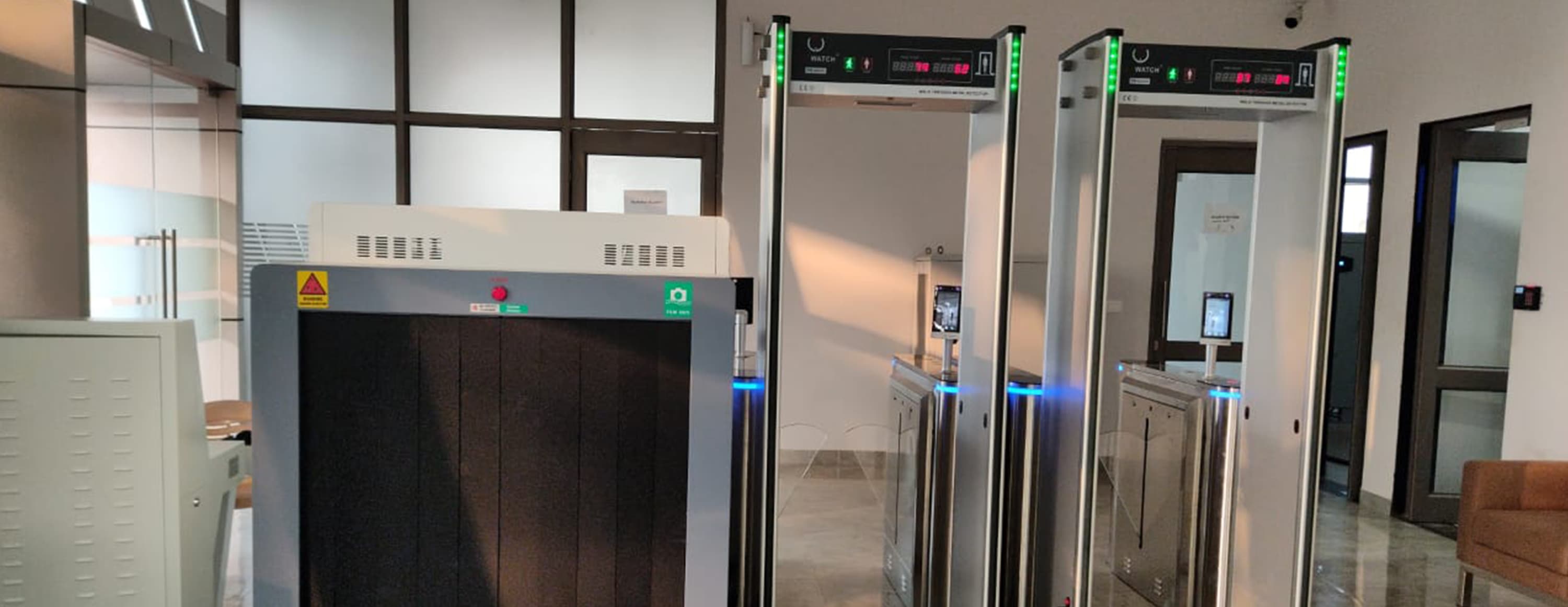
- X-ray baggage scanners — the person walks through the archway while their bags pass through the scanner alongside. The two together cover both carried items and items on the body.
- Handheld metal detectors — the standard secondary screening tool, used to resolve an archway alarm at the indicated zone.
- CCTV — cameras covering the lane so any alarm event can be reviewed against footage afterwards.
- Turnstiles and entrance control — physically preventing progress until screening is completed, so an alarmed person cannot simply walk on.
- Access control — combining credential verification with screening at the same checkpoint.
- Visitor management — registering the visitor and recording that screening took place as part of the entry record.
- Central monitoring — alarm and throughput data collected across multiple lanes for operational oversight.
Installation Considerations
A DFMD is more sensitive to its installation environment than most security equipment, because it is detecting small disturbances in a magnetic field — and the environment is full of metal.
- Distance from large metal masses — steel shutters, lift shafts, structural columns and metal doors near the archway can affect the field. Moving metal nearby is worse than static metal, because static metal can be calibrated out while moving metal cannot.
- Reinforced concrete floors — rebar beneath the unit influences the field. The detector is calibrated in position to account for it, which is why a unit must be recalibrated if it is relocated.
- Spacing between adjacent units — two archways too close together will interfere. Where multiple lanes are needed, units must either be spaced per the manufacturer's guidance or synchronised so their transmitters do not conflict.
- Electrical interference — variable-frequency drives, large motors, fluorescent lighting and poor-quality power can all inject noise. A stable, well-earthed supply is worth arranging properly.
- Level floor and rigid mounting — panels must remain parallel and stable. Flexing panels cause erratic behaviour.
- Queue and divestment layout — space for a divestment tray before the archway and for secondary screening after it. Without it, an alarm blocks the whole lane.
- Environmental protection — units at semi-open entrances need appropriate protection from rain and dust.
Maintenance and Operational Testing
Unlike most equipment, a metal detector can fail in a way that is invisible — it keeps running, passes everyone, and alarms on nothing. Routine operational testing is what catches this.
- Operational test piece checks — pass a standard test object through the archway at the start of each shift, at several heights, and confirm the unit alarms in the correct zone. This is the single most important maintenance task and takes under a minute.
- Zone-by-zone verification — confirm every zone responds, not just the middle ones. A dead coil pair is otherwise undetectable in normal use.
- Settings audit — verify sensitivity settings have not been altered informally. Sensitivity quietly reduced to stop nuisance alarms is a common and serious failure mode.
- Panel alignment and mounting — check panels remain parallel and fixings tight.
- Alarm rate review — a rising alarm count relative to traffic count usually signals an environmental change or a settings drift worth investigating.
- Cable and connector inspection — particularly the interconnect between panels and control unit.
- Battery backup testing — confirm the unit continues through a power interruption if that is the expectation.
Benefits and Limitations
Benefits
- Screens people at walking pace, so throughput stays high at busy entrances.
- Non-contact — no physical search required unless the unit alarms.
- Zone indication directs secondary screening to the right part of the body, shortening each check.
- Consistent — applies the same threshold to every person, without fatigue or judgement variation.
- Visible deterrent at the entrance, independent of what it detects.
- Traffic and alarm counters give measurable operational data.
Limitations and considerations
- It detects metal, not threats. Non-metallic weapons — ceramic and composite blades, and most explosive material — will not be detected. Sites with that threat profile need X-ray screening, body scanners or trace detection in addition.
- It cannot identify objects. The unit reports a metallic mass and its approximate location. Everything beyond that is operator judgement.
- Nuisance alarms are inherent to any usable sensitivity setting and are managed through divestment and zone tuning rather than eliminated.
- Environment affects performance — nearby moving metal, electrical noise and adjacent units all matter, and relocation requires recalibration.
- Effectiveness depends on procedure. A detector with no secondary screening behind it, or with sensitivity quietly turned down, provides the appearance of screening rather than screening.
- Specifications vary by model. Zone count, discrimination capability, sensitivity programs and interference handling differ between units and should be confirmed against the datasheet for the specific equipment.
DFMD vs Handheld Detector vs Body Scanner
| Aspect | DFMD (walk-through) | Handheld detector | Body scanner |
|---|---|---|---|
| Detects | Metal only | Metal only | Metallic and non-metallic items concealed on the body, depending on technology |
| Screening speed | Walking pace — high throughput | Slow — manual sweep per person | Slower than an archway; person stands still |
| Localisation | By zone, depending on zone count | Precise — operator-guided | Precise, with image or indicator display |
| Typical role | Primary screening of everyone | Secondary screening after an alarm | Enhanced or selective screening where the threat profile requires it |
| Requires an operator | To respond to alarms | Yes, throughout | Yes, to interpret output |
These are complementary layers, not competing options. A well-designed checkpoint uses an archway for primary screening of everyone, handhelds to resolve alarms, X-ray for carried bags, and body scanners where the threat assessment justifies them.

Are Door Frame Metal Detectors Safe?
Walk-through metal detectors operate using low-intensity electromagnetic fields. They do not use X-rays or any ionising radiation — that distinction separates them from X-ray baggage scanners, which screen bags rather than people, and from certain body scanner technologies.
The general guidance published by detector manufacturers is that walk-through units are safe for the public, including pregnant women. People with implanted medical devices such as pacemakers or implantable defibrillators are commonly advised to inform screening staff so that an alternative screening method can be used, and anyone with a specific medical concern should follow their doctor's advice and the guidance supplied with their device. Where an organisation needs a formal position for its own screening policy, it should refer to the manufacturer's documentation for the specific equipment installed.
Frequently Asked Questions
How does a walk-through metal detector detect metal?
It generates an alternating electromagnetic field across the archway using transmitter coils. When metal passes through, the changing field induces circulating eddy currents inside the conductive object, and those currents produce a secondary magnetic field. Receiver coils on the opposite panel sense this disturbance, and the control unit alarms if it exceeds the configured sensitivity threshold.
What does 18-zone or 33-zone mean in a metal detector?
A zone is an independently monitored horizontal band of the archway's height, each with its own coil pairing and processing. An 18-zone detector divides the body height into eighteen such bands, a 33-zone into thirty-three. More zones means the alarm indicates the position of the metal more precisely, and — often more useful in practice — each zone's sensitivity can be tuned separately, so the ankle region can be relaxed to reduce alarms from footwear while the torso stays fully sensitive.
Is a higher zone count always better?
Not automatically. Higher zone counts give finer localisation and more tuning control, which suits high-throughput and high-security sites. But the benefit is only realised if the site has the secondary screening capacity to act on precise localisation. A site that conducts a full manual check on every alarm gains less from 33 zones than one running fast targeted checks. Zone count should follow from throughput, threat profile and operating procedure.
Can a door frame metal detector detect a mobile phone?
Yes, at normal operating sensitivity. A phone contains enough conductive material to produce a clear response. This is precisely why most screening points ask people to place phones in a tray before walking through — removing the commonest alarm sources keeps the queue moving and stops operators becoming desensitised to routine alarms.
Why does a metal detector beep for keys and belt buckles?
Because it detects conductive metal mass, not weapons specifically. Keys, coins, belt buckles, watches, underwired garments and steel shoe shanks all present enough metal to cross the alarm threshold at usable sensitivity settings. Sites manage this through a divestment procedure and by reducing sensitivity in the zones covering feet and ankles rather than by lowering sensitivity overall.
Can a metal detector detect non-metallic weapons?
No. A DFMD works by detecting conductive metal, so ceramic or composite blades and most explosive materials will not be detected. Where that threat profile applies, walk-through screening must be supplemented with X-ray baggage screening, body scanners or trace detection equipment.
Are door frame metal detectors safe for pregnant women?
Walk-through metal detectors use low-intensity electromagnetic fields and do not emit X-rays or ionising radiation. Manufacturer guidance generally indicates they are safe for the public including pregnant women. People with pacemakers or other implanted medical devices are commonly advised to inform screening staff so an alternative method can be used, and anyone with a specific medical concern should follow their doctor's advice and the documentation supplied with their device.
What is the difference between a DFMD and a handheld metal detector?
A DFMD is an archway that screens everyone at walking pace, giving high throughput and indicating which zone of the body the metal is in. A handheld detector is swept manually over one person at a time, giving precise localisation but far lower throughput. They are used together: the archway screens everyone, and the handheld resolves each alarm at the indicated zone.
Why does a metal detector need to be recalibrated when it is moved?
Because it is calibrated against its surroundings. Reinforced concrete, structural steel, nearby shutters and electrical equipment all influence the field, and the unit's baseline accounts for the environment where it was set up. Moving it to a new location changes those conditions, so recalibration in position is required for it to work correctly.
How do you check a door frame metal detector is working?
Pass a standard operational test piece through the archway at several heights and confirm the unit alarms and indicates the correct zone each time. This should be done at the start of each shift. It is the only reliable way to detect the most dangerous failure mode — a detector that appears to be running normally but has a dead zone or sensitivity that has been quietly reduced.
Can two metal detectors be installed next to each other?
Yes, but not without planning. Two archways placed too close will interfere because each one's transmitted field affects the other's receivers. They must either be separated by the distance the manufacturer specifies, or electronically synchronised so their transmitters operate in a coordinated sequence rather than conflicting.
