
What Is a Security Body Scanner?
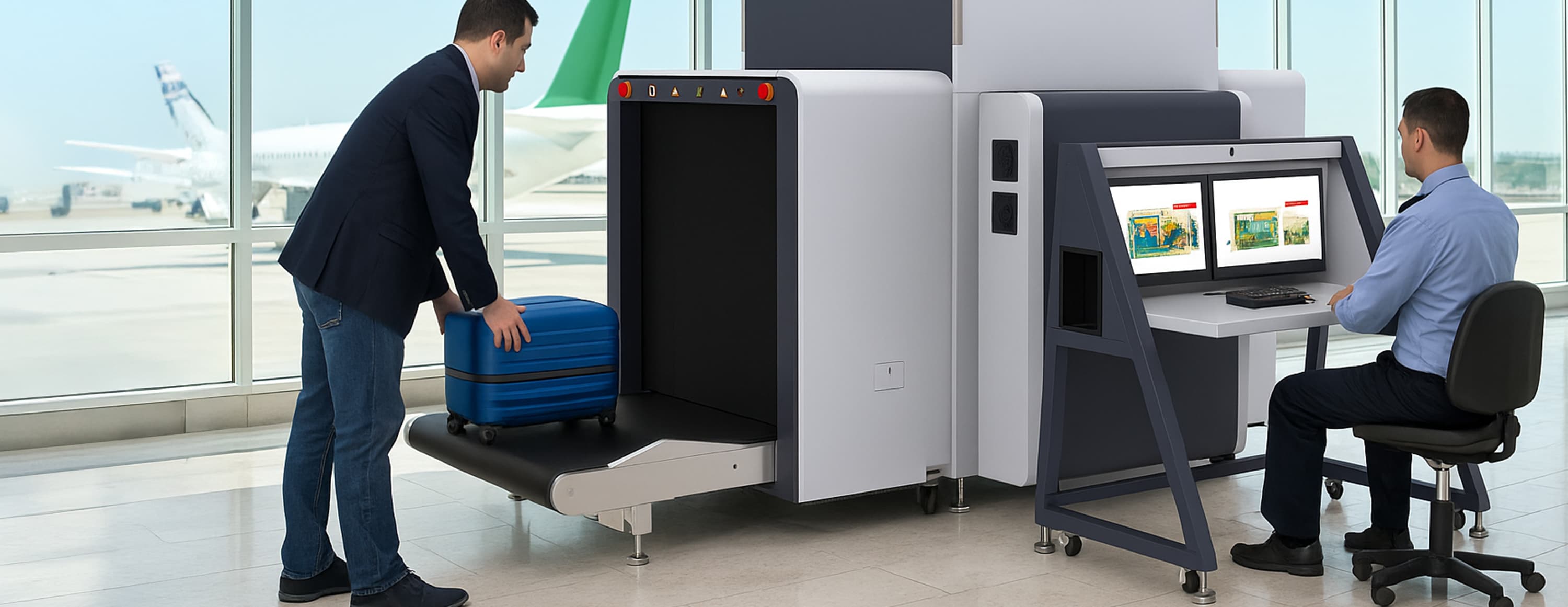
It is also called a full body scanner or a passenger screening portal. It sits at the same checkpoint as a door frame metal detector and an X-ray baggage scanner, but answers a different question. The archway answers "is there metal on this person?" The body scanner answers "is there anything on this person's body that does not look like a body?"
That shift is the point of the technology. An archway is blind to a ceramic blade, a packed powder or a moulded composite object, because none is conductive metal. A body scanner responds to the shape of what is present rather than its conductivity, which is why it can indicate items the archway cannot.
How Does a Body Scanner Work?
An active millimetre wave body scanner works by transmitting low-power, non-ionising radio energy in the millimetre wavelength band towards the person standing in the portal. Clothing is largely transparent at these wavelengths, so the energy passes through fabric and reflects off the skin and off any object between the skin and the clothing. Receiver antennas capture those reflections as the array sweeps around the body or steers electronically across it. A signal processing unit reconstructs a three-dimensional representation of the body surface from the timing and strength of the returns. Automatic target recognition software then analyses that reconstruction for regions that depart from the expected body contour, and displays a generic outline with a marker over any flagged region so the operator can resolve it directly.
The scan itself takes a few seconds. The person stands still in a defined pose throughout.
The Two Body Scanner Technologies
Two physically different approaches have been used for people screening. They are often discussed together, which causes confusion — particularly around radiation, where they are not comparable at all.
Active millimetre wave
This is the dominant technology for passenger screening. An antenna array transmits radio energy in the millimetre band at low power. The wavelength is short enough to resolve objects of a useful size, and long enough that clothing is largely transparent to it. The energy reflects from the skin, and differently from materials sitting against or near it.
By capturing reflections from many positions around the body — by rotating an array around the person, or by switching electronically between many fixed antenna elements — the system builds returns from which a three-dimensional surface can be reconstructed. Millimetre wave energy of this kind is non-ionising. It does not use X-rays.
Passive millimetre wave
A passive system transmits nothing. It detects millimetre wave energy naturally emitted and reflected by the body and its surroundings, in the same general sense that a thermal camera detects emitted infrared. An object concealed under clothing alters the emission pattern reaching the sensor, and the system detects that alteration.
Because passive systems emit nothing, they sidestep the transmission question entirely, and some work at a stand-off distance rather than requiring a portal. Performance differs from active systems and is equipment-specific, so capability should be taken from the datasheet.
Backscatter X-ray
Backscatter systems direct a low-dose X-ray beam at the body and detect the X-rays scattered back from it rather than those transmitted through it, which is what produces a surface representation rather than a medical-style internal one.
The critical point for anyone specifying equipment is that backscatter uses ionising radiation and millimetre wave does not. Backscatter systems have been withdrawn or restricted for passenger screening in a number of jurisdictions on radiation and privacy grounds, and are now far less common than millimetre wave for screening people. Anyone evaluating one must establish the applicable regulatory position in their jurisdiction before going further.
What Is Automatic Target Recognition (ATR)?
Automatic target recognition is the feature that made this technology deployable in public, and it is the most misunderstood aspect of body scanning.
In an ATR system, the reconstructed three-dimensional data is never displayed to the operator. Detection algorithms analyse it for regions departing from an expected body contour, and the operator's screen shows a generic outline or avatar — the same stylised figure for every person screened, carrying no individual physical detail — with a box over the region where an anomaly was found. If nothing is flagged, the screen shows a clear result.
The significance is easy to miss. The detection physics did not change when ATR was introduced; the scanner senses what it sensed before. What changed was how the output is presented — and that is what made the technology acceptable for public screening. Before generic-avatar display, the privacy objection was severe enough to block deployment in several places and force removal of installed equipment in others. ATR did not answer the objection by arguing with it; it removed the thing being objected to.
Anyone specifying a body scanner should treat ATR-only display as a baseline requirement, and confirm the equipment has no operator-accessible mode showing anything other than the generic avatar.
Main Components of a Body Scanner
| Component | Function |
|---|---|
| Portal or panel assembly | The physical structure the person stands within or beside. Defines the scan volume and the standing position. |
| Transmitter antenna array | Emits the millimetre wave energy towards the body. Absent in a passive system, which transmits nothing. |
| Receiver antenna array | Captures reflected or emitted energy. On many designs the transmit and receive elements are combined into transceiver modules. |
| Scanning mechanism or electronic steering | Moves the array around the body, or switches electronically between many fixed elements to achieve the same angular coverage without moving parts. |
| Signal processing unit | Digitises the returns and reconstructs the three-dimensional representation of the body surface. |
| ATR software | Analyses the reconstruction for anomalies and decides what to flag. The detection performance of the whole system is largely determined here. |
| Operator display | Shows the generic avatar with flagged regions, or a clear indication. Positioned so waiting passengers cannot read it. |
| Control interface | Operator controls for initiating the scan, recording the resolution outcome and managing operating modes. Configuration access is password-protected. |
| Passenger guidance indicators | Lights, floor markings or footprints and on-screen prompts showing where to stand and what pose to adopt. These matter more for throughput than their simplicity suggests. |
| Power supply and conditioning | Mains input with conditioning; backup arrangements depend on the site's continuity requirement. |
How Does a Body Scanner Work Step by Step?
| Step | What happens | How it works |
|---|---|---|
| 1 | Person divests metal and pocket contents | Coins, keys, phones, belts and similar items are removed. Items left in pockets are the commonest cause of an avoidable anomaly flag. |
| 2 | Person enters the portal and stops | Unlike an archway, the scan requires the person to stand still within a defined position, usually marked on the floor. |
| 3 | Required pose is adopted | Typically arms raised and slightly away from the body, so the arms do not shadow the torso and sides from the array. |
| 4 | Scan is initiated | The operator or an automatic sequence starts the scan once the person is correctly positioned. |
| 5 | Energy is transmitted towards the body | The array emits low-power millimetre wave energy. Clothing is largely transparent at these wavelengths, so the energy reaches the skin. A passive system omits this step and senses naturally emitted energy instead. |
| 6 | Reflections are produced | Energy reflects from the skin surface and from any object between the skin and the clothing, with characteristics that depend on the object's material and shape. |
| 7 | Array sweeps the body | The array rotates around the person or steers electronically, so reflections are captured from many angles rather than one. |
| 8 | Returns are captured and digitised | Receiver antennas collect the reflections; the signal processing unit converts them into data with position and intensity information. |
| 9 | Three-dimensional reconstruction | The processing unit assembles the returns into a representation of the body surface and anything sitting on it. |
| 10 | ATR analyses for anomalies | Detection algorithms compare the reconstruction against expected body contour and flag regions that depart from it. |
| 11 | Generic avatar is displayed | The operator sees a standard outline figure with a box over each flagged region — or a clear result. No body image is displayed at any point. |
| 12 | Targeted resolution or release | If a region is flagged, the operator resolves it at that location only, commonly with a handheld detector or a localised physical check. If nothing is flagged, the person proceeds. |
What a Body Scanner Can and Cannot Detect
The advantage of a body scanner over an archway is that it is not limited to conductive metal. Because it responds to what is physically present between the skin and the clothing, it can indicate anomalies that are metallic and non-metallic — and the non-metallic case is where a walk-through detector has nothing to offer.
Two limits need stating just as plainly. First, the system detects anomalies, not threats: it flags a region that does not look like body surface, and what is actually there is established by the operator at the resolution stage, not by the machine. No screening device of this type identifies a specific object with certainty, and tender wording implying otherwise should be corrected.
Second, it screens the body surface, not the body's interior and not carried bags. Items inside baggage are the job of the X-ray scanner on the adjacent belt. Neither substitutes for the other.
Throughput: Why Body Scanners Are Rarely Primary Screening
This is the operational reality most specifications underestimate, and it drives checkpoint design more than any detection specification does.
A walk-through metal detector screens a person at walking pace; nobody stops. A body scanner requires the person to stop, step into a marked position, adopt a pose, hold it while the scan completes, then step out and wait for the result. That is several times longer per person than an archway pass — and pose compliance is hard to achieve consistently across a mixed public queue, in several languages, with luggage and children in the picture.
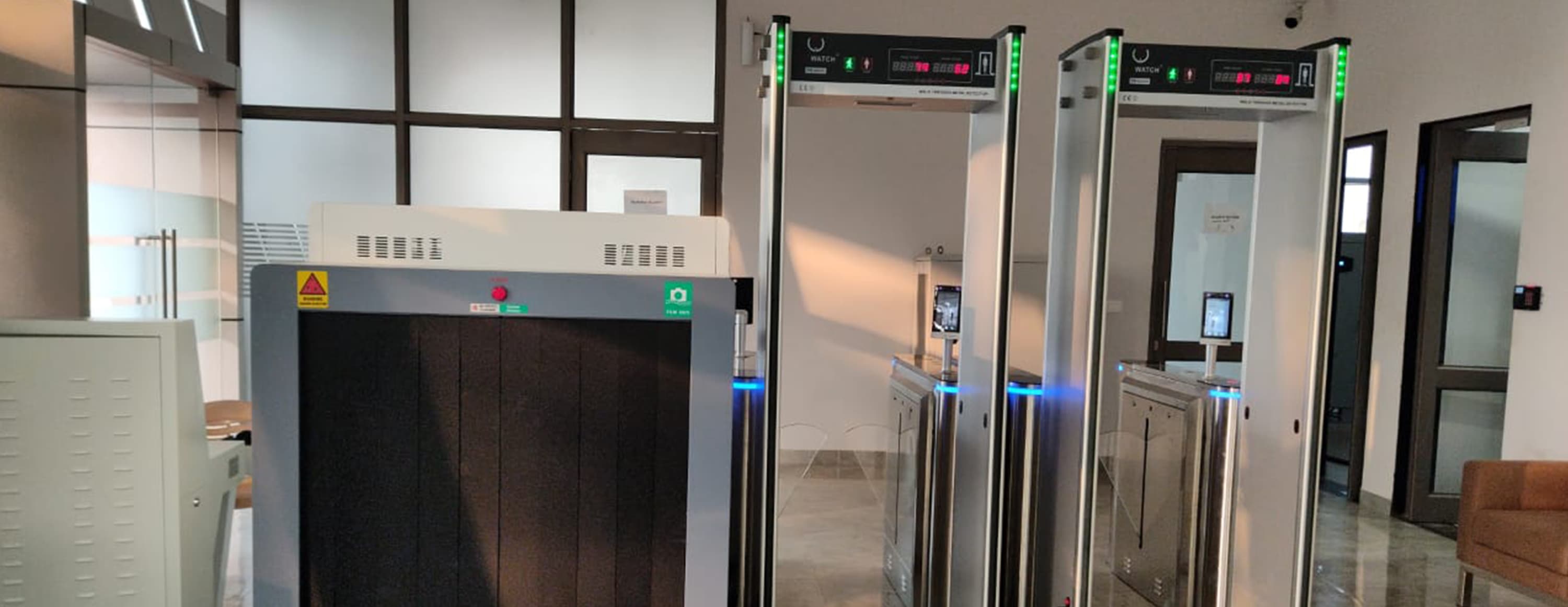
So a body scanner is almost never primary screening for everyone. It is used as selective or secondary screening: everyone passes the archway, and a proportion — those who alarm, those selected under a defined procedure, or those in a specific screening category — are directed to the scanner. A checkpoint trying to put every passenger through one will either need a great many scanners or produce a queue that becomes its own problem.
Nuisance Alarms and Anomaly Resolution
Body scanners flag ordinary things constantly, and operators who do not expect this lose confidence in the equipment quickly.
Common sources of a flagged anomaly include thick clothing folds and bunched fabric at the waist or shoulders, heavy seams, sweat, bandages, prosthetics, orthopaedic supports, insulin pumps and other worn medical devices, and items left in a pocket. None is a threat. All can legitimately produce a region that does not match an expected body contour, because none of them is body contour.
The operational rules follow directly. Anomaly does not mean threat, and staff should be trained to say so plainly to the person being screened. Resolution should be targeted at the flagged region rather than expanded into a general search. People with worn medical devices or prosthetics should be able to declare them beforehand, with a defined and dignified procedure for that conversation. And the flagged-anomaly rate should be monitored: a rate drifting upwards usually points at a divestment procedure that has quietly stopped being enforced.
Where Body Scanners Are Used
- Airports — the principal application, used for selected passengers alongside archways and baggage X-ray. Relevant at the international gateways serving Maharashtra, the Delhi region, Karnataka, Telangana, West Bengal and Tamil Nadu.
- Government and high-security buildings — controlled entry where the threat assessment extends beyond metallic items.
- Prisons and correctional facilities — visitor and inmate screening, where non-metallic contraband is the central concern.
- Courts, critical infrastructure and defence establishments — enhanced screening at designated entrances, or where a defined screening category exists for personnel and visitors.
- High-value manufacturing sites — exit screening against theft of small high-value material, including electronics and precious-metal operations of the kind found around Bengaluru, Hyderabad and Kochi.
- Major events and venues — as a secondary screening position rather than a lane everyone passes through.
Deployments in Delhi, Mumbai, Bengaluru, Hyderabad, Chennai, Kolkata and Kochi share one design pattern regardless of sector: the scanner sits behind the archway, not in front of it. TimeWatch India works with organisations across Kerala and the other southern and western states on checkpoint layout and on the inspection and screening equipment surrounding the scanning position, since a scanner's usefulness depends on what is in the lane before and after it.
Integration With Other Screening Layers
A body scanner is a layer, not a checkpoint. In practice it is deployed with:
- Walk-through metal detectors — the primary screening line. Everyone passes the archway; a proportion is directed to the scanner. Understanding how a door frame metal detector works makes the division of labour clearer.
- X-ray baggage scanners — carried bags and trays run on the parallel belt. The body scanner has nothing to say about bag contents.
- Handheld metal detectors — used to resolve a flagged region, particularly where the anomaly is likely to be metallic.
- Trace detection equipment — where the threat assessment includes explosive residue, swab-based trace detection covers ground neither the archway nor the scanner does.
- CCTV — coverage of the screening position for incident review, positioned so operator displays are not in shot.
- Queue and lane management — barriers, divestment tables and a defined hold area, without which a flagged anomaly stalls the lane.
- Checkpoint-wide design — how these layers fit together is the subject of a complete airport security solution, where the scanner is one position among several.
Installation and Operational Considerations
- Floor area and standing position — the portal needs clear space and a defined approach, exit and hold area. Scanners are frequently forced into a footprint planned for an archway, which does not work.
- Operator display placement — the screen must not be visible to the queue or to passers-by. A layout requirement, not a preference.
- Environmental conditions — temperature, humidity and dust limits are specified per model and matter more here than for an archway.
- Interference and separation — clearances from other equipment and reflective structures follow the manufacturer's installation guidance.
- Regulatory position — applicable approvals, radio emission requirements and, for any X-ray-based equipment, radiation regulatory requirements must be confirmed for the jurisdiction and the specific equipment before installation.
- Operator training — pose instruction, anomaly resolution and handling of declared medical devices. Weak training shows up immediately as low throughput.
- Routine functional checks — a defined test procedure per the manufacturer's documentation, run and recorded on a schedule. A scanner producing no flags is not necessarily one with nothing to flag.
- Privacy governance — a documented position on display mode, data retention and operator access.
Body Scanner vs DFMD vs Handheld Detector
| Aspect | Walk-through metal detector (DFMD) | Millimetre wave body scanner | Handheld metal detector |
|---|---|---|---|
| What it detects | Conductive metal on or carried by the person | Surface anomalies under clothing, metallic and non-metallic | Conductive metal, at close range |
| Radiation type | Low-intensity electromagnetic field; non-ionising, no X-rays | Low-power millimetre wave; non-ionising, no X-rays. Backscatter X-ray systems, by contrast, use ionising radiation | Low-intensity electromagnetic field; non-ionising |
| Throughput | High — walking pace, no stopping | Low — person stops, poses and waits for the scan and result | Low — manual sweep of one person at a time |
| Privacy handling | No imaging of any kind; an audible alarm and a zone indicator | ATR generic avatar with flagged regions; no body image shown to the operator | No imaging; audible and tactile response |
| Typical checkpoint role | Primary screening of everyone | Selective or secondary screening of a proportion of people | Resolution of an alarm or flagged region |
These are complementary layers. Each covers something the others cannot: the archway gives throughput, the scanner reaches non-metallic items, and the handheld resolves precisely where the other two only indicate. Adding a body scanner does not remove the need for the archway or the baggage scanner.
Body Scanner Safety: Radiation and Privacy
These two questions account for most of the public interest in this technology, and both deserve a precise answer rather than a reassuring one.
Radiation
Millimetre wave scanners transmit non-ionising radio frequency energy at low power. They do not use X-rays and do not emit ionising radiation. Backscatter X-ray systems are a different technology and do use ionising radiation — which is precisely why their use for passenger screening has been restricted or withdrawn in several jurisdictions. Treating the two as one category is the commonest error in discussions of body scanner safety.
Manufacturers publish safety positions for their specific equipment, and national regulators publish guidance on the technologies permitted in their jurisdiction. Those two sources, not a general article, are what an organisation should rely on. Any organisation deploying a body scanner must confirm the applicable regulatory position for its own jurisdiction and equipment type, and keep that documentation available.
Anyone with a specific medical concern, an implanted device such as a pacemaker or defibrillator, an insulin pump, or a condition affected by screening should inform screening staff before the scan and follow their doctor's advice and the guidance supplied with their device. Screening procedures ordinarily provide an alternative method, and staff should be trained to offer it without the person having to argue for it.
Privacy
On a system operating with automatic target recognition, the operator does not see an image of the person's body. The display shows a generic outline identical for every person screened, with a box marking any region flagged for resolution. This is the standard display mode for modern passenger screening equipment, and what an organisation should require in its specification and be able to demonstrate on request.
An organisation operating a scanner should also hold a documented position on which display modes the equipment supports and which are enabled, whether scan data is retained and for how long, who can access the operator position, and what the alternative procedure is for someone who declines. Writing that down before anyone asks is easier than assembling it afterwards.
Frequently Asked Questions
How does an airport body scanner work?
An active millimetre wave scanner transmits low-power, non-ionising radio energy towards the person standing in the portal. Clothing is largely transparent at these wavelengths, so the energy reflects off the skin and off any object concealed underneath. Receiver antennas capture the reflections as the array sweeps around the body, and a processing unit reconstructs a three-dimensional representation of the body surface. Automatic target recognition software analyses that reconstruction for anomalies and displays a generic outline with a box over any flagged region.
Do body scanners use radiation, and are they safe?
Millimetre wave scanners transmit non-ionising radio frequency energy at low power and do not use X-rays or emit ionising radiation. Backscatter X-ray scanners are a different technology and do use ionising radiation, which is why their use in passenger screening has been restricted or withdrawn in several jurisdictions. Safety positions are published by manufacturers for their specific equipment and by national regulators in their guidance, and an organisation deploying a scanner must confirm the applicable regulatory position for its jurisdiction and equipment type. Anyone with a specific medical concern or an implanted device should inform screening staff and follow their doctor's advice.
Do body scanners show an image of your body?
Not on a system operating with automatic target recognition, which is the standard display mode for modern passenger screening equipment. The reconstructed data is analysed by software and never shown to the operator. What the operator sees is a generic outline or avatar that is identical for every person screened, with a box marking any region flagged for resolution, or a clear result if nothing is flagged.
What is automatic target recognition in a body scanner?
Automatic target recognition is the software layer that analyses the scanner's three-dimensional reconstruction for regions that depart from an expected body contour, and presents the result as a generic avatar with flagged regions rather than as an image of the person. It is the reason the technology became acceptable for public screening. The detection physics did not change when ATR was introduced; only the way the output is presented changed.
Can a body scanner detect non-metallic items?
It can indicate anomalies that are non-metallic as well as metallic, and this is the main advantage over a walk-through metal detector, which responds only to conductive metal. What the system actually reports is a region that does not match expected body contour. It does not identify what the object is, and no screening device of this type detects a specific threat with certainty — the operator establishes what is there during targeted resolution.
What is the difference between a body scanner and a metal detector?
A walk-through metal detector uses an electromagnetic field to detect conductive metal, screens people at walking pace and gives high throughput, but it cannot respond to non-metallic items. A body scanner uses millimetre wave energy to examine the body surface under clothing, can indicate metallic and non-metallic anomalies, but requires the person to stop and pose, so throughput is much lower. The archway is used as primary screening for everyone and the scanner as selective or secondary screening.
Why do you have to raise your arms in a body scanner?
The scan captures reflections from the body surface, and arms held down against the sides shadow the torso, the waist and the underarm region from the antenna array. Raising the arms and holding them slightly away from the body gives the array a clear line to those areas. Poor pose compliance is one of the commonest causes of a rescan, which is also why floor markings and clear operator instruction matter to throughput.
Why did the scanner flag an area when I was not carrying anything?
Because the system flags anomalies, not threats. Thick clothing folds, bunched fabric, heavy seams, sweat, bandages, prosthetics, orthopaedic supports, worn medical devices and items left in a pocket can all produce a region that does not match expected body contour. A flagged region means the operator needs to check that location, nothing more, and resolution should be targeted at that area rather than expanded into a general search.
Is backscatter X-ray still used for passenger screening?
It is far less common than millimetre wave for screening people. Backscatter systems use low-dose ionising radiation, and their use in passenger screening has been restricted or withdrawn in several jurisdictions on radiation and privacy grounds. Millimetre wave is the dominant technology for this application. Any organisation considering X-ray-based people screening must establish the applicable regulatory position in its jurisdiction before proceeding.
Can a body scanner replace a metal detector or an X-ray baggage scanner?
No. The three cover different ground. The archway screens everyone quickly for metal, the body scanner examines the body surface of selected people for metallic and non-metallic anomalies, and the X-ray scanner examines the contents of bags, which the body scanner does not see at all. A checkpoint needs all three layers because each covers what the others cannot.
Can I refuse a body scan?
Screening procedures ordinarily provide an alternative screening method, and the operating authority defines what that is at each location. Anyone who does not wish to be scanned, or who has a medical reason to avoid it, should tell screening staff, who should be trained to offer the alternative without the person having to argue for it. An organisation operating a scanner should have its alternative procedure documented and available to anyone who asks.
