
How Does a Boom Barrier Work?
What Is a Boom Barrier?
A boom barrier (also called a barrier gate or boom gate) manages the flow of vehicles at a controlled point: a parking entry, a factory gate, a toll lane, an office campus, a residential society. It is a traffic control device rather than a crash protection device, a distinction that matters when specifying equipment and one we return to at the end of this page.
The arm itself does not physically stop a determined vehicle. What the barrier actually provides is a controlled, auditable decision point: nothing passes until the system has established that it is allowed to, and every passage is logged.
How Does a Boom Barrier Work?
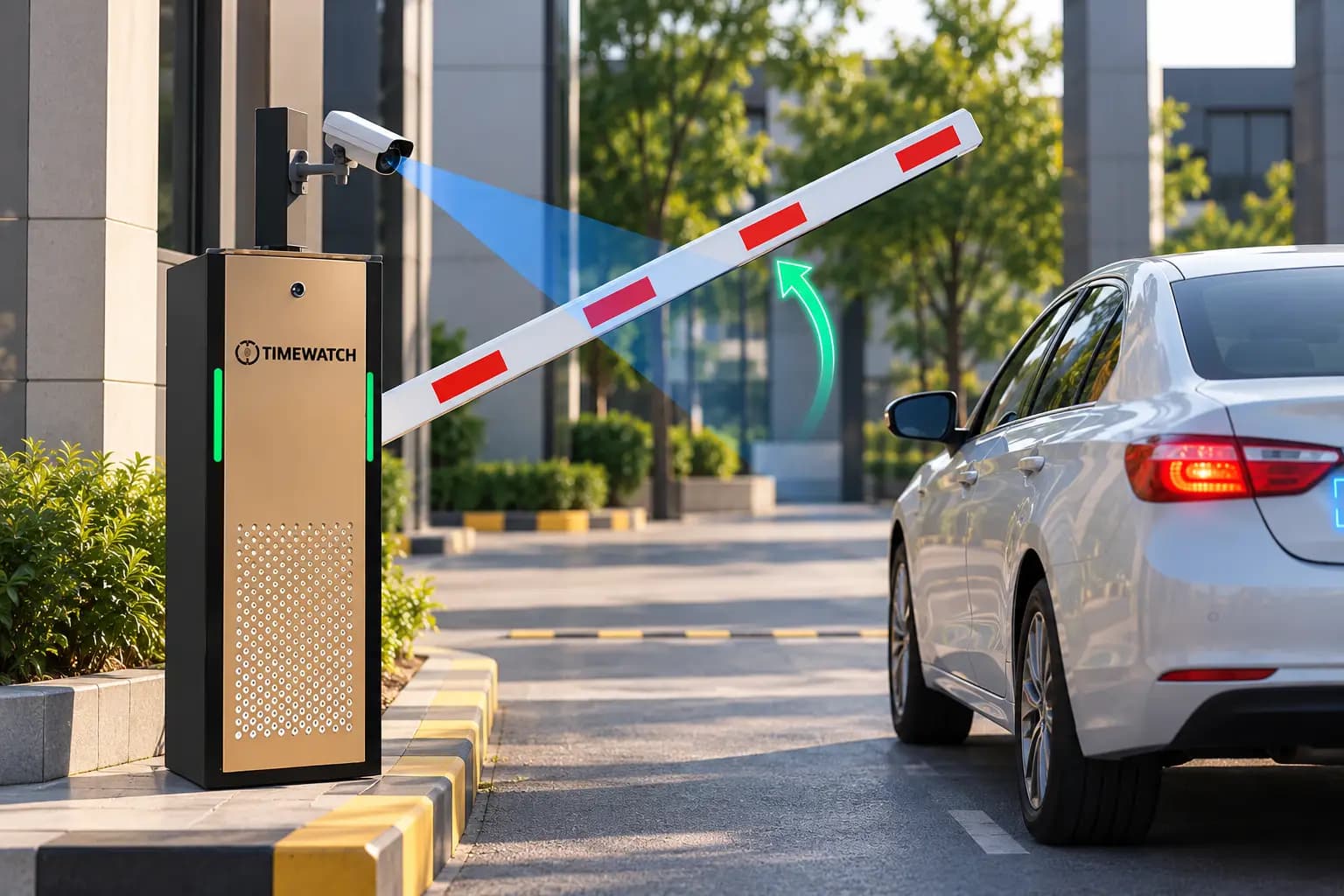
A boom barrier works in four stages. A sensor detects that a vehicle has arrived. An access method authorises it, an RFID tag, a recognised number plate, a ticket, or a guard pressing a button. The controller then drives a motor and gearbox that rotate the boom arm to the vertical position, where a limit switch or encoder stops it. After the vehicle passes, a safety loop or photocell confirms the lane is clear, and the controller lowers the arm.
Everything else on this page is detail beneath those four stages: detect, authorise, drive, confirm and close.
Main Components of a Boom Barrier
| Component | Function |
|---|---|
| Barrier housing (cabinet) | Weather-resistant steel or aluminium enclosure holding the drive assembly, controller and manual release. Usually powder-coated for outdoor life. |
| Drive unit | Electric motor with a gearbox (electromechanical), or a pump and cylinder (hydraulic), providing the torque that turns the arm. |
| Crank and linkage | Converts the drive unit's rotation into the arm's 90-degree sweep. |
| Balance spring | A torsion or tension spring counterbalancing the arm's weight, so the motor moves a near-balanced load rather than lifting the full arm mass. Correct spring tension is central to smooth operation and motor life. |
| Boom arm | Aluminium octagonal, round or rectangular section, typically 3 to 6 metres. Optional skirt fencing, articulated joint for low headroom, or LED strip for night visibility. |
| Controller / control board | The logic of the system. Accepts open, close and safety inputs, drives the motor, manages timers, and communicates with access control or parking software. |
| Limit switches or encoder | Tell the controller when the arm has reached fully open or fully closed so the motor stops at the right point. |
| Loop detector | Electronics that sense a vehicle over a wire loop cut into the road surface. |
| Photocell / infrared beam | An optical beam across the lane that halts or reverses the arm if the path is obstructed. |
| Access control input | RFID reader, ANPR camera, ticket dispenser, push button, remote control or intercom, whatever grants the authorisation. |
| Manual release | A key-operated mechanism that disengages the drive so the arm can be raised by hand during a power failure. |
Drive unit and gearbox
Most barriers in commercial use are electromechanical: an AC or brushless DC motor turning a worm or helical gearbox. The gearbox provides the reduction that turns a fast, low-torque motor output into slow, high-torque arm movement, and its self-locking characteristic helps hold the arm in position. Higher-duty models use brushless DC motors with soft start and soft stop, which reduces mechanical shock at each end of travel and extends service life in lanes cycling thousands of times a day.
Boom arm and balance spring
The balance spring is the component most often misunderstood. It is not a safety device; it is a counterweight. Set correctly, the arm is close to neutrally balanced through its travel, so the motor does far less work and the barrier moves smoothly. Set incorrectly (commonly after an arm is replaced with one of a different length) the motor labours, travel becomes uneven, and the drive wears prematurely. Any change of arm length requires the spring tension to be reset.
Controller and position sensing
The controller decides what happens and when. It holds the open and close timers, the logic for which inputs are permitted to trigger movement, the response to each safety device, and the interface to external systems. Position is confirmed either by mechanical limit switches at each end of travel or, on newer units, by an encoder reading the drive shaft continuously, which also allows the controller to detect that the arm has stalled against an obstruction.
Detection and safety devices
These are covered in full in the two sections below, but the principle is worth stating early: detection devices decide when to open, safety devices decide when it is not permitted to close. Conflating the two is a common specification error.
How Does a Boom Barrier Work Step by Step?
| Step | What happens | How it works |
|---|---|---|
| 1 | Vehicle approaches and is detected | An inductive loop buried in the road, or an IR, radar or camera sensor, registers the vehicle's presence at the entry point. |
| 2 | Credential is presented and read | A UHF RFID tag on the windscreen is read at range, a camera reads the number plate, a ticket is taken, a card is tapped, or a guard presses the open button. |
| 3 | Authorisation is decided | The credential is checked against the permitted list held in the controller, access control panel or parking software. A valid match produces an open command; an invalid one does not, and is logged as a denied attempt. |
| 4 | Controller energises the drive | The control board switches power to the motor. Soft start ramps it up to avoid jerking the arm. |
| 5 | Arm rotates to vertical | The gearbox and crank convert rotation into the arm's upward sweep, assisted by the balance spring. Typical travel is 1.5 to 6 seconds depending on arm length and model. |
| 6 | Open position is confirmed | A limit switch or encoder tells the controller the arm has reached full open, and the motor is stopped. |
| 7 | Vehicle passes through | The safety loop beneath the arm, and the photocell across the lane, both register the vehicle in the passage zone. |
| 8 | Lane is confirmed clear | The controller waits until the safety loop de-energises and the photocell beam is unbroken, meaning no vehicle remains under the arm. |
| 9 | Close is triggered | Either immediately on the lane clearing, or after a configured delay, or on an exit loop being crossed, depending on how the site is set up. |
| 10 | Arm lowers and the event is logged | The arm returns to horizontal and stops at the closed limit. The passage (credential, direction, timestamp, lane) is written to the access control or parking database. |
If an obstruction is detected at any point during step 10, the controller immediately stops and reverses the arm. This is the single most important behaviour in the cycle and is covered below.
How the Barrier Knows a Vehicle Is There
Inductive loop detectors
The inductive loop is the most common vehicle detector in Indian installations, and the least visible, it sits inside the road surface. A loop of wire is cut into the asphalt or concrete in a rectangular or diagonal pattern and connected to a detector card. The card drives a small alternating current through the loop, which forms an oscillating circuit with a characteristic frequency.
When a large metal mass (a vehicle body) enters the loop's field, eddy currents induced in the metal alter the loop's effective inductance, shifting that frequency. The detector card senses the shift and outputs a presence signal. It detects the vehicle's metal mass, not its weight, which is why loops reliably detect cars and trucks but may not register a person or a bicycle.
A typical lane uses more than one loop with distinct jobs: an arming loop ahead of the barrier to wake the system or trigger the reader, a safety loop directly under the arm to prevent closing on a vehicle, and sometimes an exit loop past the barrier to confirm the vehicle has fully cleared and trigger the close.
RFID and long-range readers
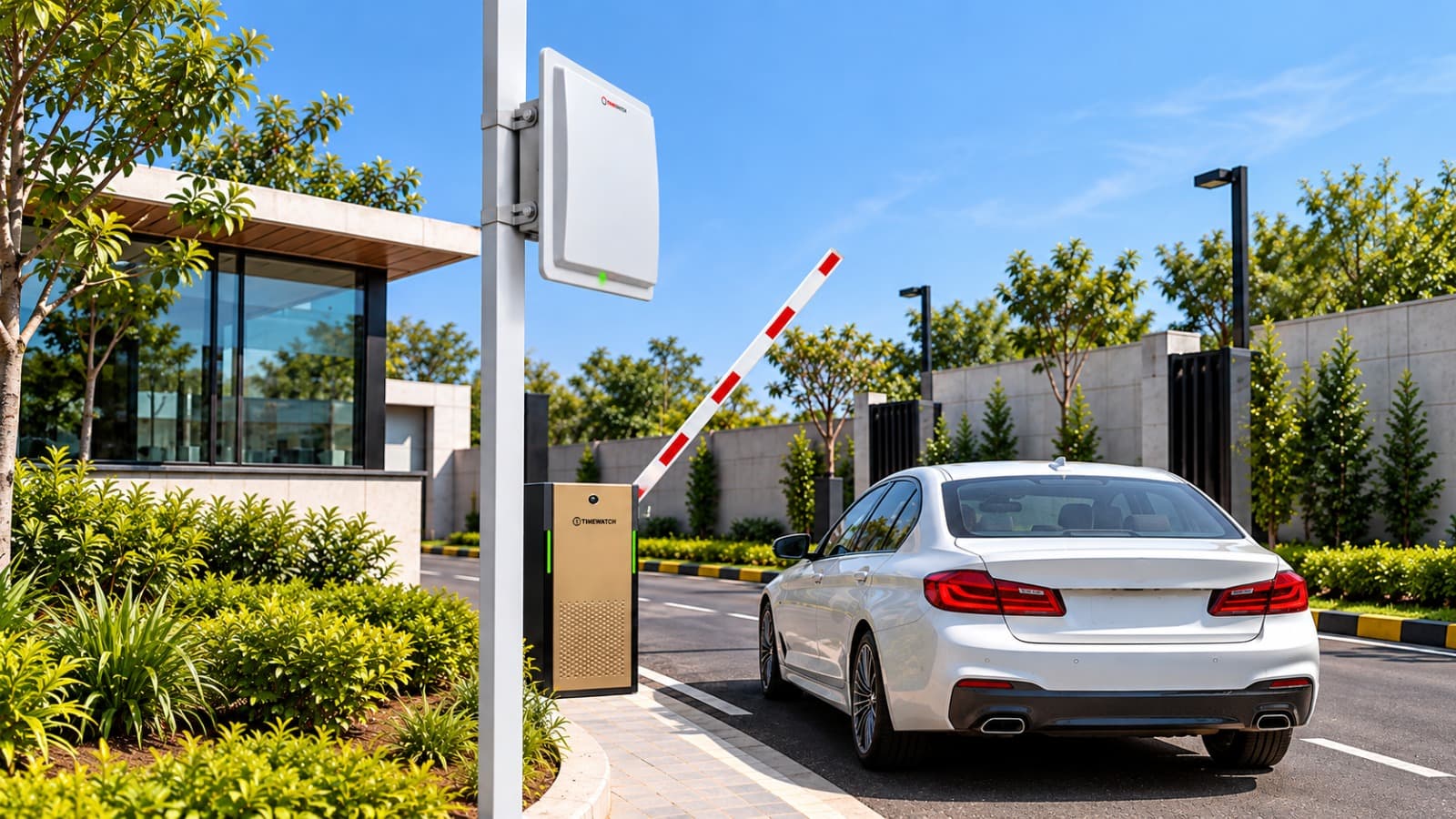
For gated communities, corporate campuses and industrial sites where the same vehicles return daily, UHF RFID is the usual method. A passive tag (a windscreen sticker or a hard tag) carries an identifier but no battery. The reader's antenna radiates RF energy; the tag harvests enough of it to power its chip and reflect back its ID. Read ranges of several metres mean the vehicle is identified while still approaching, so the barrier is already opening as the driver arrives and no window needs to be lowered.
ANPR number plate recognition
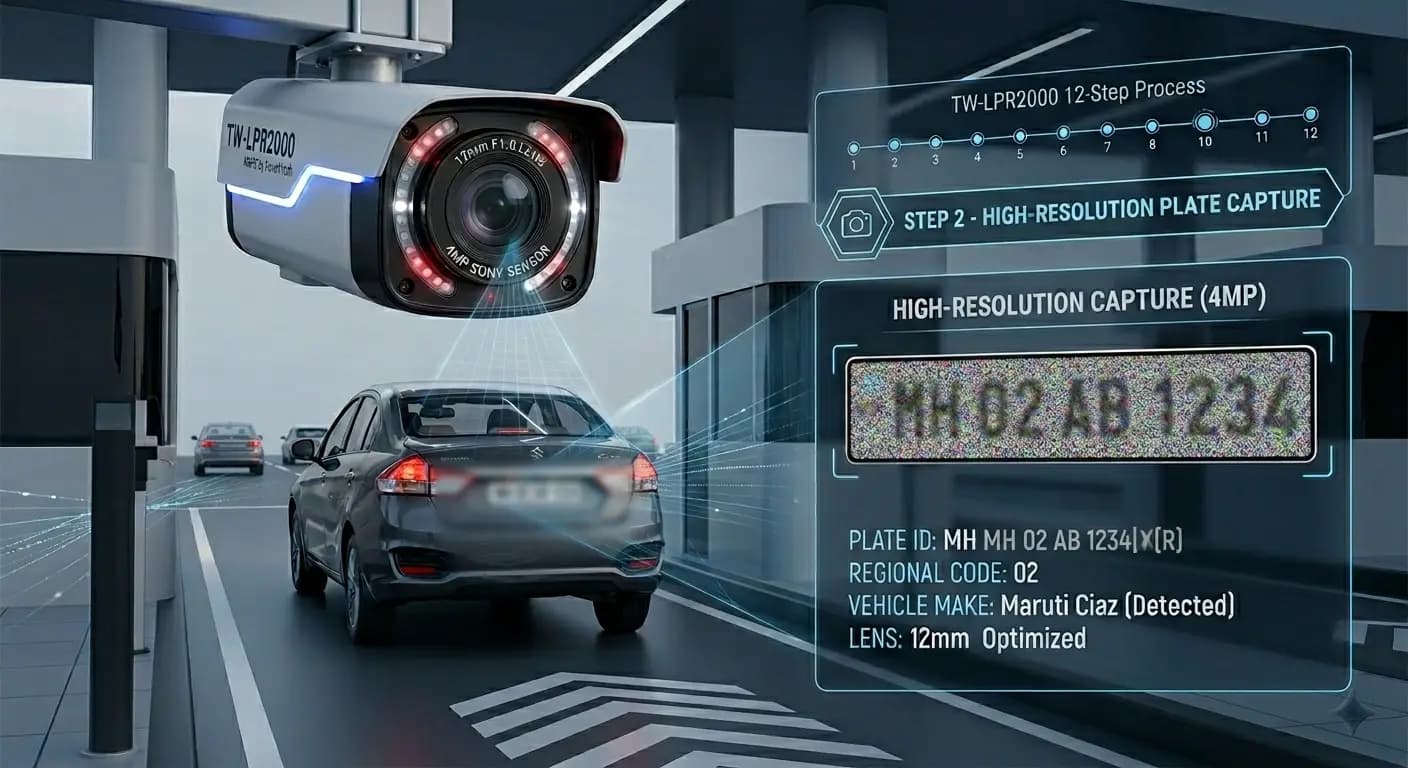
Automatic Number Plate Recognition uses a camera and optical character recognition to read the plate itself. An infrared-illuminated camera captures the plate (IR is used because retroreflective plates return it strongly and it works in darkness) and software locates the plate within the frame, segments the characters and converts them to text. That text is checked against the permitted list.
ANPR needs no tag in the vehicle, which makes it well suited to visitor traffic and to sites where issuing tags is impractical. Its accuracy depends on camera angle, mounting height, illumination, vehicle speed and plate condition. In Indian conditions, non-standard, damaged, obscured or decorative plates are the practical limiting factor, and most sites run ANPR alongside a fallback (an intercom, a guard, or a ticket) rather than relying on it alone.
Tickets, tokens and manual operation
Public and commercial car parks commonly issue a ticket or token at entry, which carries the entry timestamp for later tariff calculation. Where traffic is low or highly varied, manual operation by a guard using a push button, remote handset or intercom remains entirely legitimate, and every automatic barrier retains a manual override for exactly this reason.
Electromechanical vs Hydraulic Boom Barriers
| Aspect | Electromechanical | Hydraulic |
|---|---|---|
| Drive method | Electric motor turning a gearbox and crank | Electric pump driving hydraulic fluid through a cylinder |
| Typical application | Parking, offices, societies, most commercial lanes | Long arms, very high duty cycles, industrial and toll lanes |
| Arm length suitability | Shorter to medium arms | Handles longer and heavier arms more comfortably |
| Duty cycle | Suits low to medium cycling; high-duty variants available | Better suited to continuous, high-frequency operation |
| Maintenance profile | Mechanical wear points: gearbox, spring, limit switches | Fluid level, seals and hoses in addition to mechanical checks |
| Behaviour on power loss | Manual release key disengages the drive | Manual release valve bleeds pressure to free the arm |
The selection is driven by arm length, the number of cycles per day and the operating environment, not by a general notion that one type is better. A dusty, high-throughput industrial gate and a residential society entrance are genuinely different specification problems.
How Boom Barrier Safety Systems Work
Because the arm moves through a space that vehicles and people occupy, layered protection is standard. Each layer works differently, which is why competent installations use more than one.
- Safety loop: the loop directly beneath the arm. While it senses a vehicle, the controller is inhibited from closing. This is a presence interlock rather than a reaction: it prevents the close command rather than interrupting one.
- Photocell / infrared beam: a transmitter and receiver across the lane. If the beam is broken while the arm is lowering, the controller stops and reverses it. This catches what a loop cannot, including pedestrians and low-metal objects.
- Obstruction detection at the drive: the controller monitors motor current or encoder feedback. A sudden rise in load, or travel that stops when it should not have, is read as an impact and triggers a reverse.
- Manual release: allows the arm to be raised by hand in a power failure, so a lane never becomes permanently blocked.
- Fire alarm interface: a dry contact from the fire panel that drives all barriers to open and hold, clearing egress routes during an evacuation. On any site with occupancy, this integration should be treated as essential rather than optional.
Technologies Used in a Boom Barrier System
A modern barrier lane brings together several distinct technologies:
- Electromagnetic induction: loop detectors sensing vehicle presence through inductance shift.
- Passive UHF RFID: backscatter communication between reader antenna and unpowered windscreen tag.
- Optical character recognition with IR illumination: ANPR reading number plates in daylight and darkness.
- Motor control electronics: soft start and soft stop, current monitoring, and on some models variable-frequency drive.
- Position feedback: mechanical limit switches or rotary encoders confirming arm position.
- Optoelectronic sensing: modulated infrared photocells resistant to ambient light interference.
- Network communication: TCP/IP, RS-485 or dry-contact interfaces to access control, parking and surveillance platforms.
Where Boom Barriers Are Used
Boom barriers appear anywhere vehicle movement needs to be controlled and recorded:
- Commercial and IT parks: controlling employee and visitor parking, commonly with RFID for staff and ANPR or ticketing for visitors. Common across the technology corridors of Karnataka, Telangana and Maharashtra, and in the business districts of Gurugram and Noida.
- Residential societies and gated communities: resident vehicles on RFID, visitors managed through the guard post and visitor management software.
- Industrial plants and warehouses: goods vehicle movement, weighbridge integration and contractor access control across the manufacturing belts of Gujarat, Tamil Nadu and Haryana.
- Hospitals: separating ambulance lanes from general parking, with priority opening for emergency vehicles.
- Educational campuses: regulating entry across large university and school sites.
- Hotels, malls and event venues: managing high-turnover public parking in Mumbai, Delhi, Bengaluru, Hyderabad, Chennai, Pune, Ahmedabad and Kolkata.
- Government and defence establishments: usually as the traffic-management layer in front of a crash-rated barrier rather than as the protective element itself.
- Toll plazas and parking operators: high-cycle lanes paired with ticketing or electronic toll collection.
TimeWatch India supplies, installs and services boom barriers and associated parking and traffic control equipment across India, with projects spanning Uttar Pradesh, Rajasthan, Madhya Pradesh, Andhra Pradesh, Kerala and West Bengal alongside the states named above.
Integration With Other Systems
A barrier rarely operates alone. Typical integrations:
- Access control: the same credential database governing doors and turnstiles also governs the vehicle gate, so one revocation closes every route.
- Parking management software: occupancy counting, slot allocation, tariff calculation and shift-wise reporting.
- ANPR and long-range RFID readers: automatic identification, removing the need for driver interaction.
- Visitor management: a pre-approved visitor's vehicle recognised at the gate, with arrival notified to the host.
- CCTV and video analytics: the camera bookmarks footage against each barrier event, so any passage can be reviewed by its log entry.
- Fire alarm systems: automatic open-and-hold on alarm.
- Weighbridges: in industrial and logistics sites, the barrier releases only after the weighment is complete and recorded.
Installation Considerations
Most barrier problems trace back to installation rather than the equipment. The principal considerations:
- Foundation: a level concrete plinth with correctly positioned anchor bolts. An out-of-level housing causes uneven travel and premature wear.
- Loop cutting: the slot must be cut to correct depth and width, the wire laid with the specified number of turns, and the slot sealed so water does not enter. Loop faults are among the most frequent causes of erratic behaviour, and almost all are workmanship issues.
- Loop positioning: arming, safety and exit loops each need to sit in the right place for the lane geometry and expected vehicle lengths.
- Cable routing and separation: loop feeder cables should be twisted and routed away from power cabling to limit interference.
- Earthing and surge protection: outdoor electronics on long cable runs are exposed to induced surges; proper earthing and surge arrestors materially affect reliability, particularly in high-lightning regions.
- Arm length and headroom: the arm must cover the lane without over-swinging into obstructions. Low canopies call for an articulated arm.
- Power supply: stable supply, with a UPS where the gate must keep working through outages.
- Camera positioning for ANPR: mounting height, angle and distance determine plate capture reliability and should be set during design, not adjusted afterwards.
Maintenance Considerations
Barriers are mechanical devices in an outdoor environment, cycling continuously. Routine attention is what keeps them dependable:
- Inspect and lubricate the drive mechanism and linkage at the manufacturer's interval.
- Check balance spring tension, and always reset it after an arm change.
- Verify limit switch or encoder positions so the arm stops cleanly at both ends.
- Clean photocell lenses and confirm alignment; dust and spider webs are common causes of false obstruction detection.
- Test loop continuity and insulation, particularly after any road resurfacing.
- Confirm the manual release operates, before it is needed.
- Test the fire alarm interface as part of scheduled fire drills.
- Inspect the arm for impact damage and confirm reflective strips or LEDs remain visible at night.
Benefits and Limitations
Benefits
- Controlled, recorded vehicle access without permanent manual staffing at the point of entry.
- Fast throughput, sub-two-second opening on suitable models keeps queues moving at busy gates.
- A complete audit trail of entries and exits by credential, direction and time.
- Integrates with access control, parking, CCTV and visitor systems so vehicle and pedestrian movement share one record.
- Deters casual unauthorised entry and enforces parking allocation.
Limitations and considerations
- It is not a security barrier in the protective sense. A boom arm will not stop a vehicle driven through it deliberately. Where hostile vehicle mitigation is the requirement, crash-rated bollards or road blockers are the correct equipment, with the boom barrier handling routine traffic in front of them.
- Tailgating is possible: a second vehicle can follow closely before the arm lowers. Sites needing strict one-vehicle-per-authorisation control pair the barrier with loop-based sequence logic or CCTV verification.
- ANPR accuracy varies with plate condition, weather, lighting and vehicle speed, and needs a fallback path.
- Loop detectors are embedded in the road, so resurfacing, heavy vehicle damage or water ingress can disturb them and repair means cutting the surface again.
- Duty cycle must match the site. A barrier specified for light use will fail early in a high-throughput lane.
Exact behaviour (opening time, safety response, integration options and duty rating) depends on the specific model, controller, software and site configuration. Detailed figures should always be confirmed against the datasheet for the equipment being specified.
Boom Barrier vs Bollard: What Is the Difference?
| Aspect | Boom barrier | Security bollard |
|---|---|---|
| Primary purpose | Traffic control and access recording | Physical vehicle impact protection |
| Stops a hostile vehicle | No | Yes, when crash-rated to a recognised standard |
| Typical cycle speed | Fast, suits high-volume lanes | Slower for hydraulic rising types; fixed types do not move |
| Lane coverage | Spans the full lane with one arm | Multiple units set across the opening |
| Common pairing | Handles routine traffic | Sits behind or alongside the barrier for protection |
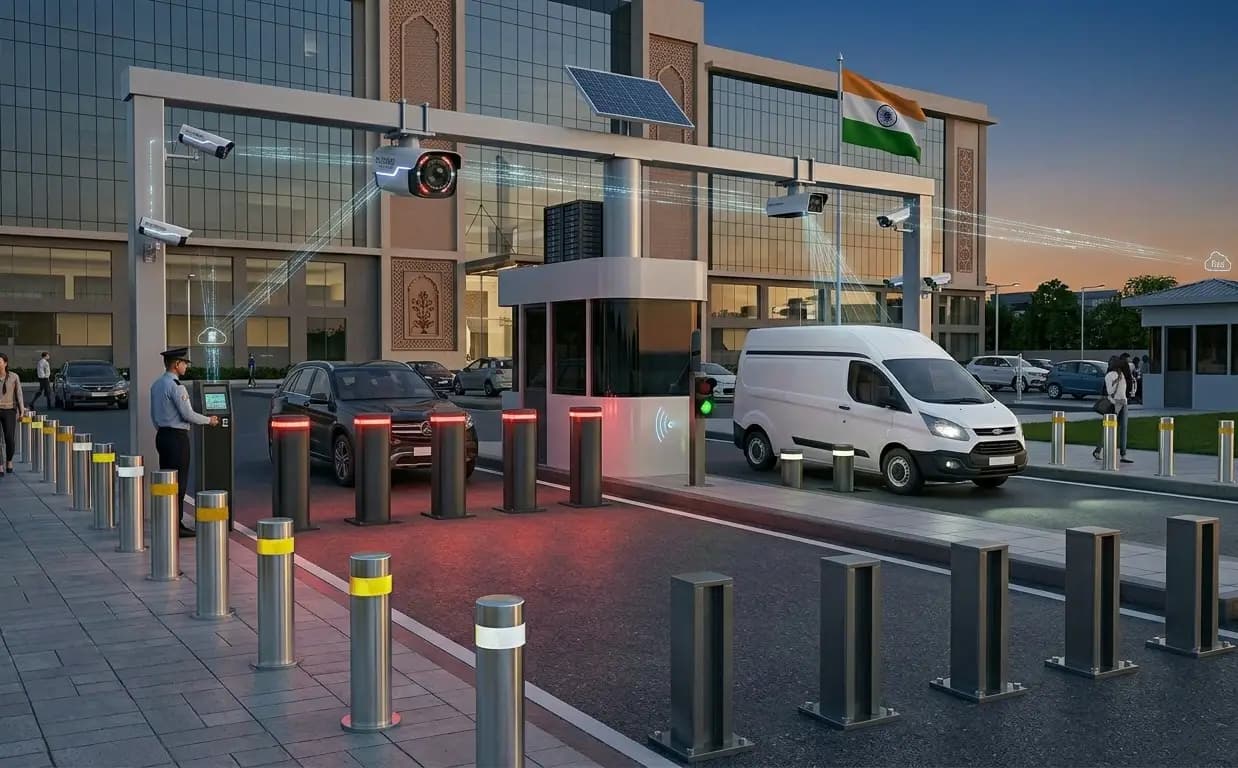
The two are complements, not alternatives. High-security sites routinely install both: the barrier manages everyday flow, the bollards provide the protective line.
Frequently Asked Questions
How does a boom barrier detect a car?
Most barriers detect vehicles using an inductive loop buried in the road. The loop carries an alternating current; when a vehicle's metal mass enters its field, the loop's inductance changes and the detector card registers a presence. Some installations instead use infrared, radar or camera-based detection.
What is a loop detector in a boom barrier?
A loop detector is the electronic card connected to a wire loop cut into the road surface. It senses the change in the loop's inductance when a vehicle passes over it and outputs a presence signal to the barrier controller. A single lane commonly uses separate loops for arming the system, preventing closure on a vehicle, and confirming the vehicle has exited.
How long does a boom barrier take to open?
Typically between 1.5 and 6 seconds, depending on arm length, drive type and model. Shorter arms on high-speed units open fastest; long arms and heavy-duty industrial barriers take longer. The exact figure is a specification of the individual model.
Can a boom barrier stop a vehicle?
No. A boom barrier is a traffic control device, not a crash barrier. Its arm will break if a vehicle is driven through it. Where physically stopping a vehicle is the requirement, crash-rated bollards or road blockers are the appropriate equipment.
What happens if a boom barrier hits a car?
A correctly configured barrier should not. The safety loop under the arm prevents closing while a vehicle is present, and a photocell beam across the lane stops and reverses the arm if the path is obstructed. Controllers also monitor motor load or encoder feedback and reverse on detecting unexpected resistance. If a strike does occur, the usual cause is a misaligned photocell, a faulty loop or a disabled safety device.
Does a boom barrier work during a power failure?
Not automatically, unless it is on a UPS or battery backup. Every barrier includes a manual release, usually a key-operated mechanism that disengages the drive so the arm can be lifted by hand. Sites that cannot tolerate a blocked lane should specify battery backup at the design stage.
What is the difference between an electromechanical and a hydraulic boom barrier?
An electromechanical barrier uses an electric motor and gearbox to move the arm. A hydraulic barrier uses a pump and cylinder. Electromechanical units suit most commercial and parking applications; hydraulic units are generally selected for longer arms, heavier duty and very high cycle counts. Hydraulic systems add fluid, seal and hose maintenance to the routine.
Can a boom barrier work with RFID and number plate recognition together?
Yes, and many sites use both. Regular vehicles carry UHF RFID windscreen tags read at several metres, while visitor vehicles are handled by ANPR or by a ticket issued at the gate. The controller accepts authorisation from either source, so residents or staff pass without stopping while visitors are still managed.
How is a boom barrier integrated with access control software?
The barrier controller connects to the access control or parking platform over TCP/IP, RS-485 or dry contacts. The software holds the permitted credential list and decides each open command, then records the passage with credential, direction, lane and timestamp. Because doors, turnstiles and vehicle gates share one credential database, revoking a person's access closes every route at once.
How much maintenance does a boom barrier need?
Servicing intervals depend on cycle count and environment rather than a fixed calendar. Routine work covers lubricating the drive, checking balance spring tension, verifying limit switches, cleaning and aligning photocells, and testing loop continuity. High-throughput and dusty industrial lanes need attention more often than a low-traffic residential gate.
