
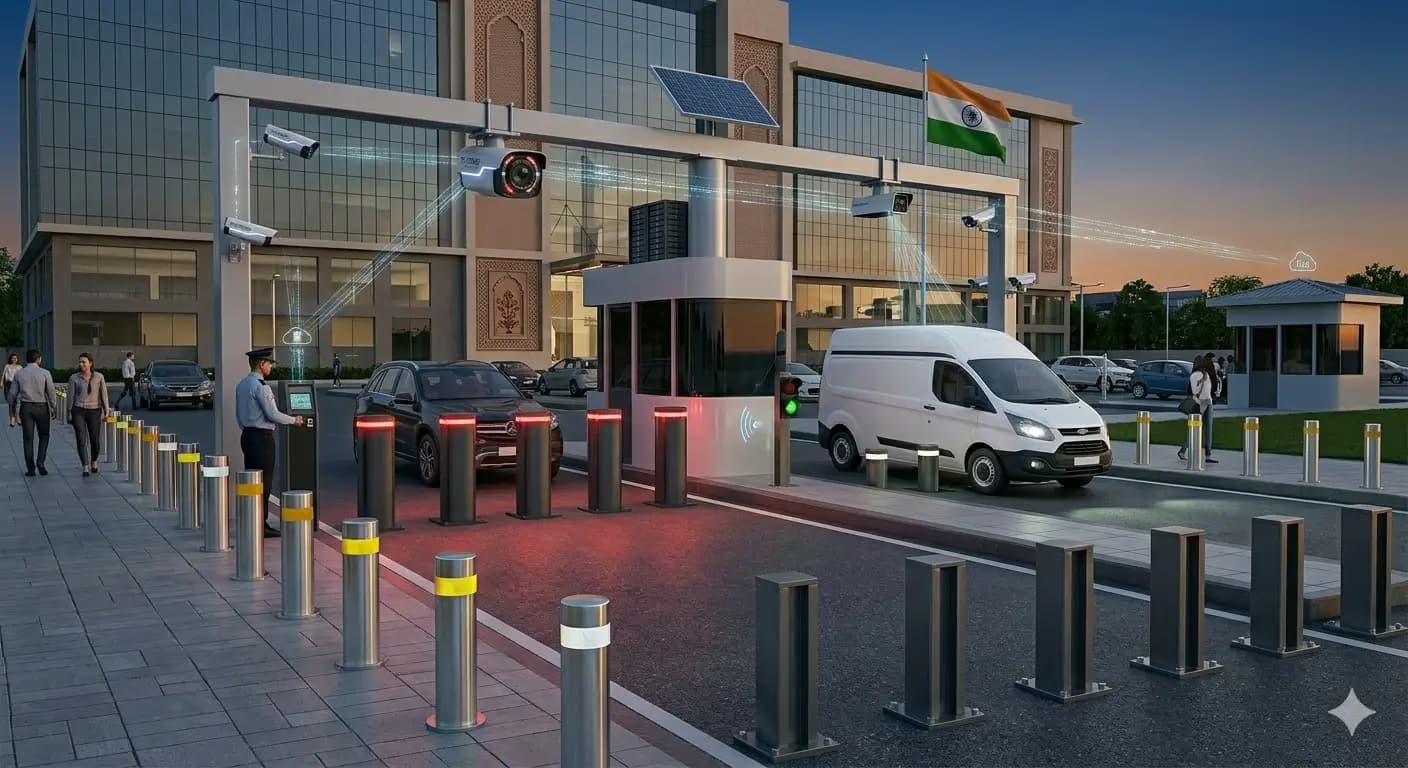
What Is a Parking Management System?
The term covers a wide range of installations. A residential society may need only that resident vehicles pass without stopping and visitor vehicles are recorded. A multi-level mall car park adds per-bay sensors, in-aisle guidance, pay-on-foot stations and shift-wise reconciliation. The underlying logic is identical; what changes is how many of the optional layers are present.
Two jobs are worth separating, because sites often buy one and expect the other. Access control decides who may enter and leave, and records it. Space management knows how many bays are free and tells drivers where they are. A system can do the first without the second, and doing the second properly needs considerably more infrastructure.
How Does a Parking Management System Work?
A parking management system works as a closed loop around each vehicle's visit. At entry, a loop sensor detects the vehicle, a reader identifies it, the software validates that identity against its permitted list or creates a new entry record with a timestamp, and the barrier opens. The occupancy counter increments. Inside, guidance displays and bay sensors direct the driver to a free space. At exit the vehicle is identified again, the duration is computed from the two timestamps, payment is settled where it applies, the exit is validated, the barrier opens, the counter decrements, and the completed transaction is logged.
Everything else on this page — slot sensors, guidance signage, user categories, reporting — hangs off that loop.
Main Components of a Parking Management System
| Component | Function |
|---|---|
| Entry station | Pedestal at the entry lane holding the reader, ticket dispenser, intercom and indication lights. |
| Exit station | Equivalent unit at the exit, holding the reader or ticket slot, payment terminal where fitted, and intercom. |
| Boom barriers | The physical gate at each lane, raised on a valid authorisation and lowered once the vehicle clears. |
| Inductive loop detectors | Wire loops cut into the road surface that sense vehicle presence — arming the reader, preventing the barrier closing on a vehicle, and confirming passage. |
| UHF RFID readers | Long-range readers that identify a windscreen tag while the vehicle is still approaching. |
| ANPR cameras | Infrared-illuminated cameras that read the number plate and convert it to text for matching or for recording against the entry event. |
| Ticket / token dispensers and readers | Issue a printed ticket or reusable token at entry and read it back at exit or at a payment station. |
| Payment terminals / pay-on-foot stations | Where a casual user settles, either in the lobby before returning to the vehicle or at the exit lane itself. |
| Slot occupancy sensors | Ultrasonic sensors above each bay, or magnetic sensors in the floor, detecting whether that individual bay is occupied. |
| Guidance displays and signage | Free-space counter at the entrance, in-aisle displays by direction, and per-bay indicator lights on sensor-equipped sites. |
| Central server and software | Holds the user database, charging rules, occupancy state and transaction history, and runs the reporting engine. |
| CCTV | Cameras covering lanes, payment points and aisles, with footage bookmarked against transactions for review. |
| UPS / power backup | Keeps lanes, readers and the server running through an outage so occupancy state is not lost and vehicles are not stranded. |
Entry and exit stations
The station is where throughput is won or lost. A well-designed one puts the reader where it sees the vehicle early, places the dispenser at a height reachable from a car window and from a two-wheeler, and gives unambiguous indication so nobody waits wondering whether the system responded. The intercom must reach a point that is actually attended, because it is the escape route for every case the automation does not cover.
Detection and identification devices
Detection and identification are different jobs. Detection answers "is a vehicle here" and is almost always an inductive loop, whose inductance shifts when a metal mass sits over it. Identification answers "which vehicle is it" and is done by an RFID reader, an ANPR camera, a ticket, or a person. The loop arms the identification step, which is why a lane with a healthy reader but a damaged loop appears completely dead.
Slot sensors, guidance displays and signage
Slot sensors are optional and are the biggest infrastructure decision in a parking project. An ultrasonic sensor above the bay measures the distance to the floor and reports occupied when that distance shortens. A magnetic sensor detects the disturbance a vehicle's mass causes in the local magnetic field. Either reports bay-by-bay state to the server, which drives aisle displays and bay indicator lights. Without them a site can still show a free-space count, but it derives that number by arithmetic rather than observation.
Server, software and supporting infrastructure
The software holds the permitted-user list, the categories users belong to, the rules for each category, the occupancy state and the transaction history. Supporting infrastructure — cabling to each lane, switches, surge protection, earthing and the UPS — is unglamorous but determines dependability. Long outdoor runs to entry stations and cameras are exposed to induced surges, a common cause of intermittent lane faults in Indian installations.
How Does a Parking Management System Work Step by Step?
| Step | What happens | How it works |
|---|---|---|
| 1 | Vehicle arrives at the entry lane | The driver pulls up to the entry station. Nothing has yet been recorded. |
| 2 | Vehicle is detected | An inductive loop under the approach senses the vehicle's metal mass and signals the controller, which arms the reader. |
| 3 | Vehicle is identified | A UHF RFID windscreen tag is read at range, an ANPR camera reads the plate, or a ticket or token is issued to a casual user. |
| 4 | Identity is validated, or an entry record is created | A tagged or recognised vehicle is checked against the permitted list and its category. For a casual user no list check applies — the software creates an open transaction stamped with entry time, lane and ticket number. |
| 5 | Barrier opens | The controller drives the boom arm to vertical. Where ANPR is fitted, the plate image is stored against the transaction whether or not ANPR granted the entry. |
| 6 | Occupancy counter increments | The software adds one to the occupied count for the car park or the zone that lane feeds, and updates the entrance display. |
| 7 | Vehicle clears and the barrier closes | A safety loop under the arm and, where fitted, a photocell across the lane confirm passage before the arm lowers. |
| 8 | Driver is guided to a space | On sensor-equipped sites, aisle displays show free counts by direction and bay indicator lights show individual availability. Elsewhere, static signage and the entrance counter are all the driver gets. |
| 9 | Bay state changes | When the vehicle parks, that bay's sensor changes state, its indicator turns red, and aisle and entrance counts update. |
| 10 | Vehicle arrives at the exit lane | An exit loop detects it and arms the exit reader. |
| 11 | Vehicle is identified again | The tag is read, the plate is read, or the ticket is presented. This is what links the exit to the open entry record. |
| 12 | Duration is computed | The software subtracts the entry timestamp from the current time to obtain the stay duration for that transaction. |
| 13 | Payment is settled where applicable | Depending on configuration, the casual user has already settled at a pay-on-foot station, or settles at the exit terminal. Monthly and validated users pass without a settlement step. |
| 14 | Exit is validated | The software confirms the transaction is complete and no unsettled time remains. Only then is the open command issued. |
| 15 | Barrier opens and occupancy decrements | The exit arm rises, the vehicle leaves, the occupied count reduces by one, and the displays update. |
| 16 | Transaction is logged | Identity, category, entry and exit times, lane, duration, settlement status and plate images are written to the database for reporting and audit. |
Steps 8 and 9 exist only on sites with slot-level detection. Steps 13 and 14 collapse to nothing where no charging applies, such as a corporate campus or a residential society. The core of the cycle is steps 2 to 7 and 10 to 16.
How Vehicles Are Identified at Entry and Exit
UHF RFID tags for regular users
For vehicles that come every day — residents, employees, monthly permit holders — UHF RFID is the usual choice. A passive windscreen tag carries an identifier but no battery. The reader's antenna radiates RF energy, the tag harvests enough to power its chip and reflects back its identifier. Read ranges of several metres mean the vehicle is identified while still approaching, so the barrier is already moving when the driver arrives. Tags must be fitted consistently, because metallised or heat-reflective glass attenuates the signal; and antenna aim matters, since a beam pointed too wide reads the adjacent lane and opens the wrong barrier.
ANPR number plate reading
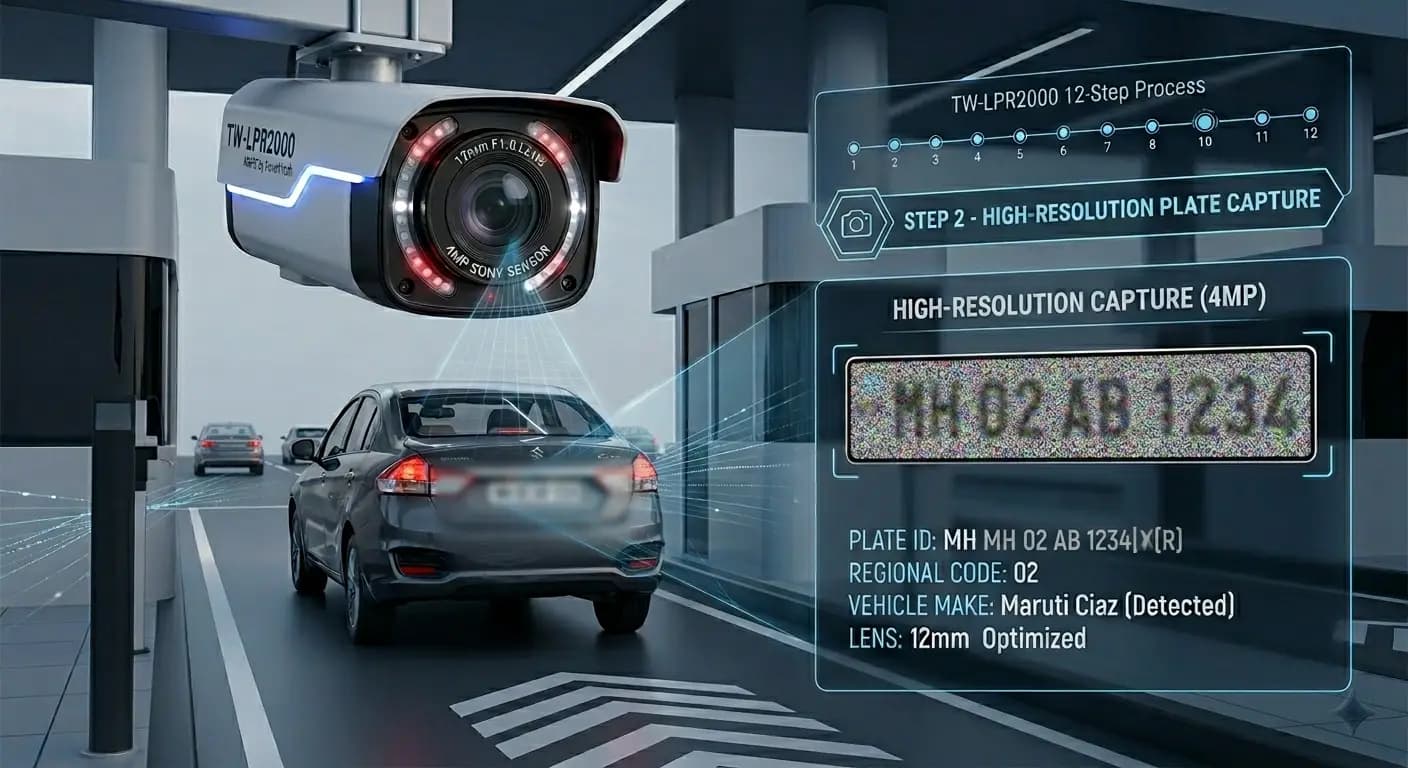
Automatic Number Plate Recognition uses an infrared-illuminated camera and optical character recognition to read the plate, locate it in the frame, segment the characters and convert them to text. That text can be matched against a permitted list, or simply stored against the transaction.
The second use deserves more attention than it usually gets. ANPR earns its place in a parking system most reliably as a backup identity rather than as the primary reader. When a ticket is lost, a tag fails to read, or a transaction is disputed at the exit, the plate captured at entry is what reconstructs the record and resolves the case in seconds. Designed in as a reconciliation layer running quietly behind the ticket or the tag, ANPR makes the lane resilient. Designed in as the sole reader, it inherits every plate condition problem on the road — non-standard fonts, damaged, dirty or obscured plates, decorative plates, two-wheeler plates at awkward angles — and those problems now sit in the path of every vehicle instead of in a fallback used occasionally.
Tickets and tokens for casual users
Visitors cannot be issued tags, so public car parks issue a printed ticket carrying a barcode or QR code, or a reusable token carrying an RFID chip. Either way the medium is a handle onto a record held in the database, not a store of information in itself — the entry timestamp lives on the server. Tokens suit high-volume Indian sites because they are reusable and are not defeated by a paper roll running out at the busiest hour. Printed tickets carry human-readable entry times, which reduces disputes, with the trade-off of consumable management.
Manual handling and overrides
Every automated lane needs an attended path: a supervisor console with an override, an intercom that reaches a person, and a documented procedure for what that person may do. These are not admissions of failure; they are the parts of the system that handle what automation does not. Sites that skip them end up with guards improvising, which is worse in every respect including audit.
Ticket vs RFID vs ANPR Parking Access
| Aspect | Ticket-based | RFID-based | ANPR-based |
|---|---|---|---|
| User type suited | Casual visitors and shoppers with no prior relationship to the site | Regular users — residents, employees, monthly permit holders, fleets | Mixed traffic; pre-registered vehicles, and any vehicle whose plate must be recorded |
| Identification speed | Slowest — the vehicle stops while the driver presses a button and takes the ticket | Fastest — identification completes at several metres while the vehicle approaches | Fast on a clean capture, but the plate must face the camera squarely, usually at low speed |
| Driver interaction required | Stop, take the ticket, retain it, present it again at exit or at a payment station | None — the driver does not stop or lower a window | None in principle, though drivers tend to slow at the capture point |
| Typical failure modes | Lost, damaged or wet tickets; paper or ribbon exhaustion; dispenser jams; queues at the button | Tag missing or behind treated glass; tag damaged; cross-lane reads from a wide beam; tag moved between vehicles | Plate non-standard, damaged, dirty or obscured; poor angle or height; glare, rain or night illumination; two-wheeler plate position |
| Infrastructure needed | Dispenser with consumables, exit reader or payment station, loop, barrier | Long-range reader and antenna per lane, tags issued and registered per vehicle, loop, barrier | Camera with IR illuminator per lane, correct mounting geometry, recognition software, image storage, loop, barrier |
Most working sites are not one of these three but a combination: RFID for daily users, tickets or tokens for everyone else, and ANPR across both as the record that ties a disputed transaction to a real vehicle. The table is a guide to which method carries which traffic, not a single choice for the whole car park.
How Occupancy Is Measured: Counting vs Slot-Level Detection
There are two ways a system can know how full it is, and they are not equivalent. A site that specifies one while expecting the behaviour of the other will be disappointed.
Entry-minus-exit counting
Counting derives occupancy arithmetically. The software starts from a known capacity, adds one on every validated entry, subtracts one on every validated exit, and displays the difference. It needs no hardware beyond the lanes, works from day one and scales to any size. Its limitation is that it never observes a bay: it knows a total and nothing else — not which floor has space, not which aisle, not whether a bay is blocked. It cannot drive meaningful in-aisle guidance or produce bay-level data.
Slot-level occupancy sensors
The richer approach puts a sensor on every bay, so the server knows the true state of each one. That unlocks what counting cannot do: per-bay indicator lights, in-aisle free counts by direction, reserved-bay enforcement and reporting on which parts of the car park are actually used. The trade-off is infrastructure — every bay needs a sensor, power and a data path running through the whole structure. Slot sensors are common in enclosed multi-level car parks in Mumbai, Bengaluru, Hyderabad and Gurugram, where guidance genuinely reduces circulation time, and uncommon in open surface parking where a driver can see the whole lot at a glance.
| Aspect | Entry-minus-exit counting | Slot-level sensors |
|---|---|---|
| What it measures | A single total derived from lane events | The true state of each individual bay |
| Accuracy over time | Drifts as miscounts accumulate; needs periodic reset | Self-correcting — each sensor reports its own bay |
| Guidance capability | Entrance free-space count only | Entrance count, in-aisle directional counts, per-bay lights |
| Reporting available | Entries, exits, totals, durations | All of the above, plus bay-level utilisation and dwell patterns |
| Infrastructure required | Only the lane equipment already present | A sensor, power and data path at every bay |
| Typical fit | Societies, campuses, surface parking, smaller commercial sites | Multi-level enclosed car parks with high turnover |
Why occupancy counts drift
This is the behaviour most specifications ignore and every operator eventually discovers. A counting-based figure is only as good as the events feeding it, and those events are never perfect. A vehicle tailgates through on one authorisation and an entry goes uncounted. A barrier is held open for a delivery and a run of vehicles passes with no events at all. A two-wheeler crosses a loop tuned for cars, falls below the detection threshold, and enters unrecorded but may be recorded on exit, or the reverse. Each error is small, none self-corrects, and they do not reliably cancel out.
Over a day the count may be off by a handful; by the end of a week it can be wrong enough that the entrance sign reports free spaces in a full car park, or reports full when the upper deck is empty. What follows is predictable — drivers stop believing the display, staff stop referring to it, and the site quietly reverts to a guard waving people in.
The fix is procedural rather than technical. A counting system needs a scheduled reconciliation: a reset to zero at a time when the car park is genuinely empty, typically overnight, or a manual count of the floors against the system figure at a defined interval with the software adjusted to match. Sites that build this into the operating routine keep a display people trust. Slot-sensor systems do not have the problem at all, because a missed lane event affects nothing — that self-correcting property is a stronger argument for slot sensors than the guidance lights usually cited.
How Parking Guidance Systems Work
Guidance converts occupancy data into something a driver can act on, at three levels of granularity.
- Entrance display — a sign showing the number of free spaces, often with a simple full or space indication. This is the minimum and the only level available to a counting-based system. Its value is preventing a driver entering a car park with nothing to offer.
- In-aisle directional displays — signs at junctions showing free counts left and right, or by zone and floor, driven by slot sensors aggregated into groups. These are what actually reduce circulation time. The groups must match how drivers decide at each junction, not how the cabling happened to run.
- Per-bay indicator lights — an LED above each bay, green when free and red when occupied, driven by that bay's sensor. Colours also flag reserved, accessible or electric-vehicle bays.
Guidance only helps where the driver has a real choice. A single-level lot with two aisles does not need in-aisle displays; a four-level structure under a mall, where the wrong decision at the first ramp wastes several minutes, is where the layer pays back.
How Different User Categories Are Handled
The software divides users into categories, and the category determines what happens at each lane.
| Category | Typical identification | How the system treats them |
|---|---|---|
| Monthly / permanent users | UHF RFID windscreen tag registered to the vehicle | Validated against the permitted list at both lanes. No ticket, no settlement, no driver interaction. Entry may be refused outside permitted hours or once a zone quota is reached, depending on configuration. |
| Casual visitors | Ticket or token at entry, with the ANPR plate recorded alongside | An open transaction is created at entry; duration is computed at exit and settlement applies where the site charges. |
| Validated customers of a tenant | Entry ticket stamped or scanned at a tenant's validation terminal | Flagged as validated for a configured period, so the exit lane releases the vehicle without a settlement step. The record retains which tenant validated it, which is what makes tenant-wise reporting possible. |
| Reserved bay holders | RFID tag linked to a specific bay or bay group | Admitted regardless of general occupancy, because their space is held. On slot-sensor sites an alert can be raised when an unauthorised vehicle occupies the bay. |
| VIP and management vehicles | RFID tag with a priority flag, or a registered plate | Entry without occupancy checks and typically without any exit settlement. Movements are still logged, which matters for audit even where nothing is charged. |
| Service, delivery and contractor vehicles | Temporary tag, ticket, or plate registered for a defined window | Usually restricted to specific lanes, zones or hours. Time-bounded authorisation that expires automatically avoids temporary access quietly becoming permanent. |
| Two-wheelers | Tag, token or a separate lane, depending on site design | Frequently handled through a dedicated lane with its own detection arrangement, for the reasons set out under installation considerations. |
Which categories a platform supports, and how finely their behaviour can be configured, varies between software. The categories a site will need should be listed during design, because retrofitting a category structure onto a live car park means reissuing tags.
How Duration and Payment Are Handled
Where the site charges, duration is the basis. The entry timestamp is written when the transaction opens; at exit the software subtracts it from the current time and applies the configured charging rules — free periods, rounding, category exemptions, tenant validations. What is worth explaining is the layout choice and the failure case.
The layout choice is where settlement happens. In pay-on-exit, the driver settles at the exit lane: simple to build, but it puts a transaction into the exit queue. In pay-on-foot, the driver settles at a station in the lobby or lift area and the exit lane only verifies that the ticket is settled. Pay-on-foot keeps the exit fast, which matters when a mall or cinema empties in a short window, and is the usual choice for high-turnover sites in Delhi, Mumbai and Bengaluru. Its trade-off is the additional stations and the signage to make sure drivers settle before walking back.
The failure case is the lost ticket, and it belongs in the design brief rather than in the exceptions list. A customer who cannot produce their entry ticket has, from the system's point of view, no recorded entry time, therefore no computable duration and no way to close the transaction. This is not rare. At any public car park of reasonable size it happens daily, at the exit lane, with vehicles queued behind. There are three usual answers, and a site needs to have chosen one, documented it and trained staff on it before go-live:
- ANPR lookup of the entry image — the supervisor searches open transactions by plate, finds the entry event and its timestamp, and closes the transaction normally. The cleanest resolution, and the strongest practical argument for fitting ANPR even where tickets or tags are primary.
- A defined lost-ticket procedure — a standard rule applied whenever entry time cannot be established, applied consistently and logged as a lost-ticket transaction so it appears in the exception report.
- Supervisor override — a manual release with a recorded reason. Necessary as a last resort, but a site where overrides are the routine answer has lost its audit trail.
The common failure is going live with no answer, discovering the problem in week one, and improvising a different answer on each shift.
What Reports a Parking Management System Produces
Reporting is where a parking system stops being a gate and becomes an operational tool.
- Occupancy over time — occupied count through the day, week and month, showing when the car park fills and empties. The base data for staffing and capacity decisions.
- Peak utilisation — the highest occupancy reached and how long it held. A site at capacity for twenty minutes on a Saturday has a different problem from one at capacity all day.
- Duration distribution — how long vehicles stay, grouped into bands. A site dominated by long stays is behaving as employee parking whatever it was designed for, and the remedy is policy rather than more bays.
- Revenue reconciliation — settled transactions matched against what terminals and stations recorded, shift by shift and operator by operator.
- Exception reports — lost tickets, overrides, forced opens, denied entries, unmatched exits, manually closed transactions. This reveals how the car park is really run; reviewing it weekly catches both faults and procedural drift.
- Category and tenant reports — movements by category, and validations by tenant where a mixed-use building must attribute usage to occupiers.
- Bay-level utilisation — available only on slot-sensor sites; shows which zones are used and which sit empty.
The exact report set, export formats and whether reports can be scheduled vary considerably between platforms, and should be checked against a real requirement list during evaluation.
Where Parking Management Systems Are Used
- Shopping malls and retail centres — high turnover, heavy casual traffic, tenant validation, and the strongest case for slot-level guidance. Common across the retail developments of Maharashtra, Karnataka and Telangana.
- IT parks and corporate campuses — RFID for employees, tickets or ANPR for visitors, and zone quotas by building. Widespread around Bengaluru, Hyderabad, Pune, Gurugram and Noida.
- Hospitals — a difficult mix of staff, long-stay attendants, short visits and emergency traffic, usually needing separate lanes and priority handling for ambulances.
- Residential societies and gated communities — residents on RFID, visitors recorded at the guard post, and two-wheeler volumes that often exceed car volumes. Township projects across the Delhi region, Rajasthan and Gujarat follow this pattern.
- Airports, railway stations and transport hubs — very high volume, long dwell times and strict transaction audit requirements.
- Hotels and convention centres — valet integration, guest validation and event peaks that briefly exceed normal capacity.
- Commercial office buildings — monthly allocations by tenant, reserved bays, and reporting that attributes usage to occupiers, from the business districts of Mumbai and Delhi to those of Chennai, Ahmedabad, Kolkata and Jaipur.
- Public and municipal parking — surface lots and multi-level structures run by civic bodies or concessionaires, where counting-based occupancy and ticketing are typical.
- Industrial plants and logistics yards — separating goods vehicles from staff parking, often with weighbridge integration, across the manufacturing belts of Gujarat, Tamil Nadu and West Bengal.
TimeWatch India supplies, installs and services parking and traffic control equipment across the country — barriers, readers, ANPR systems and the software that ties them together.
Integration With Other Systems
- Access control — sharing a credential database with doors and turnstiles, so one revocation removes both building and parking access.
- Visitor management — a pre-registered visitor's vehicle recognised at the gate, the host notified on arrival, and the visit and parking transaction linked as one record.
- CCTV and video analytics — cameras bookmarked against each lane event, which is what makes dispute resolution practical.
- ANPR and long-range RFID — the identification layer, supplying both the credential and the reconciliation record.
- Payment and accounting systems — settled transactions exported for reconciliation against the site's financial records.
- Fire and building management systems — barriers driven to open and hold on a fire alarm, which on any enclosed multi-level car park should be treated as essential rather than optional.
- Tenant and property management platforms — validation terminals and allocation data feeding the systems the property team already uses.
Installation and Design Considerations
As with barriers, most parking system problems trace to design and installation rather than to equipment.
- Two-wheelers defeat assumptions built for cars. This is the most common design mismatch in Indian parking, and at many sites two-wheelers are the majority of traffic rather than an edge case. A loop tuned for a car's metal mass may not reliably detect a scooter, so either sensitivity is raised — risking cross-lane detection — or a separate detection arrangement is used. Barrier timing set for a car is wrong for a two-wheeler that clears the lane far faster, and a car-length timer invites the next rider to slip through on the same open. Slot sensors sized for a car bay behave unpredictably over a two-wheeler bay, so those areas are usually managed by area count instead. Plate size and position make two-wheelers the hardest ANPR subject on any site. The usual resolution is a dedicated two-wheeler lane with its own detection, timing and identification method.
- Lane geometry and queue space — enough stacking ahead of the entry station that a queue does not spill onto the public road, and enough distance past the barrier that a vehicle clears the arm before the next arrives.
- Loop cutting and positioning — correct depth, width, turns and sealing, with arming, safety and exit loops placed for the lane geometry and expected vehicle lengths. Loop workmanship is among the most frequent causes of erratic lane behaviour.
- Reader and antenna aim — set so the read zone covers one lane's approach and does not spill into the next.
- ANPR camera geometry — height, angle and distance fixed at design stage. Even where ANPR is only the reconciliation layer it must be positioned properly, because an unreadable plate image is no help when a ticket goes missing.
- Slot sensor coverage and cabling — sensor type matched to the bay and structure, with the data path planned alongside the electrical layout rather than added later.
- Display positioning — entrance and aisle displays placed where a driver can read them with enough distance to act. A sightline problem, not a mounting-convenience problem.
- Power and network resilience — UPS at lanes and server, surge protection and earthing on long outdoor runs, and a defined behaviour for lanes when the link to the server is lost.
- Occupancy reconciliation procedure — decided at design, not discovered later.
- Signage and driver communication — where to take a ticket, where to pay, which lane is which. A large share of lane delay is drivers not knowing what is expected of them.
Maintenance Considerations
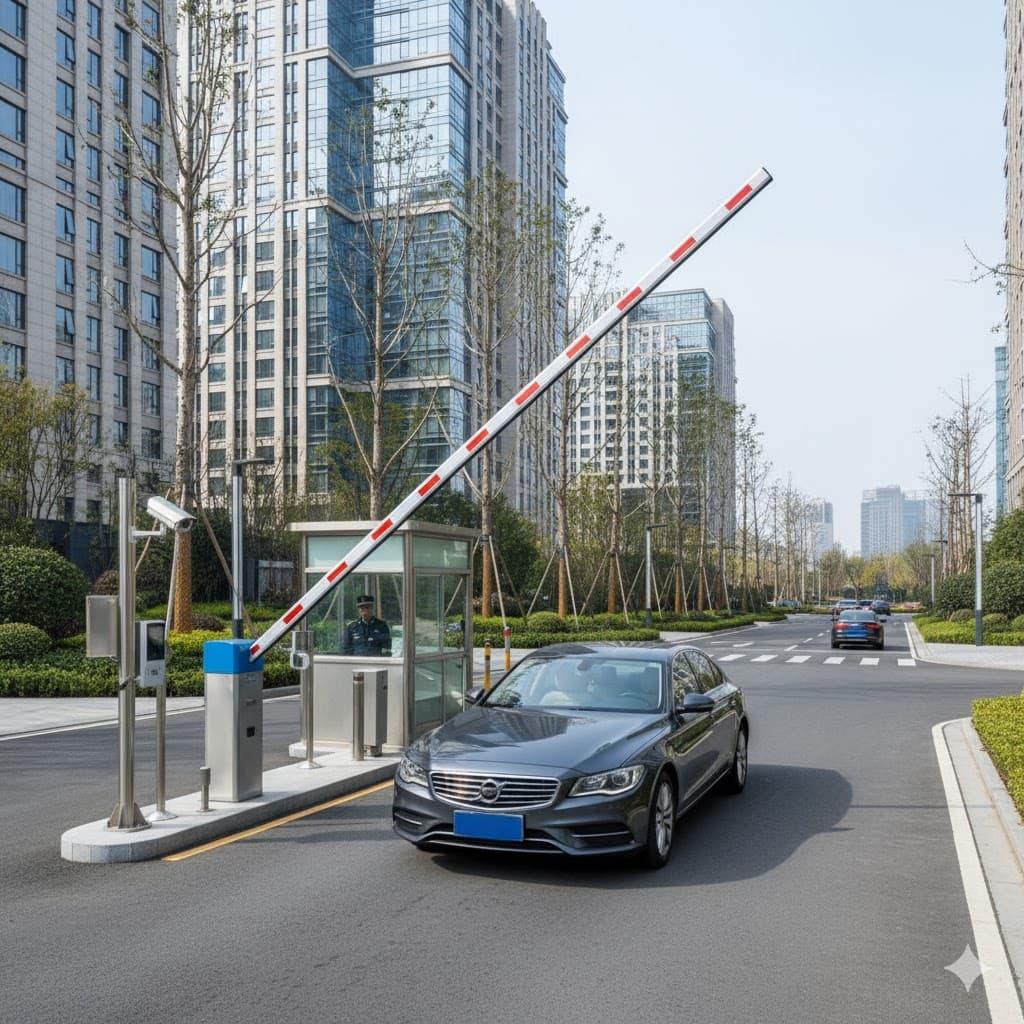
- Service the boom barriers at the manufacturer's interval — drive lubrication, balance spring tension, limit switches and photocell alignment.
- Test loop continuity and insulation, particularly after resurfacing or civil work in the lanes.
- Verify RFID read performance at each lane; a gradual decline usually means antenna drift, a loosened mount or a connector fault.
- Check ANPR recognition rates against actual traffic, and clean camera housings and IR illuminators.
- Maintain ticket dispenser consumables and clean the print and read mechanisms.
- Spot-check slot sensors against physical bay state; a sensor reporting an empty bay as occupied quietly skews guidance.
- Carry out the scheduled occupancy reconciliation, and record that it was done.
- Review exception reports weekly — overrides, lost tickets, unmatched exits and denied entries are early indicators of faults and of procedural drift.
- Verify UPS battery health and test the fire alarm interface during scheduled drills.
- Take and verify database backups, and confirm the transaction and image retention period still matches the site's requirement.
Benefits and Limitations
Benefits
- Controlled, recorded vehicle access without a person making every decision at the lane.
- Regular users pass without stopping, which is what clears the morning queue at a campus or society gate.
- A complete transaction record — identity, category, times, duration, lane and settlement status — for audit and dispute resolution.
- Occupancy visibility, so drivers are not sent into a full car park and operators know when capacity is genuinely reached.
- Guidance that reduces circulation time inside large enclosed structures where sensors and displays are fitted.
- Reporting that turns daily operation into data, and integration with access control, visitor management and CCTV.
Limitations and considerations
- Counting-based occupancy drifts and needs a scheduled reconciliation, or the free-space display stops being trusted.
- The lost ticket is an operational problem, not a technical one. It will happen daily and needs a documented procedure before go-live.
- Every identification method has failure modes — unread tags, unreadable plates, jammed dispensers — so a resilient lane needs a fallback and an attended override.
- Tailgating is possible at any barrier lane, and each instance corrupts both the access record and the occupancy count.
- Two-wheelers need their own design for detection, timing, identification and space management, rather than being treated as small cars.
- Slot-level detection is an infrastructure commitment running through the whole structure, and is hard to retrofit into an operating car park.
- A parking barrier is a traffic control device, not a protective one. Where physically stopping a vehicle is the requirement, crash-rated bollards or road blockers are the appropriate equipment, with the barrier handling routine traffic in front of them.
Exact behaviour — identification ranges, sensor accuracy, report sets, category handling, integration options and offline behaviour — depends on the specific equipment, software platform and site configuration, and should be confirmed against the datasheets and software documentation for the system being specified.
Frequently Asked Questions
How does a parking management system work?
It detects each arriving vehicle with an inductive loop, identifies it by RFID tag, number plate or issued ticket, validates that identity or creates a new entry record with a timestamp, and opens the entry barrier. The occupancy count increases and, where slot sensors are fitted, guidance displays direct the driver to a free bay. At exit the vehicle is identified again, the duration is computed from the two timestamps, payment is settled where applicable, the barrier opens, the count decreases and the transaction is logged.
How does a parking system know how many spaces are free?
By one of two methods. A counting system starts from the known capacity, adds one on each validated entry and subtracts one on each validated exit. A slot-level system puts an ultrasonic or magnetic sensor on every bay and reports the true state of each one. Counting needs no extra hardware but only produces a total; slot sensors give bay-by-bay accuracy and can drive in-aisle guidance and per-bay indicator lights.
Why does the free-space count on a parking display become wrong?
Because counting-based occupancy is derived from lane events, and any miscount accumulates. A tailgating vehicle, a barrier held open during a busy period, or a two-wheeler that falls below the loop detection threshold each produce an entry or exit that was never counted. These errors do not cancel out, so the figure drifts further from reality over days and weeks. Counting systems need a scheduled reset when the car park is empty, or a periodic physical count reconciled against the system figure.
What is a parking slot occupancy sensor?
A sensor dedicated to one bay that reports whether that bay is occupied. Ultrasonic sensors are mounted above the bay and measure the distance to the floor, registering occupied when that distance shortens. Magnetic sensors sit in or on the floor and detect the change a vehicle causes in the local magnetic field. The sensor feeds the server, which drives the bay indicator light and the aisle and entrance displays.
How does RFID parking access work?
A passive UHF RFID tag, usually a windscreen sticker, carries an identifier but no battery. The long-range reader at the lane radiates RF energy, the tag harvests enough of it to power its chip and reflects back its identifier, and the software checks that identifier against the permitted list. Because the read happens at several metres, the vehicle is identified while still approaching and the driver does not need to stop or lower a window.
What happens if you lose your parking ticket?
Without the ticket the system has no link to the entry record, so it cannot compute the duration or close the transaction automatically. Sites handle it in one of three ways: an operator searches open transactions by number plate using the ANPR image captured at entry, a defined lost-ticket procedure is applied and logged as an exception, or a supervisor issues a manual override with a recorded reason. This happens daily at any busy public car park, so the procedure should be decided and staff trained before the system goes live.
Is ANPR necessary in a parking management system?
Not necessary, but useful in a specific role. ANPR is most valuable as a backup identity rather than as the primary reader: when a ticket is lost, a tag fails to read or a transaction is disputed, the plate captured at entry is what reconstructs the record. Used as the sole identification method it inherits every plate condition problem on the road, including non-standard, damaged and obscured plates. Designed in as a reconciliation layer behind tickets or tags, it makes the lane resilient.
How are monthly users and visitors handled differently?
Monthly or permanent users carry a registered RFID tag, are validated against the permitted list at both lanes, and pass without a ticket or a settlement step. Visitors take a ticket or token at entry, which creates an open transaction stamped with the entry time, and at exit the duration is computed and settlement applied where the site charges. Sites also commonly define validated customers of a tenant, reserved bay holders, VIP vehicles and time-bounded contractor access, each with its own rules in the software.
Do parking management systems work for two-wheelers?
Yes, but they need to be designed for. A loop tuned for a car may not reliably detect a scooter, barrier timing set for a car is wrong for a two-wheeler that clears the lane much faster, slot sensors sized for a car bay behave unpredictably over a two-wheeler bay, and plate position makes two-wheelers the hardest ANPR subject on a site. At many Indian locations they are the majority of traffic rather than an exception, and the usual answer is a dedicated two-wheeler lane with its own detection, timing and identification arrangement.
What happens during a power failure or network outage?
It depends on how the site is configured. A UPS on the lanes and the server keeps the system running through a short outage, which is why enclosed car parks normally specify one. If the network to the central server is lost, some lane controllers hold a local copy of the permitted list and continue validating offline, syncing transactions when the link returns, while others fall back to manual operation. Offline behaviour varies between platforms and should be confirmed during evaluation rather than assumed.
What reports does a parking management system produce?
Typical reports cover occupancy over time, peak utilisation, duration distribution, revenue reconciliation by shift and operator, and exception reports listing lost tickets, overrides, forced opens, denied entries and unmatched exits. Sites with tenant validation also report movements by category and validations by tenant, and slot-sensor installations add bay-level utilisation. The exact report set and export options vary between software platforms.
