
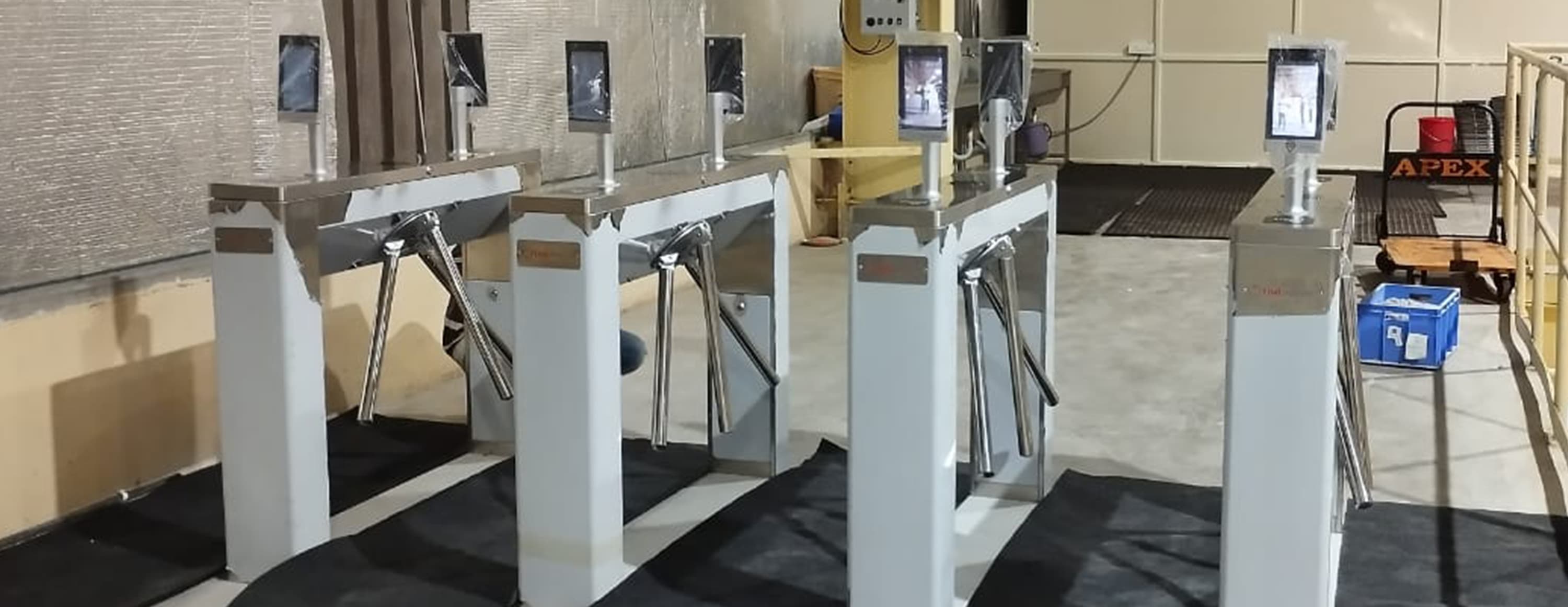
What Is a Tripod Turnstile?
A tripod turnstile — also called a tripod barrier, tripod gate or waist-height turnstile — controls the flow of people at a factory shift gate, a stadium entry, a construction site, a metro concourse or a college campus. It belongs to the same family as the flap barrier and the swing barrier, but solves the one-person-per-credential problem in a fundamentally different way.
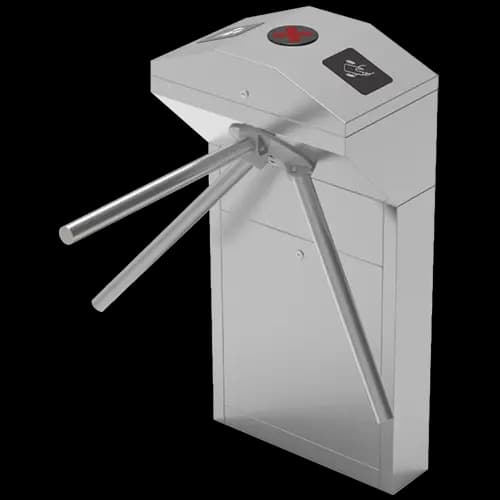
The rotor head is mounted at an angle rather than horizontally, so the arms sit at a comfortable pushing height on the approach side and sweep upward and away as the user walks through. That angle is what lets a single 120-degree turn clear the lane for one body and then present the next arm in the blocking position.
How Does a Tripod Turnstile Work?
A tripod turnstile works in five stages. A person presents a credential at the reader — a card, a fingerprint, a face, a QR code. The controller validates it and, on a valid result, releases the lock by energising a solenoid or electromagnet that withdraws a locking pin from the cam plate on the rotor shaft. The user then pushes the arm and the rotor turns through 120 degrees, its speed governed by a damper. A microswitch or encoder confirms the completed rotation, the lock re-engages against the next cam position, and the passage is logged.
Everything else on this page is detail beneath those five stages: present, validate, release, rotate and re-lock.
Main Components of a Tripod Turnstile
| Component | Function |
|---|---|
| Housing / pedestal | Stainless steel cabinet, usually 304 grade with 316 preferred in coastal and humid environments, carrying the rotor, lock, damper, controller and power supply. |
| Rotor head and three arms | Three horizontal arms 120 degrees apart on a hub, the shaft angled so the arms sweep up and away as the user passes. |
| Locking mechanism | A solenoid or electromagnet driving a locking pin, plus a cam plate keyed to the rotor shaft. The pin sits in a notch to hold the rotor. |
| Damper | A hydraulic or friction unit on the rotor shaft governing rotation speed, so the arms cannot be spun violently and come to a controlled stop. |
| Controller / control board | Drives the solenoid per direction, applies direction and anti-passback rules, manages the release timeout and talks to the access control platform. |
| Microswitch or rotary encoder | Reads rotor position and confirms a full 120-degree rotation, which triggers the re-lock and the log entry. |
| Credential reader | RFID card reader, fingerprint or palm sensor, face recognition terminal or QR scanner, normally one per side. |
| Direction indicator LEDs | Arrow and cross symbols showing whether the lane is released in a given direction, so users do not push a locked rotor. |
| Power supply | Low-voltage DC inside the housing, with battery or UPS backup where the lane must stay controlled through an outage. |
| Drop-arm mechanism (where fitted) | A latch releasing the arms so they fall vertically on fire alarm or loss of power, clearing the lane for evacuation. |
Housing and pedestal
The housing takes every push, so its fixing matters more than it looks. A tripod on an uneven or under-anchored base rocks slightly under each passage, and that movement works into the rotor bearing and the lock alignment over a few hundred thousand cycles.
Rotor head and the three arms
Three arms at 120 degrees is the smallest number that keeps one arm blocking the lane while another is clear of the walking path. Two arms would need a 180-degree turn, sweeping the trailing arm through the user's path; four would leave a gap too narrow to walk through. Arms are usually stainless steel tube and, on most models, individually replaceable after an impact.
Locking mechanism: solenoid, cam plate and locking pin
This is the heart of the device. Keyed to the rotor shaft is a cam plate carrying three notches, one per arm position. A spring-loaded pin rests in whichever notch is presented, and while it is seated the rotor cannot turn. When access is granted, a solenoid or electromagnet pulls the pin clear. The rotor is now free, but only free — nothing drives it, and the user supplies the force.
As the rotor turns, the pin rides the plate's outer profile under spring pressure until, at 120 degrees, the next notch arrives beneath it and the pin drops in. That sequence completes mechanically whatever the electronics do next, which is what makes a tripod dependable.
The damper
The damper resists rotation in a controlled way. Without it a released rotor could be spun hard, the arms would whip round and the pin would slam into the next notch. With it, the arms move at a steady pace whatever force is applied and stop softly as the lock re-engages.
It is also the component that wears. A tripod that has started to feel loose, notchy, or that slams audibly at the end of each rotation is almost always reporting its damper, not its lock. Solenoids and controllers are often replaced chasing that symptom when the fix is a damper service.
Controller, reader and rotation sensing
The controller holds the release timeout — how long the rotor stays unlocked before the permission lapses — the direction rules, the anti-passback logic and the interface to the wider system. The reader is separate from the mechanism, so a lane can be re-fitted from card to fingerprint or face recognition without touching the rotor.
Rotation is sensed by microswitches tripped by lobes on the cam plate, or on newer models by a rotary encoder reading the shaft continuously. An encoder can tell a completed passage from a turn abandoned halfway. Which method a lane uses, and how it treats a partial rotation, varies by model and should be confirmed against the datasheet.
How Does a Tripod Turnstile Work Step by Step?
| Step | What happens | How it works |
|---|---|---|
| 1 | Lane sits locked at rest | The pin is seated in a cam plate notch, holding the rotor. One arm blocks the lane at waist height and the indicator shows a cross. |
| 2 | Credential is presented | An RFID card is tapped, a finger or palm placed, a face presented, or a QR code shown to the scanner. |
| 3 | Credential is validated | The controller or access control platform checks the identity against the permitted list, with any time zone, direction or anti-passback rule. An invalid one is logged as a denied attempt. |
| 4 | Lock is released | The controller energises the solenoid for that direction, withdrawing the pin from the notch. The rotor is free and the indicator changes to an arrow. |
| 5 | User pushes the arm | On mechanical and semi-automatic models the user supplies the force. On a fully automatic model a motor drives the rotation instead. |
| 6 | Rotor turns under damper control | The damper holds the arms to a steady pace however hard they are pushed, so they cannot be spun onto the next person. |
| 7 | Rotation reaches 120 degrees | The next notch arrives beneath the waiting pin, which drops in. The rotor is locked and the next arm blocks the lane. |
| 8 | Completed rotation is detected | A microswitch tripped by the cam plate, or an encoder on the shaft, confirms a full segment has been travelled. |
| 9 | Permission is consumed | The controller clears the release, so anyone following finds the rotor locked. If rotation is not completed within the release timeout, the permission lapses with no passage recorded. |
| 10 | Event is logged | The passage - identity, direction, lane, timestamp - is written to the access control or attendance database. |
Step 9 is where a tripod differs from every other entrance control device, and it deserves its own section.
Why One Authorisation Equals Exactly One Person
A tripod turnstile is the most mechanically honest anti-tailgating device in the entrance control family, and the reason is structural rather than clever. A flap or swing barrier opens a clear lane, then uses an infrared sensor array to work out how many bodies went through it, and raises an alarm after the fact if it decides two people passed on one credential. The detection can be very good, but it is detection, and detection can be defeated by a close follower, an unusual gait, a large bag, or a lane with too few beam pairs.
A tripod does not detect anything. One release withdraws the pin from one notch, and the next notch arrives 120 degrees later and locks the rotor again. There is no configuration in which a single release permits two rotations, because the cam plate cannot present two notches in one segment. A second person cannot follow through, because by the time the first has cleared the lane an arm is already back across it.
That is why tripods persist in factories, stadiums, construction sites and transport concourses long after they stopped being the obvious choice for a corporate lobby. They are the least elegant device in the family and by some distance the most stubborn about the thing they exist to do. Where the requirement is genuinely one person per credential — headcount accuracy at shift change, ticket validation at a stadium gate, contractor control on a plant — that matters more than a better-looking lane with a sensor array.
Two honest caveats. A tripod controls passage at waist height and nothing above or below it, so the arms can be climbed over or crawled under; it depends on being part of a line — a fence, a wall, a manned lobby — not standing alone. And it guarantees one rotation per release, not that exactly one human body occupied that rotation.
Mechanical, Semi-Automatic and Fully Automatic Tripod Turnstiles
The three build types share the same rotor and the same 120-degree geometry, and differ in how the release and the rotation are produced.
| Type | How the lock is released | What turns the rotor | Typical setting |
|---|---|---|---|
| Mechanical | No electrical release. The rotor turns freely in the permitted direction, or is released by a coin, token or an attendant's lever. | The user pushes the arm. | Counting and queue discipline where no credential is needed - a paid entry point, a sports ground gate, a controlled queue lane. |
| Semi-automatic | A solenoid or electromagnet withdraws the pin on a valid credential. | The user pushes the arm. | The most common commercial configuration: factory gates, campuses, offices, construction sites. |
| Fully automatic | A solenoid or electromagnet withdraws the pin on a valid credential. | A motor drives the rotor through the full 120 degrees after release. | Higher-traffic and public-facing lanes, and sites wanting a smoother experience for users carrying items. |
Semi-automatic is what most people picture, and for good reason: fewest powered parts, tolerant of dust and rough handling, and if the electronics fail the mechanical lock still holds. Fully automatic units move the effort from the user to a motor, and add one more powered assembly to maintain. The choice is a duty and environment decision, not a hierarchy.
Drop-Arm Turnstiles and Emergency Egress
A locked rotor across a walking route is a problem during an evacuation, and there are two accepted answers to it.
The first is a drop-arm turnstile. The arms are held by a latch rather than fixed rigidly to the hub, and on a fire alarm signal or loss of power the latch releases and all three arms fall vertically. The lane is then completely clear — not merely unlocked but physically open — so people can stream through in a crowd without the rotor being turned at all. The arms are re-set by hand afterwards.
The second is a fail-locked rotor with a separate adjacent emergency gate. The turnstile keeps its integrity through an alarm and evacuation is routed through a wide side gate released by the fire panel. This suits sites where the turnstile line must stay secure during an incident.
Which of the two applies is a life-safety design decision, made with the building's fire strategy and the applicable regulations, in conversation with the fire consultant, at design stage. It is not a setting to be chosen in the controller afterwards: a drop-arm mechanism is a hardware variant that must be specified and ordered, and an emergency gate needs floor space, a signal from the fire panel and a place on the evacuation plan. Both are straightforward to get right during design and disruptive to retrofit once the fire drawings are signed off.
Behaviour on power loss varies by model and configuration and should never be assumed: some units are fail-safe, releasing the lock so the rotor can be pushed freely, some are fail-secure and hold locked, and drop-arm units clear entirely. Confirm it against the datasheet, then test it.
How Bi-Directional Control Works
A tripod rotates in one direction at a time, and most models carry separate release logic for each direction — in practice a second solenoid, or a single lock with directional cams, on its own controller input. That allows three configurations from the same hardware:
- Entry controlled, exit free — a credential is required to come in, and the rotor turns freely outward. Suits offices and campuses where egress should never be impeded but entry must be recorded.
- Both directions controlled — a credential is required each way. Necessary wherever exit events matter: attendance capture at shift end, anti-passback, occupancy counting and muster reporting.
- One direction locked entirely — the lane is made single-direction, creating dedicated entry-only and exit-only lanes in a bank of turnstiles, which improves flow at a busy gate.
The consequence people often miss: anti-passback, the rule that stops a credential entering twice without an intervening exit, only works if exits are actually read. A site that leaves exit free cannot enforce it and cannot produce a reliable live headcount. If muster reporting is on the requirement list, both directions must be controlled, and that has to be settled before the lane count is fixed.
Throughput: How Fast Is a Tripod Turnstile Lane?
Because each person must physically rotate the arms through a full segment, a tripod is slower than a retracting-flap lane. Figures commonly quoted are in the region of 20 to 30 people per minute per lane, but this is approximate and equipment-dependent — it varies with the model, whether the unit is semi-automatic or fully automatic, the damper setting and the controller timing.
The quoted rate also assumes credentials are presented smoothly and continuously. In a real factory gate at shift change the limiting factor is rarely the rotor; it is how long each person takes to find a card or position a finger. Sizing lane count from observed peak behaviour produces a gate that works. Dividing headcount by a catalogue figure produces a queue in the sun.
Technologies Used in a Tripod Turnstile System
A tripod turnstile lane brings together several distinct technologies:
- Electromagnetic actuation — a solenoid or electromagnet converting a control signal into the movement that withdraws the locking pin.
- Mechanical indexing — the cam plate and spring-loaded pin that make one release equal exactly one segment.
- Hydraulic or friction damping — speed governance independent of applied force.
- Position sensing — cam-actuated microswitches or a rotary encoder confirming completed rotation and direction.
- Credential technologies — 13.56 MHz and 125 kHz RFID, fingerprint and palm biometrics, face recognition, QR reading.
- Embedded control logic — direction rules, release timeouts, anti-passback and alarm handling, with TCP/IP, RS-485 or Wiegand communication to access control, attendance and surveillance platforms.
- Dry-contact fire interface — the hardwired link that drops the arms or releases the lock on alarm, overriding all software logic.
Where Tripod Turnstiles Are Used
Tripod turnstiles appear wherever passage needs to be controlled and counted one person at a time, and where the environment is harder on equipment than a reception floor:
- Manufacturing plants and industrial estates — shift entry and exit with attendance capture at the gate, across the industrial belts of Maharashtra and Gujarat and the textile and engineering clusters around Surat and Ahmedabad.
- Construction sites and project offices — contractor and labour headcount control, where equipment must tolerate dust, vibration and temporary power.
- Stadiums and sports grounds — ticket validation at entry, where the mechanical one-person-per-scan property directly protects crowd capacity limits.
- Metro stations and transport terminals — passenger lanes paired with ticketing and QR validation, alongside wider gates for luggage.
- Educational campuses — student and staff entry with attendance recorded at the lane, common on the large university sites of Tamil Nadu, Karnataka and Uttar Pradesh.
- Warehouses, logistics parks and ports — separating pedestrian movement from vehicle routes, including the port and industrial developments around Bhubaneswar and across coastal Odisha.
- Offices, public institutions and government buildings — secondary entrances, service lobbies and controlled visitor entry with logging, in use across Kolkata, Chennai, Bengaluru, Pune, Mumbai and West Bengal more widely.
TimeWatch India supplies, installs and services tripod turnstiles and associated pedestrian entrance control equipment across India.
Integration With Other Systems
A tripod turnstile lane rarely operates alone. Typical integrations:
- Access control — the credential database governing doors and vehicle gates also governs the lane, so one revocation closes every route.
- Time and attendance — the passage event doubles as the attendance punch. On a factory gate this is often the main reason the turnstile is there at all, because it removes a separate clocking queue at shift change.
- Visitor management — a pre-registered visitor receives a QR code or temporary card the lane accepts for a defined window.
- Contractor and induction systems — the lane can be set to release only for workers whose safety induction and permit are current, so compliance is enforced at the gate rather than checked on paper.
- CCTV and video analytics — footage is bookmarked against each lane event, so any denied attempt can be reviewed by its log entry.
- Fire alarm systems — the dry contact that drops the arms or releases the lock on alarm.
- Occupancy and muster reporting — reliable only where both directions are controlled.
Installation Considerations
Most tripod turnstile problems trace back to layout and installation rather than the equipment. The principal considerations:
- An accessible route is mandatory, not optional. No wheelchair, trolley, stretcher, pram or large item of luggage can pass through a tripod turnstile, and no configuration changes that. Any installation built only from tripods must have an adjacent wide gate, planned into the entrance from the start.
- The adjacent gate must itself be controlled. This is where accessible routes usually go wrong. A wide gate left on a manual latch, or propped open at busy times, becomes the weak point in the whole line — everything the turnstiles enforce is undone by the gate beside them. It needs its own reader, its own lock and its own place in the log.
- Foundation and anchoring — a level base and correctly torqued anchor bolts. Movement under load transfers into the rotor bearing and the lock alignment.
- Lane geometry — guide railings or a fence line on both sides, so the turnstile cannot simply be walked around. A tripod standing free in an open concourse controls nothing.
- Approach and exit space — enough depth in front for a queue and clear space behind so people leaving are not blocked.
- Reader position — set where the user is already reaching the arm as the release lands. A badly placed reader adds a second to every passage, visible at shift change.
- Cabling — power, network and reader cabling up through the floor into the housing base in conduit laid before the floor finish, and the fire panel dry contact pulled and tested during installation with whichever egress strategy has been chosen.
- Power supply and backup — stable supply, with UPS where lane control must survive an outage, and a tested understanding of what the lane does when the supply fails.
Maintenance Considerations
Tripod turnstiles are mechanical devices cycling continuously, often in dusty or humid environments. Routine attention keeps them dependable:
- Check the damper. A lane that has become loose, notchy, or that slams at the end of rotation is usually reporting damper wear, and this is the most commonly misdiagnosed fault on the device.
- Verify the pin seats cleanly in each of the three notches and that the rotor cannot be reversed once locked.
- Listen to the solenoid on release; a sluggish or chattering actuation is an early warning. Confirm the microswitch or encoder registers every completed rotation, by comparing physical passages against logged events over a sample period.
- Inspect the arms for bending, impact damage and secure fixing at the hub, and check the housing for movement under load.
- On drop-arm units, test the drop and the manual re-set during fire drills, and confirm the arms fall cleanly and completely.
- Review logs for a rise in incomplete rotations, which usually points to a release timeout set too short, a reader too far from the arm, or a damper that has stiffened.
Benefits and Limitations
Benefits
- Mechanical one-person-per-credential enforcement that does not depend on sensors, software or configuration being correct.
- Robust in dust, humidity, vibration and rough handling, which is why the type endures at factory and site gates.
- Few powered components on semi-automatic models, and a mechanical lock that holds if the electronics fail.
- Reader-agnostic: card, fingerprint, face or QR, changeable without altering the mechanism.
- A complete audit trail by identity, direction and time, usable for attendance and, where both directions are controlled, for occupancy reporting.
Limitations and considerations
- No accessible passage whatsoever. Wheelchairs, trolleys, stretchers, prams and large luggage cannot pass. An adjacent wide gate is required, and unless it is itself controlled it becomes the weakest point in the installation.
- Waist-height control only. The arms can be climbed over or crawled under. The device works as part of a physical line, not on its own.
- Lower throughput than flap and swing barriers, because each person must complete a physical rotation.
- The user has to do something. Semi-automatic models require a deliberate push, awkward for anyone carrying items.
- The damper is a consumable. Plan for its service or replacement rather than chasing a change in feel through the electronics.
- Egress behaviour must be designed in. Drop-arm or adjacent emergency gate is a hardware and layout decision taken with the fire strategy, not a configuration choice made later.
Exact behaviour — release timeout, rotation sensing method, damper characteristics, power-failure state and integration options — depends on the model, controller, firmware and site configuration, and should always be confirmed against the datasheet for the equipment being specified.
Tripod Turnstile vs Flap Barrier vs Swing Barrier vs Full-Height Turnstile
| Aspect | Tripod turnstile | Flap barrier | Swing barrier | Full-height turnstile |
|---|---|---|---|---|
| Mechanism | Three arms on an angled rotor; the user pushes through a 120-degree segment after release | Flaps retract horizontally into the pedestals | Solid panels rotate open through an arc on a vertical pivot | Full-height rotor with vertical bars turning within a fixed cage |
| Anti-tailgating method | Mechanical. One release permits exactly one rotation; a second person cannot follow | Sensor-based. An infrared array counts bodies and alarms on a violation | Sensor-based, same principle as the flap barrier | Mechanical and complete; the cage blocks the opening from floor to head height |
| Accessibility | None. A separate wide gate is required, and it must itself be controlled | Standard lanes are narrow; a wide accessible lane is normally added alongside | Wide-panel versions often serve as the accessible lane in a bank of gates | None. A separate accessible gate is always required |
| Throughput | Moderate; commonly quoted around 20 to 30 people per minute per lane, equipment-dependent | Fast; commonly quoted around 30 to 40 people per minute per lane, equipment-dependent | Moderate; the panel sweeps an arc, so the cycle is longer than a flap | Lowest of the four; the rotor is large and each passage takes longer |
| Robustness | High. Simple mechanism, few powered parts, tolerant of dust and rough handling | Light flaps designed to yield; can be forced or vaulted | Heavier panels, somewhat more resistant, still not a restraint | Highest. A physical barrier that cannot be climbed or bypassed |
| Typical setting | Factory gates, construction sites, stadiums, campuses, concourses | Corporate lobbies, IT parks, metro concourses, high-traffic entrances | Reception areas needing a wider lane, mixed pedestrian and trolley traffic | Perimeter lines, unmanned entrances, substations, high-security compounds |
The four are not better and worse versions of one another. A tripod is chosen for mechanical enforcement and durability, a flap barrier for throughput and appearance, a swing barrier for lane width and mixed traffic, a full-height turnstile for an unmanned perimeter that must not be climbed. Many sites use more than one type on the same entrance — a bank of tripods for the shift crowd, a controlled wide gate beside them, and a full-height unit on the perimeter after hours.
Frequently Asked Questions
How does a tripod turnstile allow only one person at a time?
The rotor carries a cam plate with three notches, one per arm position, and a spring-loaded pin sits in whichever notch is presented. A valid credential energises a solenoid that pulls the pin clear, and the rotor turns 120 degrees until the next notch arrives beneath the pin and locks it again. One release permits exactly one rotation, so a second person finds the rotor locked and must present their own credential.
Why does a tripod turnstile rotate 120 degrees?
Three arms set 120 degrees apart is the smallest arrangement that keeps one arm blocking the lane while another is clear of the walking path. Two arms would need a 180-degree turn, sweeping the trailing arm through the user's path, and four arms would leave a gap too narrow for comfortable passage.
What is the damper in a tripod turnstile for?
The damper is a hydraulic or friction unit on the rotor shaft that governs rotation speed. It stops the arms being spun violently however hard they are pushed and brings them to a controlled stop as the lock re-engages. It is also the part that wears: a turnstile that feels loose or notchy, or that slams at the end of each rotation, is usually reporting damper wear rather than a fault in the lock or the controller.
What is the difference between a mechanical, semi-automatic and fully automatic tripod turnstile?
A mechanical tripod has no electrical release and turns freely in the permitted direction, or is released by a coin, token or attendant lever. A semi-automatic tripod uses a solenoid or electromagnet to release the lock on a valid credential, and the user pushes the arm. A fully automatic tripod releases the lock in the same way, but a motor drives the rotation.
What is a drop-arm tripod turnstile?
A drop-arm tripod holds its three arms on a latch rather than fixing them rigidly to the hub. On a fire alarm signal or a loss of power the latch releases and all three arms fall vertically, leaving the lane physically clear so people can evacuate in a crowd without turning the rotor. The arms are re-set by hand afterwards.
What happens to a tripod turnstile during a fire alarm or power failure?
It depends on which egress strategy was designed in. A drop-arm unit releases its arms so the lane clears completely. Other installations keep a fail-locked rotor and route evacuation through a separate adjacent emergency gate released by the fire panel. Some units are configured fail-safe and some fail-secure, varying by model. It is a life-safety decision to be agreed with the fire consultant at design stage, not a setting chosen in the controller afterwards.
Are tripod turnstiles wheelchair accessible?
No. No wheelchair, trolley, stretcher, pram or large item of luggage can pass through a tripod turnstile, and no configuration changes that. Any installation built only from tripods needs an adjacent wide gate, and that gate must itself be controlled with its own reader and lock, because one left on a manual latch or propped open at busy times becomes the weakest point in the whole line.
Can a tripod turnstile be used in both directions?
Yes. Most models carry separate release logic for each direction, so a lane can be set to control entry while leaving exit free, to control both directions, or to allow one direction only. If anti-passback, live occupancy counting or muster reporting is required, both directions must be controlled, because none of those can work unless exits are actually read.
How many people per minute can a tripod turnstile handle?
Figures commonly quoted are in the region of 20 to 30 people per minute per lane, but this is approximate and varies by model, by whether the unit is semi-automatic or fully automatic, and by the damper and controller settings. In practice the limiting factor is how quickly people find their card, so lane count should be sized from observed peak behaviour rather than a catalogue rate.
Can a tripod turnstile be climbed over or bypassed?
The arms control passage at waist height and do nothing above or below that line, so a determined person can climb over or crawl under them. A tripod works as part of a physical line such as a fence, a wall or a manned lobby, not standing alone in an open concourse. Where a barrier that cannot be climbed is the requirement, a full-height turnstile is the appropriate equipment.
How is a tripod turnstile integrated with access control and attendance software?
The lane controller connects to the access control platform over TCP/IP, RS-485 or Wiegand. The software holds the permitted credential list, applies time zone, direction and anti-passback rules, and records each completed rotation with identity, direction, lane and timestamp. On factory and campus gates that event commonly doubles as the attendance punch, removing a separate clocking queue at shift change.
