

What Is a Flap Barrier Gate?
A flap barrier gate — often called a flap barrier turnstile, and in its taller glass-clad lobby form a speed gate — manages the flow of people at a controlled point: an office reception, a metro concourse, a factory gate, a campus entrance. It sits in the same family as the swing barrier and the tripod turnstile, and the differences between them are mechanical rather than conceptual.
The important framing is this: a flap barrier is an access management and detection device, not a physical restraint, and its flaps are light by design. What it provides is a controlled, auditable decision point where nothing passes until the system has established that it is allowed to, every passage is logged, and anything irregular raises an alarm.
How Does a Flap Barrier Gate Work?
A flap barrier gate works in five stages. A person presents a credential at the reader — a card, a fingerprint, a face, a QR code on a phone. The controller validates it against the permitted list. On a valid result the drive motor retracts the flaps horizontally into the pedestal housings, clearing the lane. The infrared sensor array tracks the person through the lane, counting bodies and reading direction. Once passage is confirmed, the flaps extend back across the lane and the event is written to the access control log.
Everything else on this page is detail beneath those five stages: present, validate, retract, track, close and log.
Main Components of a Flap Barrier Gate
| Component | Function |
|---|---|
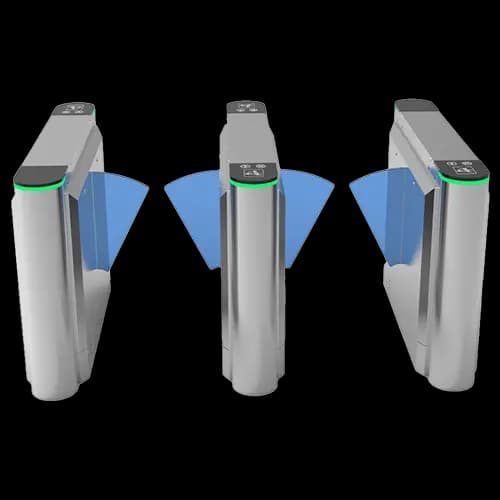
| Pedestal housings | Stainless steel cabinets either side of the lane, holding the drive assembly, controller, sensor array and the retracted flaps. Usually 304 or 316 grade, with 316 preferred in coastal and humid environments. |
| Retractable flaps | The moving panels that block the lane. Typically acrylic or polycarbonate, sometimes tempered glass. They withdraw into slots in the pedestals rather than rotating open. |
| Drive motor and mechanism | A servo or brushless DC motor with a linkage, rack or belt converting rotation into the flaps' horizontal retraction and extension. Low flap mass means low inertia, which allows a short cycle. |
| Controller / control board | The logic of the lane. Accepts reader and sensor inputs, drives the motor, applies the anti-tailgating and direction rules, raises alarms and communicates with the access control platform. |
| Infrared sensor array | Multiple transmitter and receiver beam pairs at varying heights down the facing sides of both pedestals. The pattern and sequence of broken beams is what the controller reads to determine presence, direction and body count. |
| Credential reader | RFID card reader, fingerprint or palm sensor, face recognition terminal, QR scanner, or a combination. Mounted on the pedestal top or integrated into its face. |
| Direction indicators | LED arrows or cross symbols on the pedestal tops showing whether the lane is open in a given direction. |
| Alarm | Audible and visual indication on tailgating, wrong-way entry, forced passage or an unauthorised attempt. Normally also sent to the software as an event. |
| Power supply and backup | Low-voltage DC supply inside the pedestal, with battery or UPS backup where the lane must stay controlled through an interruption. |
| Manual release | A mechanism freeing the flaps so the lane can be opened by hand during power failure or maintenance. |
Pedestal housings and retractable flaps
The pedestal is not simply a cover. Its internal width sets how far the flaps can withdraw and therefore the clear lane width, and its facing surface carries the sensor array — so alignment relative to the opposite pedestal is a functional requirement, not a cosmetic one. Two pedestals installed slightly out of parallel produce intermittent sensor faults that are easily misdiagnosed as an electronics problem.
Drive motor and retraction mechanism
Most current models use a brushless DC or servo motor with encoder feedback rather than a simple geared AC motor. The encoder tells the controller exactly where the flaps are throughout travel, which supports precise stopping, soft start and soft stop so the flaps do not snap open, and obstruction detection by comparing expected against actual position. Cycle behaviour, holding force and reversal sensitivity are configurable on most controllers and differ between models.
Controller and credential reader
The controller holds the open timers, the direction rules, the response to each sensor pattern, the alarm logic and the interface to the wider system. The reader is deliberately separate from it — a lane can be re-fitted from card to face recognition, or made to accept both, without changing the barrier mechanism, because the reader simply supplies a validated identity to the same controller input.
Infrared sensor array
This is the part that makes a flap barrier more than a powered gate, and it is covered in full in the next section.
How Does a Flap Barrier Gate Work Step by Step?
| Step | What happens | How it works |
|---|---|---|
| 1 | Person approaches the lane | The first beams of the infrared array register someone at the entry mouth, and the direction indicator shows whether the lane is open that way. |
| 2 | Credential is presented | An RFID card is tapped, a finger or palm is placed, a face is presented to the terminal, or a QR code is shown to the scanner. |
| 3 | Credential is validated | The reader passes the identity to the controller or access control platform, which checks it against the permitted list along with any time zone, direction or anti-passback rule. A valid match produces an open command; an invalid one is logged as a denied attempt. |
| 4 | Drive motor retracts the flaps | The controller energises the motor, which draws both flaps horizontally into the pedestal housings, clearing the lane. This horizontal retraction is the mechanical difference from a swing barrier, whose panels rotate open through an arc. |
| 5 | Open position is confirmed | The encoder or a limit position tells the controller the flaps are fully withdrawn, and the motor stops. |
| 6 | Person walks through | The infrared beam pairs break and restore in sequence as the body moves down the lane. The controller reads that sequence continuously. |
| 7 | Passage is analysed | From which beams broke, at what heights and in what order, the controller determines direction, counts bodies in the lane, and decides whether the passage is a single authorised person or a violation. |
| 8 | Passage is confirmed complete | When the exit-side beams clear and no further body is detected, the controller treats the passage as finished. |
| 9 | Flaps extend back across the lane | The motor drives the flaps out of the pedestals until they meet at the lane centre, ready for the next credential. |
| 10 | Event is logged | The passage - identity, direction, lane, timestamp and any alarm - is written to the access control or attendance database. |
If a second person is detected in the lane without a second authorisation, or if someone enters against the set direction, the controller does not complete step 9 normally. It closes the flaps and raises an alarm instead, which is the subject of the next section.
How the Infrared Sensor Array Detects Tailgating
The sensor array is the core of the anti-tailgating logic and the single component that most distinguishes a capable lane from a basic one. Along the facing side of each pedestal sits a column of infrared emitters with matching receivers opposite, each pair forming a beam across the lane at a set height. A lane may carry anywhere from a handful of pairs to well over twenty, depending on the model. Nothing about a single beam is clever; what the controller does with the whole pattern is.
As a person walks through, their body interrupts beams in a characteristic order — entry-side first, then middle, then exit-side — and beams at torso height break for longer than those at head or knee height. From that pattern the controller derives three things:
- Direction — the order in which beams break tells the controller which way the person is travelling; entry against a lane set for exit is flagged as wrong-way passage.
- Body count — one body produces a single continuous block of interruption moving down the lane; two produce a second block before the first has cleared.
- Anomalies — a low break with nothing above it may be a bag or trolley; a break that stops mid-lane may be someone who has turned back.
On a violation the controller closes the flaps and raises the alarm, and the event appears in the software with its own classification so it can be reviewed later against CCTV.
Sensor array quality decides anti-tailgating quality. A lane with too few beam pairs, or with all of them clustered at one height, simply cannot resolve a second person following closely behind the first — the two bodies read as one continuous interruption and nothing is flagged. Where anti-tailgating is a genuine requirement rather than a line item, the number of beam pairs and their height distribution deserves as much attention during specification as the finish of the pedestal.
Flap Materials and Why They Are Chosen
Flaps are usually acrylic or polycarbonate, and the choice is deliberate on two counts. First, mass: a light panel has low inertia, so it can be accelerated and stopped quickly, which is what makes the short cycle possible. Second, behaviour on contact: a light panel with rounded edges yields rather than injures if it meets a person, which matters in a device closing across a walking route used by children, older people and anyone carrying something.
Polycarbonate is the tougher of the two and resists impact better; acrylic is more scratch-resistant and holds optical clarity well. Some models, particularly speed gates for corporate lobbies, use tempered glass flaps for appearance. Glass is heavier and changes the drive requirement, so it is a design choice made at model level rather than a field substitution.
Throughput: How Fast Is a Flap Barrier Lane?
Because the flaps retract rather than swing through an arc, the cycle is short. Figures commonly quoted for flap barrier lanes are in the region of 30 to 40 people per minute per lane, but this is approximate and equipment-dependent — it varies with the model, the drive, the controller timing and how the lane is configured.
It also assumes something real entrances rarely deliver. Quoted throughput figures assume people present credentials smoothly and continuously. In an actual lobby at nine in the morning the limiting factor is almost never how fast the flaps move; it is how long someone takes to find their card in a bag, position a finger correctly, or stop and look at the face terminal. A lane whose mechanism supports 40 passages a minute will deliver far fewer if each person needs three seconds to produce a credential.
The design consequence is straightforward: size the lane count from observed peak behaviour at the entrance, not from the catalogue rate. Watching an existing entrance during its real morning peak produces a lane count that works. Dividing headcount by a catalogue figure produces a queue.
How Flap Barrier Safety Systems Work
Because the flaps move across a space people occupy, layered protection is standard, and each layer works differently.
- Presence interlock — while the array detects a body in the lane the controller is inhibited from closing, which prevents the close command rather than interrupting one.
- Obstruction detection — the controller monitors motor load or encoder feedback. A rise in load, or travel stopping short of the expected position, is read as contact and the flaps reverse. Sensitivity is usually configurable and differs between models.
- Yielding flap material — the light acrylic or polycarbonate panel is itself part of the safety design, limiting the force applied to a person.
- Fire alarm interface — a dry contact from the fire panel drives the flaps to retract and hold open, clearing the escape route. On any lane that forms part of an egress path this should be treated as essential.
- Power failure behaviour — most lanes are configured to retract and stay open on loss of power where they sit on an escape route.
That last pair is a life-safety decision, not a default. Fail-safe means the lane opens on alarm or power loss, prioritising evacuation; fail-secure means it stays closed, prioritising containment. Which applies depends on the route, the building's fire strategy and the applicable regulations, and it must be agreed with the fire consultant and recorded.
Speed Gates vs Standard Flap Barriers
The terms overlap and are used loosely, so it is worth being precise. A speed gate works on the same principle as a standard flap barrier — retracting panels, infrared array, the same operating sequence. The difference is build and setting:
- Taller glass pedestals rather than short stainless cabinets, often with the array hidden behind the glass.
- Slimmer profile, so a bank of lanes takes less floor area and reads as part of the reception design.
- Quieter drive, because a lobby where people are met and greeted cannot tolerate mechanical noise.
- Finish-led design — glass, brushed metal, integrated lighting and flush readers, for corporate lobbies rather than factory gates.
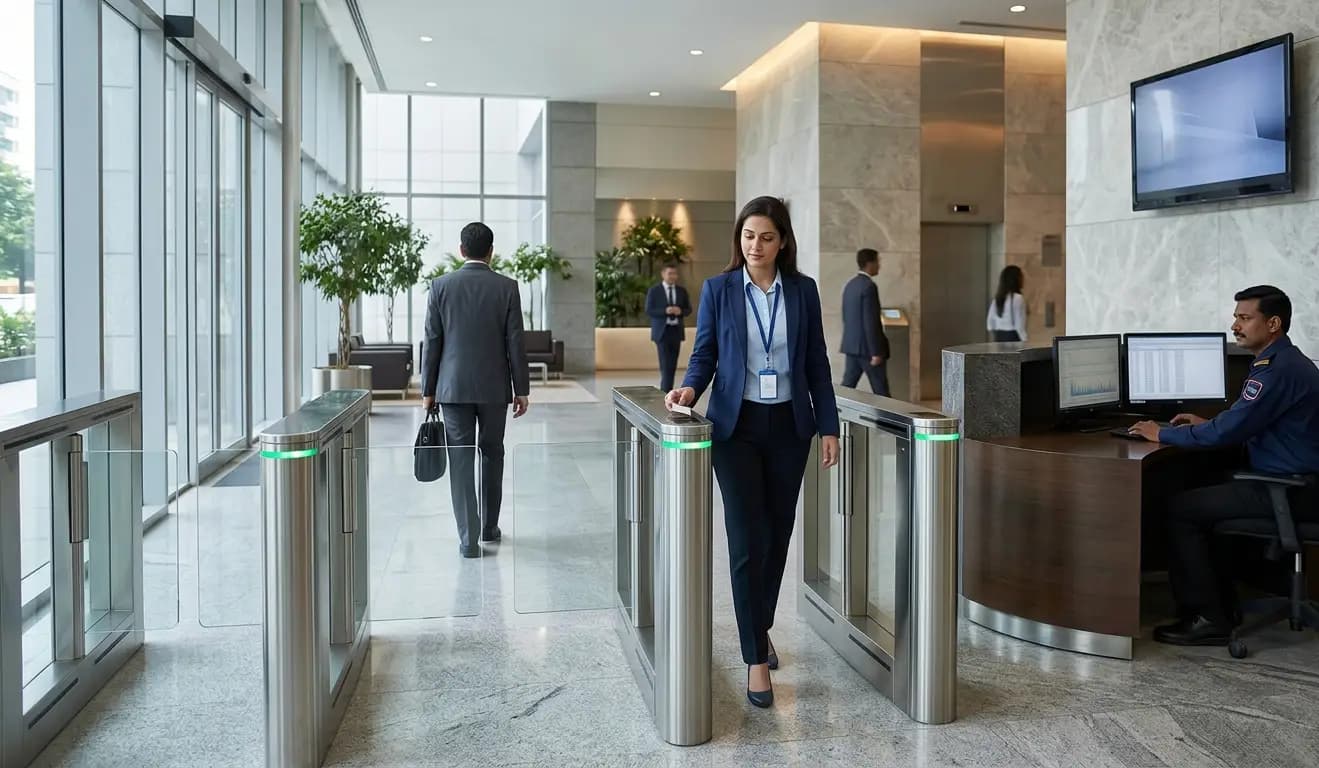
A standard flap barrier is built for utility: robust stainless pedestals, straightforward maintenance access, and tolerance of the dust and traffic of an industrial gate or transport concourse. Neither is a better device; they are built for different rooms.
Technologies Used in a Flap Barrier System
A modern flap barrier lane brings together several distinct technologies:
- Modulated infrared sensing — beam pairs resistant to ambient light interference.
- Servo or brushless DC motor control — soft start and stop, current monitoring, configurable holding force.
- Encoder position feedback — continuous position sensing supporting precise stopping and obstruction detection.
- Credential technologies — 13.56 MHz and 125 kHz RFID, fingerprint and palm biometrics, face recognition, QR reading.
- Embedded control logic — sequence analysis converting broken-beam patterns into direction, count and violation decisions.
- Network communication — TCP/IP, RS-485 or Wiegand to access control, attendance and surveillance platforms.
- Dry-contact fire interface — the hardwired link overriding all logic to open the lane on alarm.
Where Flap Barrier Gates Are Used
Flap barrier gates appear anywhere pedestrian movement needs to be controlled, counted and recorded:
- Corporate offices and IT parks — reception lanes controlling employee and visitor entry, usually in speed gate form, common across the technology corridors of Karnataka and Telangana and the business districts of Gurugram and Noida.
- Manufacturing plants and industrial estates — shift entry and exit with attendance capture at the gate, across the industrial belts of Maharashtra, Haryana and Tamil Nadu.
- Metro stations and transport terminals — high-throughput passenger lanes, often paired with ticketing and QR validation.
- Hospitals — separating restricted clinical areas from public circulation while keeping a wide lane clear for stretchers and equipment.
- Educational campuses — regulating student and staff entry across large university and school sites, with attendance recorded at the lane.
- Government buildings and public institutions — visitor-controlled entry with logging, including sites across Uttar Pradesh and West Bengal.
- Data centres and high-security facilities — tighter anti-tailgating settings, denser sensor arrays and interlocked lanes.
- Stadiums, exhibition centres and event venues — managing large crowds in and out in Mumbai, Bengaluru, Hyderabad, Chennai, Pune and Kolkata among others.
TimeWatch India supplies, installs and services flap barrier gates, speed gates and associated pedestrian entrance control equipment across India.
Integration With Other Systems
A flap barrier lane rarely operates alone. Typical integrations:
- Access control — the credential database governing doors and vehicle gates also governs the lane, so one revocation closes every route.
- Time and attendance — the passage event doubles as the attendance punch, removing a separate clocking step at shift change.
- Visitor management — a pre-registered visitor gets a QR code or temporary card the lane accepts for a defined window, with arrival notified to the host.
- Face recognition terminals — hands-free presentation, which removes one of the main causes of queueing at the lane.
- CCTV and video analytics — footage is bookmarked against each lane event, so any tailgating alarm can be reviewed by its log entry.
- Fire alarm systems — automatic retract-and-hold on alarm where the lane forms an escape route.
- Occupancy and muster reporting — because the array counts bodies rather than credentials, the lane can support a reasonably accurate live occupancy figure.
Installation Considerations
Most flap barrier problems trace back to installation and layout rather than the equipment. The principal considerations:
- Floor flatness and pedestal alignment — the pedestals must be level and truly parallel, or opposing sensor pairs fall out of alignment and produce intermittent faults.
- Lane width and accessibility — a standard flap lane will not take a wheelchair, a trolley or large luggage, so an entrance built entirely from standard lanes has an accessibility problem. Most installations pair several standard lanes with at least one wide accessible lane, and this should be settled at design stage, not discovered at handover.
- Queueing and circulation space — approach depth in front of the lanes and clear space behind, so people leaving are not blocked by those waiting for a lift.
- Cable routing — power, network and reader cabling up through the floor into the pedestal base, in conduit laid before the floor finish.
- Reader position — set at a height and angle people find without being told. A badly placed reader slows every single passage.
- Lighting — direct sunlight onto the array affects some models; check the manufacturer's guidance for lanes near a glazed façade.
- Power supply and backup — stable supply, with UPS where lane control must survive an interruption.
- Fire interface wiring — the dry contact from the fire panel must be pulled and tested during installation, not added later.
Maintenance Considerations
Flap barriers are electromechanical devices cycling continuously in a public space. Routine attention keeps them dependable:
- Clean the emitter and receiver windows on both pedestals; dust and fingerprints are a frequent cause of erratic detection.
- Check pedestal alignment, particularly after any floor work or an impact from a trolley.
- Inspect flaps for scratches, cracks and edge damage, and confirm they meet cleanly at the centre.
- Verify the drive runs smoothly through full travel with no binding at either end.
- Test obstruction reversal deliberately, with a soft object, at the configured sensitivity.
- Test the fire alarm interface during scheduled drills and confirm the lane behaves as the fire strategy requires.
- Confirm the manual release operates, before it is needed.
- Review alarm logs — a rise in tailgating alarms at one lane often points to a sensor or layout problem rather than a change in behaviour.
Benefits and Limitations
Benefits
- Fast cycle and high lane throughput compared with rotating-arm devices, because the flaps retract rather than sweep.
- Anti-tailgating and direction detection through the infrared array, with each violation logged and alarmed.
- A complete audit trail by identity, direction and time, usable for attendance and occupancy reporting.
- Reader-agnostic: card, fingerprint, face or QR, changeable without altering the mechanism.
- In speed gate form, an entrance control device that suits a designed reception rather than fighting it.
Limitations and considerations
- A flap barrier controls passage; it does not physically restrain. The flaps are light by design and a determined person can force or vault them. The security value comes from the barrier, the alarm, CCTV coverage and a defined response procedure together — the device alone is not the control.
- Lane width is a real constraint. Standard lanes do not take wheelchairs, trolleys or large luggage, so a wide accessible lane is normally required alongside.
- Anti-tailgating performance varies widely with array density and height distribution. Too few beams and a close follower is not detected at all.
- Quoted throughput is not achieved throughput. Credential presentation speed, not flap speed, sets the real rate.
- Flap surfaces show wear in heavy public use; scratching is cosmetic but visible, and replacement panels should be planned for.
Exact behaviour — cycle time, sensor count, obstruction sensitivity, fail-safe configuration and integration options — depends on the specific model, controller, firmware and site configuration, and should always be confirmed against the datasheet for the equipment being specified.
Flap Barrier vs Swing Barrier vs Tripod Turnstile
| Aspect | Flap barrier | Swing barrier | Tripod turnstile |
|---|---|---|---|
| Mechanism | Flaps retract horizontally into the pedestals | Solid panels rotate open through an arc on a vertical pivot | Three horizontal arms rotate about a hub; the user pushes through one segment |
| Cycle speed and throughput | Fast; commonly quoted around 30 to 40 people per minute per lane, equipment-dependent | Moderate; the panel must sweep an arc, so the cycle is longer | Slower; each person must physically rotate the arms one segment at a time |
| Accessibility | Standard lanes are narrow; a wide accessible lane is normally added alongside | Wide-panel versions often serve as the accessible lane in a bank of gates | Not accessible; a separate gate is required for wheelchairs and trolleys |
| Physical robustness | Light flaps designed to yield; can be forced or vaulted | Heavier panels, somewhat more resistant, still not a restraint | Mechanically the most resistant of the three; the arms physically block the waist line |
| Typical setting | Corporate lobbies, IT parks, metro concourses, high-traffic entrances | Reception areas needing a wider lane, mixed pedestrian and trolley traffic | Factory gates, stadiums, construction sites and other rough-duty high-volume entries |
The three are not better and worse versions of one another. A flap barrier is chosen for throughput and appearance, a swing barrier for lane width and mixed traffic, a tripod turnstile for durability in rough conditions. Many sites use more than one type on the same entrance.
Frequently Asked Questions
How does a flap barrier gate open?
When a valid credential is read, the controller sends an open command to the drive motor, which retracts both flaps horizontally into the pedestal housings either side of the lane. The flaps slide away rather than swinging through an arc, which is what makes the cycle short. Once the infrared array confirms the person has passed, the flaps extend back across the lane.
What is the difference between a flap barrier and a swing barrier?
The difference is mechanical. A flap barrier retracts its flaps horizontally into the pedestals; a swing barrier rotates solid panels open through an arc on a vertical pivot. The retracting action gives the flap barrier a shorter cycle, while the swing barrier is generally available in wider lane formats that suit trolleys, luggage and wheelchair access.
How does a flap barrier detect tailgating?
An infrared sensor array runs down the facing sides of both pedestals, with multiple beam pairs at varying heights. As a person walks through, the controller reads which beams break and in what order, and from that pattern works out direction of travel and counts the bodies in the lane. If a second person is detected without a second authorisation, the flaps close and an alarm is raised.
How many people per minute can a flap barrier handle?
Figures commonly quoted are in the region of 30 to 40 people per minute per lane, but this is approximate and varies by model and configuration. It also assumes credentials are presented smoothly and continuously. In practice the limiting factor is how quickly people find their card or present their face, not how fast the flaps move, so lane count should be sized from observed peak behaviour rather than a catalogue rate.
What are flap barrier flaps made of?
Usually acrylic or polycarbonate. Both are light, which keeps inertia low so the flaps move quickly, and both yield rather than injure on contact. Polycarbonate resists impact better and acrylic holds optical clarity well. Some models, particularly speed gates for corporate lobbies, use tempered glass flaps for appearance.
Can a flap barrier stop an intruder?
No. A flap barrier controls passage but does not physically restrain. The flaps are deliberately light, and a determined person can force or vault them. It is an access management and detection device, and its security value comes from the barrier working together with the alarm, CCTV and a defined response procedure.
What happens to a flap barrier during a fire alarm or power failure?
Where the lane forms part of an escape route it is normally configured to retract the flaps and stay open on fire alarm or power failure, so evacuation is not obstructed, driven by a dry contact from the fire panel. Whether a lane is set fail-safe or fail-secure is a life-safety decision to be agreed with the fire consultant and recorded, because behaviour varies by configuration.
Are flap barriers wheelchair accessible?
Standard flap barrier lanes are narrow and will not take a wheelchair, a trolley or large luggage, so an entrance built entirely from standard lanes has an accessibility problem. Most installations pair several standard lanes with at least one wide accessible lane, and this should be decided at design stage rather than after handover.
What is the difference between a flap barrier and a speed gate?
They work on the same principle and follow the same operating sequence; the difference is build and setting. A speed gate has taller glass pedestals, a slimmer profile and a quieter drive, and is designed for corporate lobbies. A standard flap barrier uses shorter stainless steel pedestals built for utility and easier maintenance in industrial gates and transport concourses.
How is a flap barrier integrated with access control software?
The lane controller connects to the access control platform over TCP/IP, RS-485 or Wiegand. The software holds the permitted credential list, applies time zone, direction and anti-passback rules, and records each passage with identity, direction, lane, timestamp and any alarm raised. Because doors, vehicle gates and pedestrian lanes share one credential database, revoking a person's access closes every route at once.
How much maintenance does a flap barrier need?
Servicing intervals depend on passage count and environment rather than a fixed calendar. Routine work covers cleaning the infrared emitter and receiver windows, checking pedestal alignment, inspecting the flaps, verifying smooth drive travel, testing obstruction reversal and testing the fire alarm interface. Busy public lanes need attention more often than a low-traffic office entrance.
