
What Is a Swing Barrier?
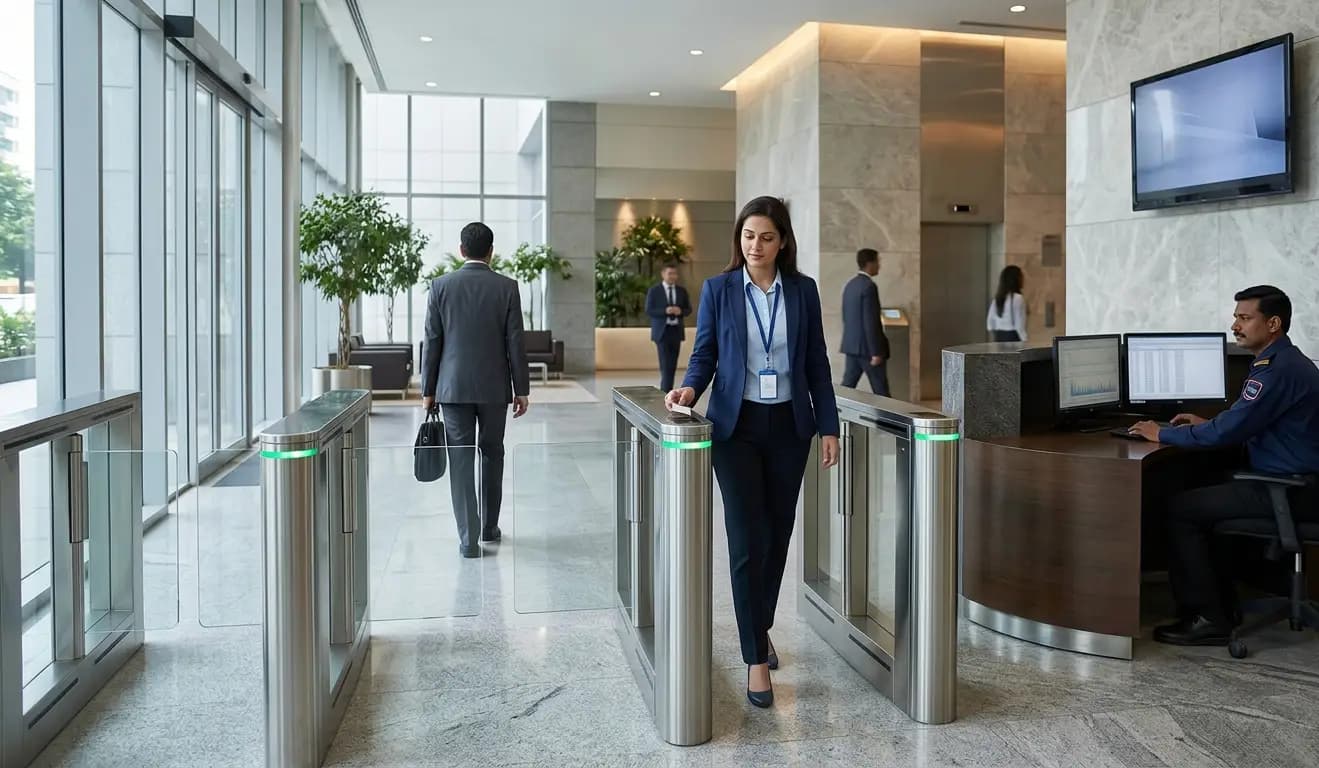
A swing barrier — also called a swing gate or swing turnstile — sits in lobbies, reception areas and campus entrances where pedestrian movement has to be controlled and recorded. It belongs to the same family as the flap barrier and the tripod turnstile, and the three are frequently installed together in one entrance. The distinction between them is mechanical, and it drives which lane a given person can actually use.
Like a boom barrier on a vehicle lane, a swing barrier is a controlled decision point rather than a physical defence. Its job is to ensure nobody passes without being identified, and that every passage is logged.
How Does a Swing Barrier Work?
A swing barrier works in four stages. A person presents a credential at the reader built into the pedestal. The controller validates it against the access list. On a valid match the controller drives the motor, and the panel rotates roughly 90 degrees about its vertical axis to clear the lane. An infrared sensor array then tracks the passage, and once it confirms the person has cleared the lane the panel swings closed and the event is written to the log.
Everything else on this page is detail beneath those four stages: present, validate, swing open, track and close.
Main Components of a Swing Barrier
| Component | Function |
|---|---|
| Pedestal housings | Stainless steel or powder-coated enclosures standing on either side of the lane, holding the drive assembly, controller, sensor array and reader. Finish and profile are usually matched to the lobby's architecture. |
| Swing panel and panel mount | The moving element: toughened glass, acrylic or steel, fixed to a mounting boss on the drive shaft. Panel height and width define the lane geometry and the effort needed to climb or duck. |
| Drive motor and gearbox | Typically a brushless DC servo motor with a reduction gearbox, providing the torque that rotates the panel and the controlled deceleration that stops it cleanly at each end of travel. |
| Position feedback (encoder) | Reports shaft position continuously, so the controller always knows where the panel is and can detect an obstruction by monitoring drive load. |
| Main controller | The logic of the lane. Accepts credential and safety inputs, drives the motor, runs the passage timers and anti-tailgating logic, and communicates with the access control platform. |
| Infrared sensor array | Transmitter and receiver beam pairs at multiple heights along both pedestals, tracking objects and people in the lane. |
| Credential reader | Card, face recognition, fingerprint, QR or mobile reader mounted in or on the pedestal head, facing the approach direction. |
| Direction indicator LEDs | Arrow or cross indicators on the pedestal head telling the user whether the lane is open to them and in which direction. |
| Alarm | Audible and visual annunciation for tailgating, wrong-direction entry, forced passage or a panel held open too long. |
| Manual release | A mechanism that disengages the drive so panels can be pushed open by hand during a power failure or evacuation. |
| Power supply | Regulated low-voltage supply for the drive and electronics, commonly with a battery or UPS provision where the lane must keep functioning through an outage. |
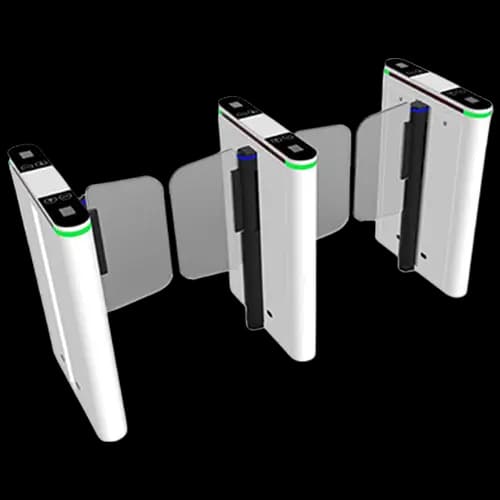
Pedestals and swing panel
The pedestal is not just a cover. Its length and internal layout determine how many sensor beams can be fitted and how far apart they sit, which in turn determines how well the lane distinguishes one body from two. Panel material is the other decision made at this stage, and it is a mechanical decision as much as an aesthetic one. A heavy toughened glass panel carries considerably more rotational inertia than an acrylic one, and it must be matched to a drive rated for that mass at the site's expected cycle count. A heavy glass panel on an undersized drive is a warranty problem waiting to happen: the motor runs hot, the gearbox wears, and travel becomes progressively less crisp.
Drive motor, gearbox and position feedback
Most current swing barriers use a brushless DC servo motor with a reduction gearbox. Brushless construction removes the brush wear that limits cycle life in a lane doing thousands of movements a day, and the servo arrangement gives the controller fine control over acceleration and deceleration, so the panel starts and stops smoothly rather than snatching. The encoder on the shaft closes the loop: the controller knows the panel's angle at every instant, which is what allows it to stop the panel mid-travel if something is in the way, hold it open on command, and report a mechanical fault rather than simply stalling.
Controller and credential reader
The controller holds the passage timers, the direction rules for the lane, the response to each alarm condition, and the interface to the access control platform. The reader is usually mounted in the pedestal head so the user presents a card or face without breaking stride. Whether the validation decision is taken in the reader, in a local access control panel or in server-side software varies by system design, and it affects how the lane behaves if the network link drops — a point worth settling during design rather than discovering during commissioning.
Infrared sensor array
This is the subsystem that determines how good the barrier actually is, and it is covered in full below.
How Does a Swing Barrier Work Step by Step?
| Step | What happens | How it works |
|---|---|---|
| 1 | Person approaches the lane | The sensor array registers a body at the approach side. Direction indicators show the lane's current state. |
| 2 | Credential is presented | A card is tapped, a face is presented to the terminal, a finger is placed on the sensor, or a QR code is shown to the scanner in the pedestal head. |
| 3 | Authorisation is decided | The credential is checked against the permitted list held in the controller, access control panel or server software. A valid match produces an open command; an invalid one does not, and is logged as a denied attempt. |
| 4 | Controller signals the drive | The control board commands the servo motor. Acceleration is ramped so the panel does not snatch at the start of travel. |
| 5 | Panel swings open | The gearbox turns the panel through roughly 90 degrees about its vertical axis, clearing the lane. The encoder confirms the fully open position and the drive holds it there. |
| 6 | Person enters the lane | Beams in the entry zone break in sequence. The controller begins counting bodies and establishing direction of travel. |
| 7 | Passage is tracked | As the person moves along the lane, successive beam pairs break and restore. The pattern and order tell the controller how many bodies are present and which way they are going. |
| 8 | Passage is confirmed complete | When the exit-side beams have cleared and no body remains in the lane, the controller treats the authorised passage as finished. |
| 9 | Panel swings closed | The drive returns the panel to the closed position, decelerating into the stop. If a beam breaks during closing, the panel halts or reopens depending on configuration. |
| 10 | Event is logged | The passage — credential, direction, lane, timestamp, and any alarm raised — is written to the access control or time-attendance database. |
If the array detects a second body following on one authorisation at step 7, the controller raises a tailgating alarm and, depending on configuration, closes the panel against the follower. That behaviour is the subject of the next section.
How the Sensor Array Detects Tailgating
The array is a set of infrared transmitter and receiver pairs facing each other across the lane, mounted at several heights along the length of both pedestals. Each pair forms a beam. When something interrupts a beam, the receiver stops seeing its transmitter and the controller registers that beam as broken.
On its own that is a simple presence detector. What makes it useful is the sequence. Because the beams are at known positions along the lane and at known heights, the order in which they break and restore describes a movement. A single adult walking through breaks the beams in a smooth front-to-back progression. Two adults walking close together produce a different pattern: beams at the rear of the lane remain broken after the front beams have restored, and the controller reads that as two bodies on one authorisation. Walking in from the wrong end reverses the sequence, which is how wrong-direction entry is caught.
This leads to the single most important point about specifying swing barriers: the sensor array, not the panel, determines how good the anti-tailgating is. Beam count, beam spacing and beam height decide whether the system can distinguish an adult carrying a child from two adults walking close together — a genuinely hard discrimination that needs beams low enough to see legs and enough of them along the lane to separate one gait from two. A lane fitted with too few beams will be defeated routinely, and no amount of panel quality compensates for it. When comparing equipment, the number and arrangement of beam pairs is the specification to interrogate first.
Exactly how the controller responds to a detected violation varies by model and configuration. Common options include an audible alarm only, an alarm plus a message to the security desk, closing the panel against the follower, or holding the lane locked until an operator resets it.
Credentials a Swing Barrier Can Read
The lane itself is credential-agnostic; what changes is the reader fitted in the pedestal head.
- Proximity and smart cards — the established method for staff entrances, read on a tap at the pedestal.
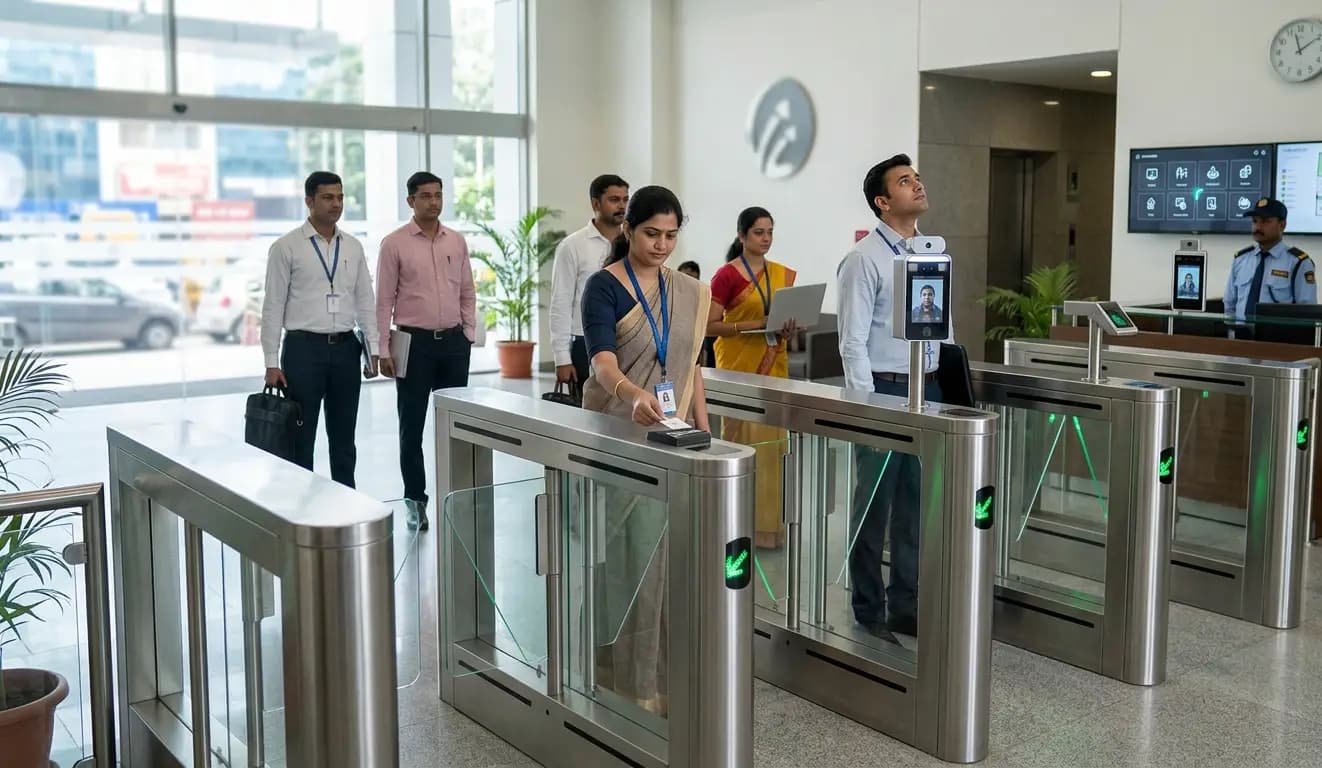
- Face recognition — a terminal mounted at head height on the pedestal, now common in corporate lobbies because it is contactless and quick.
- Fingerprint — still widely used where the population is fixed and enrolment is straightforward.
- QR and barcode — well suited to visitors, contractors and event access, since the code can be issued in advance by email or message.
- Mobile credentials — a phone acting as the card over Bluetooth or NFC, depending on the reader.
Most sites run more than one in parallel: staff on face or card, visitors on a QR pass issued by the visitor management system. Which combinations a given lane supports depends on the reader and the controller, not on the barrier mechanism.
Fail-Safe vs Fail-Secure: What Happens in an Emergency
On a fire alarm signal or a loss of power, swing barrier panels typically open and hold, clearing the egress route so the lane cannot obstruct evacuation. This is the fail-safe configuration, and it is the usual choice on any lane forming part of a designated escape route.
The alternative is fail-secure: the panels remain locked in the closed position on power loss, so the boundary is not opened by cutting the supply. Both behaviours are configurable in the controller, and both are legitimate — for different routes.
The practitioner point here is a governance one. Fail-safe versus fail-secure has to be decided with the fire strategy, not chosen by default in the controller settings. The decision belongs to whoever owns life safety for that route, in consultation with the security requirement, and it should be documented before commissioning rather than left at whatever the factory default happened to be. Where a lane is fail-secure, the escape provision has to come from somewhere else — an adjacent door, a break-glass release — and that provision needs to be part of the same conversation. The manual release in the pedestal is a complement to this decision, not a substitute for it.
Why the Wide Accessible Lane Matters
This is the swing barrier's defining characteristic. Because the panel rotates about a vertical axis at the pedestal, the lane can be made considerably wider than a tripod turnstile allows. A wide-lane swing barrier accommodates a wheelchair, a trolley, a suitcase, a delivery or a parent with a pram. A tripod turnstile physically cannot: its rotating arms define a fixed, narrow aperture.
That is why most real installations pair several narrow lanes with one wide swing lane. The narrow lanes carry the bulk of the throughput at peak; the wide lane carries everybody the narrow lanes exclude. The wide accessible lane is a regulatory and practical necessity, not an upgrade. Specifying an entrance entirely from narrow lanes creates an access problem on day one — one that is usually solved afterwards by propping a fire door open, which defeats the entrance control entirely. Getting the lane mix right at design stage is far simpler than retrofitting a wide lane into a finished lobby floor with services already cast in.
Technologies Used in a Swing Barrier System
- Brushless DC servo drive — electronically commutated motor with controlled acceleration and deceleration.
- Closed-loop position feedback — rotary encoder reporting panel angle continuously and enabling load-based obstruction detection.
- Modulated infrared optoelectronics — beam pairs coded against ambient light and against each other so adjacent lanes do not interfere.
- Sequence-based passage logic — firmware interpreting beam break order as direction, body count and violation type.
- Credential technologies — RFID card reading, facial recognition, fingerprint matching and QR decoding at the pedestal head.
- Network communication — TCP/IP, RS-485 or dry-contact interfaces to access control, attendance and surveillance platforms.
- Dry-contact life-safety interfacing — the fire panel input that drives panels to their emergency position.
Where Swing Barriers Are Used
Swing barriers appear wherever pedestrian movement needs to be controlled, recorded and made accessible:
- Corporate offices and IT campuses — reception lobbies with staff on face or card and visitors on QR, common across the technology corridors of Karnataka, Telangana and Maharashtra and in the business parks of Gurugram and Noida.
- Manufacturing plants — shift entry with attendance capture at the lane, across the industrial belts of Gujarat, Tamil Nadu and Haryana.
- Hospitals and healthcare campuses — where wheelchair and stretcher-adjacent movement makes the wide lane non-negotiable.
- Metro stations, airports and transport hubs — wide lanes for passengers with luggage alongside narrow lanes for unencumbered flow.
- Educational institutions — regulating entry across large campuses in Pune, Chennai and Ahmedabad.
- Hotels, clubs and gyms — membership validation at a lane that also passes baggage trolleys.
- Government and public buildings — controlled public entry with accessibility obligations, including large offices across Uttar Pradesh.
- Data centres — often as the outer lane in front of a mantrap or interlock, with the swing lane sized to pass equipment.
TimeWatch India supplies, installs and services swing barriers and related entrance control equipment across India, with installations in Mumbai, Bengaluru, Hyderabad and other major centres alongside the regions named above. The swing gate range includes models such as the TW-SG-2712; lane width, panel material and beam count should be confirmed against the datasheet for the model being specified.
Integration With Other Systems
- Access control — the same credential database governing doors, vehicle gates and turnstiles governs the lane, so one revocation closes every route.
- Time and attendance — the lane passage doubles as the attendance punch, removing a separate device at the entrance.
- Visitor management — a pre-registered visitor receives a QR pass that the pedestal reader accepts for a defined window.
- CCTV and video analytics — the camera bookmarks footage against each lane event, so any tailgating alarm can be reviewed by its log entry.
- Fire alarm systems — a dry contact driving panels to their configured emergency position.
- Building management and lift destination control — a validated passage can call a lift to the user's floor, which is increasingly common in tall commercial buildings.
Installation Considerations
- Floor preparation and levelling — pedestals must be anchored to a level, load-bearing surface. Out-of-level pedestals misalign the beam pairs and cause intermittent false detections that are very hard to diagnose later.
- Cable routing before the floor finish — power and data conduits have to be cast or chased in before tiling or stone is laid. Retrofitting them afterwards is disruptive and usually visible.
- Lane mix and lane count — calculate peak throughput and decide the narrow-to-wide lane ratio at design stage.
- Beam alignment — transmitter and receiver pairs must be aligned during commissioning and the alignment verified across the full lane length.
- Panel clearance — the swept path of the panel must be clear of walls, planters, signage and adjacent pedestals through its full travel.
- Reader positioning and approach direction — mount the reader so the natural approach presents the credential without the user turning back on themselves.
- Power supply — stable supply, with battery or UPS provision where the lane must operate through an outage.
- Fire panel interface — the emergency contact must be wired and tested as part of commissioning, not left for later.
Maintenance Considerations
- Clean the infrared lenses on both pedestals; dust and fingerprints on the optics are the most frequent cause of erratic detection.
- Verify beam alignment periodically, particularly after any impact to a pedestal.
- Inspect the panel mount and fixings for looseness, and glass panels for edge chips.
- Check drive and gearbox condition at the manufacturer's interval, and listen for changes in travel sound, which usually precede a failure.
- Confirm the encoder is reporting correct end positions so the panel stops cleanly at both limits.
- Test the manual release, before it is needed.
- Test the fire alarm interface as part of scheduled fire drills.
- Review tailgating alarm logs; a rising rate often indicates a sensor problem rather than a behaviour problem.
Benefits and Limitations
Benefits
- Accessible by design — the wide lane passes wheelchairs, trolleys, luggage and deliveries.
- Controlled, recorded pedestrian access with a complete audit trail by credential, direction and time.
- Active anti-tailgating and wrong-direction detection through the sensor array.
- Glass or acrylic panels suit finished lobby environments where a mechanical turnstile would look out of place.
- Integrates with access control, attendance, visitor and CCTV systems so one record covers the entrance.
Limitations and considerations
- It is not a physical security barrier. Panels are waist or chest height on most models and can be climbed or vaulted. Where a physical boundary is the requirement, a full height turnstile or a secured door is the correct equipment.
- Throughput per lane is lower than a tripod turnstile on the same footprint, because the panel must complete its swing and the array must confirm passage.
- Anti-tailgating performance varies widely between models according to beam count and arrangement, so it should be assessed on the specification rather than assumed.
- Glass panels need looking after in dusty or high-traffic environments, both for appearance and for edge integrity.
- Emergency behaviour must be set deliberately and tested, not inherited from a default.
Exact behaviour — panel opening time, lane width, beam count, alarm responses and integration options — depends on the specific model, controller, firmware and site configuration. Detailed figures should always be confirmed against the datasheet for the equipment being specified.
Swing Barrier vs Flap Barrier vs Tripod Turnstile
| Aspect | Swing barrier | Flap barrier | Tripod turnstile |
|---|---|---|---|
| Mechanism | Panel rotates about a vertical axis to clear the lane | Flap retracts into or folds back towards the pedestal | Three-armed rotor rotates 120 degrees per passage |
| Lane width and accessibility | Can be made wide; passes wheelchairs, trolleys and luggage | Standard and wide variants available; wide models pass most accessibility needs | Fixed narrow aperture; cannot pass a wheelchair or trolley |
| Throughput | Moderate; panel travel and passage confirmation set the pace | Generally faster than swing, as flap travel is shorter | High for unencumbered single-file flow |
| Physical robustness | Moderate; glass or steel panel, climbable | Moderate to lower; flaps are lighter and more easily forced | Higher; mechanical rotor resists forcing, though still waist height |
| Typical setting | Corporate lobbies, hospitals, transport hubs, any entrance needing an accessible lane | Offices and metro concourses where speed and a slim footprint matter | Factory gates, stadiums, construction sites, budget-conscious high-volume flow |
The three are complements rather than alternatives, and a well-designed entrance usually mixes them. A common arrangement pairs several flap barrier or tripod turnstile lanes for volume with one wide swing lane for accessibility and deliveries. The broader question of how these lane types fit together is covered in how a turnstile system works.
Frequently Asked Questions
How does a swing barrier detect a person?
An infrared sensor array in the two pedestals detects the person. Transmitter and receiver beam pairs at several heights face each other across the lane, and the controller reads which beams are broken and in what order. That sequence tells it how many bodies are in the lane and which direction they are moving.
How does a swing gate stop tailgating?
The controller compares the pattern of beam breaks against the pattern a single authorised passage produces. If beams at the rear of the lane stay broken after the front beams have cleared, it treats that as a second body on one authorisation and raises a tailgating alarm. Depending on configuration it may also close the panel against the follower or hold the lane locked until an operator resets it.
What is the difference between a swing barrier and a flap barrier?
The difference is how the moving element clears the lane. A swing barrier rotates a rigid panel about a vertical axis, while a flap barrier retracts or folds its flaps back towards the pedestal. Swing barriers are generally chosen where a wide accessible lane is needed; flap barriers are generally chosen where speed and a slim footprint matter more.
Can a wheelchair pass through a swing barrier?
Yes, provided a wide lane has been specified. The swing barrier is the lane type that can be made wide enough for a wheelchair, a trolley, luggage or a delivery, which a tripod turnstile physically cannot. Most entrances pair several narrow lanes with at least one wide swing lane for this reason, and the wide lane should be treated as a requirement rather than an option.
What happens to a swing barrier in a fire?
On most installations the panels open and hold on receiving a signal from the fire alarm panel, clearing the egress route. This is the fail-safe configuration. Controllers can also be set fail-secure, where panels stay locked on power loss, and the choice should be made with the fire strategy for that route rather than left at a default setting.
Does a swing barrier work during a power failure?
Not without a battery or UPS. On losing power a fail-safe lane releases its panels so they can be pushed open, and every unit also has a manual release that disengages the drive. Sites that need the lane to keep validating credentials through an outage should specify backup power at design stage.
What motor does a swing barrier use?
Most current models use a brushless DC servo motor with a reduction gearbox and a position encoder on the shaft. The encoder lets the controller track panel position continuously, decelerate smoothly into each end of travel, and detect an obstruction by monitoring drive load. Motor rating has to suit the panel material and weight, since a heavy glass panel loads the drive far more than an acrylic one.
Is a swing barrier a turnstile?
It belongs to the same family. Turnstile is the general term for a pedestrian entrance control lane, and swing barriers, flap barriers, tripod turnstiles and full height turnstiles are all types within it. Swing barriers are sometimes called swing turnstiles or swing gates for that reason.
How wide is a swing barrier lane?
Standard lanes are sized for a single person walking through, while wide accessible lanes are considerably broader to take a wheelchair or trolley. The exact dimensions are a specification of the individual model and should be read from its datasheet, because panel length and pedestal spacing vary between products.
Can a swing barrier be forced open?
The panels are not designed to resist a determined physical attack, and on most models they can be climbed or vaulted since they are waist or chest height. What the barrier does provide is detection: forcing a panel, entering against the permitted direction or following someone through all raise alarms and are recorded. Where a physical boundary is required, a full height turnstile or a secured door is the appropriate equipment.
How much maintenance does a swing barrier need?
Servicing intervals depend on cycle count and environment rather than a fixed calendar. Routine work covers cleaning the infrared lenses, verifying beam alignment, checking panel fixings, inspecting the drive and gearbox, and testing the manual release and the fire alarm interface. Busy lobbies and dusty industrial entrances need attention more often than a low-traffic office lane.
