
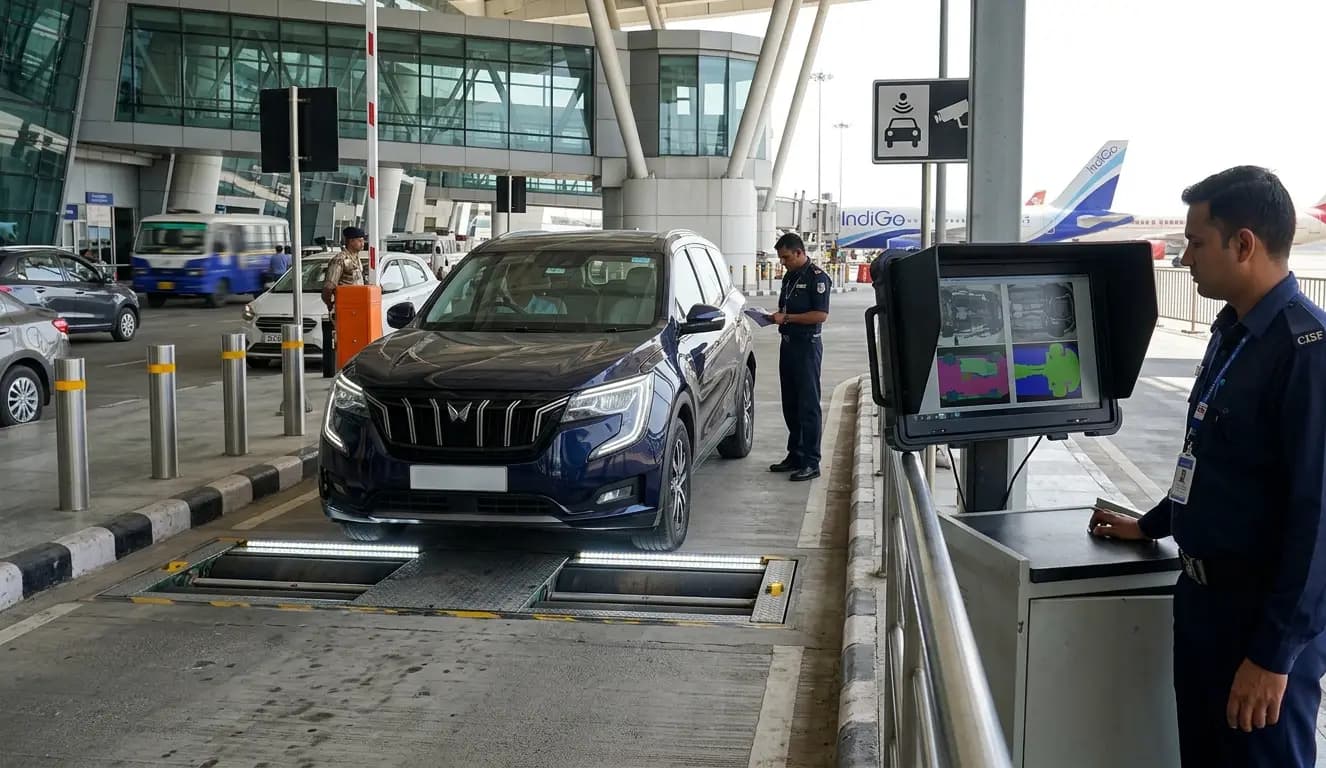
What Is an Under Vehicle Surveillance System?
A UVSS is also called an under vehicle scanner, an under vehicle inspection system (UVIS) or an undercarriage scanning system. It sits at the vehicle entry point of sites where what arrives underneath a vehicle matters: military and police establishments, government complexes, airports, embassies, refineries, hotels, data centres and border posts.
It is worth being precise about what it does. A UVSS produces an image. It does not identify objects, it does not determine whether something is dangerous, and it does not confirm that a vehicle is clean. It makes an area that is otherwise almost impossible to see — the full underside of a moving vehicle — visible in a form that a person or a comparison algorithm can examine. Every judgement that follows is made by the operator and the site's procedure.
How Does an Under Vehicle Surveillance System Work?
A UVSS works by triggering when a vehicle approaches the scan point, usually from an inductive loop or a photo sensor. Illumination from high-output LED arrays flanking the scan line lights the underside. A line scan camera records one narrow line of pixels across the vehicle's width, repeating that capture thousands of times per second as the vehicle crawls over the unit. The system assembles those consecutive lines into a single continuous composite image, using the vehicle's own forward motion to supply the second dimension of the picture. An ANPR camera identifies the vehicle by its number plate, and the finished undercarriage image is stored against that plate with a timestamp and a driver image. Where a reference image of that vehicle already exists, the software compares the new scan against it and highlights differences. The operator then decides whether to clear the vehicle or refer it for manual inspection.
The whole capture takes a few seconds — roughly the time the vehicle needs to roll over the unit at walking pace.
The Core Technology: Line Scan Imaging
Why a line scan camera and not an ordinary camera
This is the point that most descriptions of under vehicle scanning skip, and it is the one that explains everything else about how these systems behave.
An ordinary camera — the kind in a CCTV housing or a phone — is an area camera. It captures a full rectangular frame in one exposure, using a two-dimensional sensor. To photograph the entire underside of a car in one frame, such a camera would need to be far enough below the vehicle to fit the whole length of the undercarriage into its field of view. At a roadway, that distance does not exist. A camera sitting in the road surface is a few centimetres from the chassis. A very wide-angle lens at that distance would capture a small, steeply distorted patch, sharp in the middle and smeared at the edges.
A line scan camera solves this differently. Its sensor is a single row of pixels, not a rectangle. In one exposure it records one narrow transverse strip of whatever passes above it — a line across the vehicle's width, and essentially no length at all. It repeats that exposure thousands of times per second.
On its own, a single line is useless. What makes it an image is motion. As the vehicle rolls forward, each successive line captures a slightly different slice of the undercarriage, a few millimetres further back than the one before. The system stacks those lines side by side in the order they were captured, and the stack is the picture. The vehicle's own movement supplies the second dimension of the image.
The result is a single continuous view of the whole undercarriage from bumper to bumper, at uniform resolution and with none of the perspective distortion a wide-angle lens would introduce — because every strip in it was captured from the same distance, at the same angle, through the same narrow part of the optics. No single conventional camera mounted in the road surface could produce that view.
Why vehicle speed changes the image
Because the image is built from motion rather than captured in one exposure, the relationship between the camera's line rate and the vehicle's speed determines the geometry of the finished picture.
If the vehicle moves at the speed the system expects, each captured line advances the image by the right amount and the composite is correctly proportioned. If the driver accelerates across the unit, the vehicle covers more ground between successive lines and the image is compressed along its length — the undercarriage appears foreshortened. If the driver slows or brakes, the opposite happens and the image stretches. If the driver stops over the scanner altogether, the camera keeps capturing the same line, and that section of the vehicle becomes a long smeared band of repeated pixels.
For this reason most systems specify a slow, steady crawl across the scan point — typically a walking pace, with the figure stated in the equipment's documentation and varying between products. Many systems reduce the dependence on driver behaviour by taking a speed input: an inductive loop pair or an optical encoder measures how fast the vehicle is actually travelling, and the processing adjusts the line assembly to compensate. How much variation a given system can absorb this way differs considerably by product and should be confirmed against the specific equipment's datasheet rather than assumed.
Why illumination decides image quality
The underside of a vehicle is close to the hardest subject a camera can be asked to photograph. It is dark, it is irregular, it is covered in matt oil film and road grime, and it contains deep recesses alongside bright bare metal. There is no ambient light under there at all.
A UVSS therefore carries its own illumination: high-output LED arrays mounted alongside the scan line, aimed so that they light the narrow strip the camera is reading at that instant. Because the camera's exposure per line is extremely short, the illumination has to be intense and it has to be even across the full scan width.
In practice, illumination is the main determinant of whether the resulting image is usable. Two systems with similar camera specifications can produce visibly different images because one lights the subject better than the other. Shadowed recesses, uneven brightness across the width, or illumination that has degraded over time all show up directly as parts of the undercarriage an operator cannot assess. When comparing equipment, the illumination arrangement deserves as much attention as the camera resolution figure, and sample images of a real vehicle are more informative than either specification.
Main Components of a UVSS
| Component | Function |
|---|---|
| Scanner unit | The housing that sits in or on the roadway, containing the camera and illumination. Supplied either as a surface-mounted ramp or as an in-ground flush unit; the choice drives most of the installation decisions. |
| Line scan camera | The imaging element. Captures a single transverse line of pixels at a high line rate; the composite undercarriage image is assembled from successive lines as the vehicle passes. |
| LED illumination array | High-output lighting flanking the scan line, providing the intense, even light the short per-line exposure requires. The principal determinant of usable image quality. |
| Protective glass or window | The optical surface the camera looks through, exposed to tyres, water, grit and road salt. Its condition directly affects every image the system produces. |
| Loop or trigger sensor | Inductive loop, photo sensor or similar, detecting vehicle presence to start and stop the scan. A second loop or an encoder may supply speed data for image compensation. |
| ANPR camera | Reads the number plate so the undercarriage image is automatically tied to a vehicle identity, which is what makes reference comparison possible without manual data entry. |
| Driver / occupant camera | Captures an image of the driver and, depending on placement, front-seat occupants, recording who was in the vehicle at the time of the scan. |
| Processing unit | Assembles the line data into the composite image, applies speed compensation, runs the comparison against stored references and manages storage. |
| Operator workstation and software | Where the image is displayed, zoomed, compared against the reference and dispositioned. The software is what separates an inspection system from a camera. |
| Network link | Connects the scan point to the control room, the record database and any integrated access control or barrier system. |
| UPS / power conditioning | Keeps the scan point working through supply interruptions. A UVSS that is offline during a power cut means vehicles either wait or enter unscanned. |
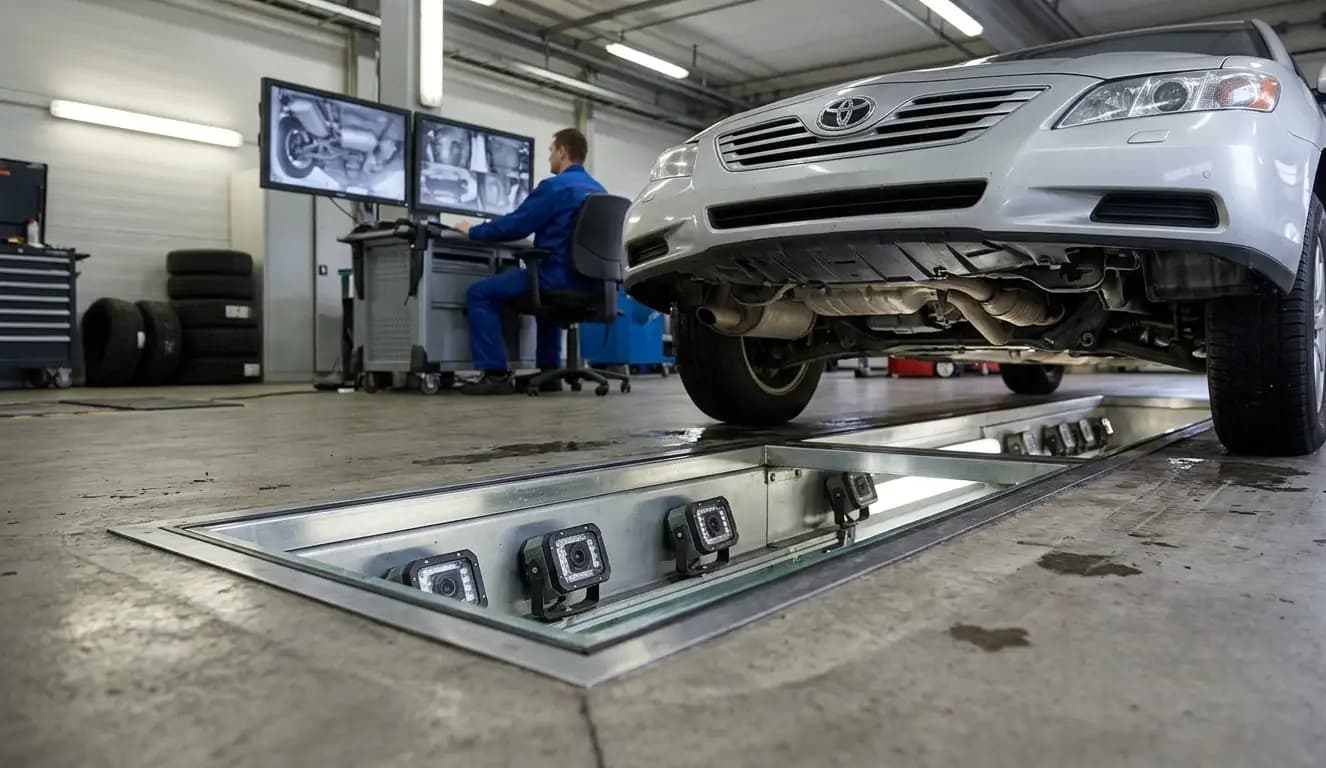
How Does a UVSS Work Step by Step?
| Step | What happens | How it works |
|---|---|---|
| 1 | Vehicle approaches at a crawl | Signage, a speed hump or a guard brings the vehicle down to the slow steady pace the scan requires. The approach is part of the system, not something that happens before it. |
| 2 | ANPR camera reads the plate | The number plate is captured and recognised, giving the system a vehicle identity to attach the scan to and to look up in the reference database. |
| 3 | Trigger sensor detects the vehicle | An inductive loop or photo sensor registers the vehicle arriving at the scan point and starts the capture sequence. |
| 4 | Illumination comes up | The LED arrays light the scan line intensely and evenly across the full width of the unit. |
| 5 | Line scan capture begins | The camera records one narrow transverse line of the undercarriage and repeats that capture thousands of times per second. |
| 6 | Vehicle motion supplies the length | Each successive line sees a slightly different slice of the undercarriage as the vehicle rolls forward. Speed data from a loop pair or encoder is used to keep the line spacing proportionate. |
| 7 | Composite image is assembled | The processing unit stacks the captured lines in order into one continuous full-length undercarriage image at uniform resolution. |
| 8 | Driver image is captured | A separate camera records the driver and occupants, so the scan record shows who was in the vehicle. |
| 9 | Record is stored | The undercarriage image, the plate, the driver image, the date and time and the lane are written to the record database as one entry. |
| 10 | Reference lookup | The software checks whether a stored reference image exists for that number plate. Registered vehicles will have one; unknown vehicles will not. |
| 11 | Comparison and highlighting | Where a reference exists, the new image is aligned against it and differences are highlighted for the operator. Where none exists, the operator reviews the live composite, often alongside a generic image of the same make and model. |
| 12 | Operator decision | The operator clears the vehicle or refers it for manual inspection. The system presents evidence; the decision and the authority to act on it stay with the operator. |
| 13 | Barrier or bollard releases | On a clear decision the controlling barrier, bollard or gate is released and the vehicle proceeds. Without that controlled stop, the inspection result arrives after the vehicle is already inside. |
Reference Image Comparison: What Turns a Scan Into an Inspection
A UVSS without reference-image comparison is only a camera, and this is the single most important thing to understand before specifying one.
Consider what an operator is actually looking at. The underside of any modern vehicle is a complicated mess: exhaust sections, heat shields, fuel and brake lines, suspension arms, wiring looms, cable ties, mud shields, brackets, spare wheel carriers, undertrays with missing clips, and a layer of road dirt over all of it. Shown a photograph of an unfamiliar undercarriage, an operator — even an experienced one — has almost no basis for deciding whether anything in that picture is out of place. There is no mental template of what that particular vehicle is supposed to look like underneath.
Reference comparison removes that problem. When a vehicle is registered with the site — staff cars, contractor vehicles, regular delivery trucks, the fleet of a protected person — the system stores a scan of its clean undercarriage as that vehicle's reference image. On every subsequent visit, the ANPR read identifies the vehicle, the software retrieves the stored reference, aligns the new scan against it and presents the two together with differences highlighted.
Now the operator's task is tractable. They are no longer being asked whether an unfamiliar arrangement of pipes looks suspicious. They are being asked whether anything is different from the last time this same vehicle came through. An object attached under a vehicle is, by definition, something that was not there before, and against a matched reference it stands out immediately.
For unknown vehicles — visitors, first-time deliveries, unregistered traffic — there is no reference, and the operator reviews the live composite image on its own. Some software supports comparison against a generic image of the same make and model, which gives a partial equivalent. Some products add automated anomaly detection that flags regions of the image for attention without a vehicle-specific reference. Capability here varies considerably between products, and the practical quality of both the alignment and the highlighting is something to assess on real images during evaluation rather than from a feature list.
The operational implication is straightforward: the value of a UVSS at a given site grows with the proportion of its traffic that is registered and has a current reference image. A site where most arrivals are known vehicles gets far more from the same equipment than a site where every vehicle is a stranger. Building and maintaining the reference library — adding new vehicles, re-baselining after a vehicle is serviced or modified — is an ongoing operational task, not a commissioning activity.
Supporting Cameras: ANPR and Driver Capture
The scanner unit is not the whole system. Two supporting cameras do work that the undercarriage image on its own cannot.
The ANPR camera reads the number plate as the vehicle approaches. Its job is to attach an identity to the scan automatically. Without it, every undercarriage image is an anonymous picture and the reference comparison described above cannot happen at all, because the system has no way of knowing which stored reference to retrieve. Manual plate entry by a guard is possible but does not survive contact with a busy lane. ANPR performance depends on plate condition, approach angle, lighting and plate format — all worth confirming against the site's actual traffic, particularly where older or non-standard plates are common.
The driver or occupant camera records who was in the vehicle at the time of the scan. This matters for the record rather than for the inspection: when a scan is reviewed later, the question asked is usually not only what was under the vehicle but who brought it in. Placement is a design decision — a camera positioned for a clean windscreen view through the glass is capturing a reflective surface at an angle, and the result depends on camera position, lens choice and whether supplementary illumination is provided.
Both feeds belong in the same record as the undercarriage image, written as one entry with the timestamp and lane. A system that stores the three separately, in three places, with three different search methods, is far less useful during an incident review than one that returns them together from a single plate search.
Ramp-Mounted, In-Ground and Portable Units
The scanner unit comes in two fixed forms and one deployable one, and the choice between them is made early because it determines what civil work is required.
Surface-mounted ramp units
A ramp unit sits on top of the existing road surface. The vehicle drives up a shallow incline, across the scanning section and down the other side. Installation needs little more than a level surface, fixings and a power and data route, so a ramp unit can be in service quickly and can be relocated if the entry arrangement changes. Semi-permanent installations at temporary entrances, event venues and sites awaiting civil work commonly use them.
The trade-offs are physical. Every vehicle has to climb over the unit, which slows traffic further — sometimes usefully, since the ramp itself enforces the slow crawl the scan wants — and which constrains ground clearance for low vehicles. The unit is exposed on the road surface, so it takes direct impact from tyres and is visible to anyone approaching.
In-ground flush-mounted units
An in-ground unit sits in a pit cut into the roadway with its top surface flush with the road. Vehicles drive straight over it with nothing to climb, so traffic flow is unaffected by the unit's physical presence and there is no ground clearance constraint. On a permanent, designed entrance this is normally the arrangement chosen.
It is also the arrangement that requires the most thought before installation, because an in-ground unit lives in a genuinely hostile environment. It sits in the road surface, which means it collects everything the road collects: rainwater, silt, leaf matter, oil and, in some regions, road salt. It also takes the full axle load of every vehicle that crosses it, which at a goods entrance means loaded trucks, not cars.
Two decisions determine how long such a unit lasts, and both are civil works decisions made before the equipment is even specified. The first is drainage: the pit needs a designed drainage path that actually works in the heaviest rainfall the site sees, because a pit that holds water becomes a tank with the scanner in it. The second is load rating: the unit and its frame must be rated for the heaviest vehicle expected to cross, with margin, and that rating must be confirmed against the site's real traffic rather than against an assumption about cars. A unit specified for light vehicles and then crossed daily by loaded trucks will fail, and it will fail in the road surface where replacing it means breaking out the pit again.
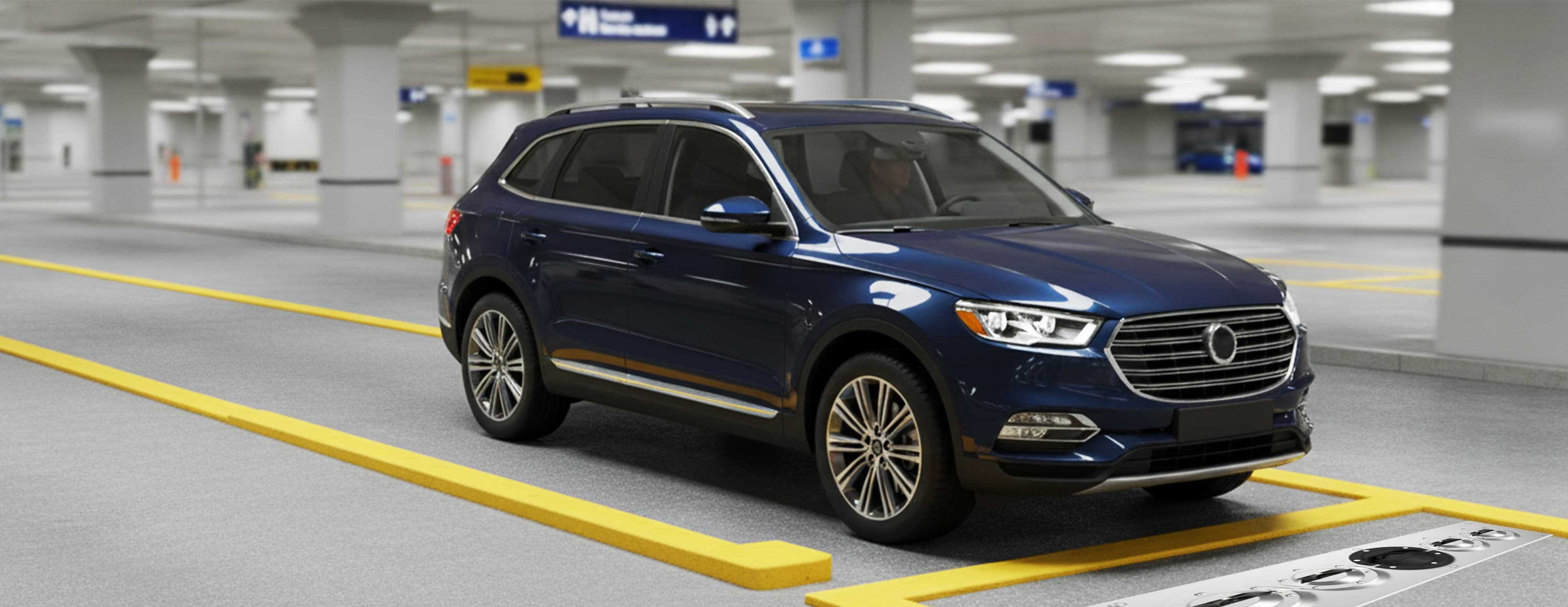
Mobile and portable units
Portable under vehicle scanners are lightweight units that can be carried to a checkpoint, placed across the lane and connected to a laptop or tablet. They are used for temporary checkpoints, event security, mobile police and military deployments, and ad hoc inspection where no fixed installation exists. Because they are placed on the surface and taken away afterwards, they need no civil work at all.
What they give up is the supporting infrastructure. A portable unit is usually operated without fixed ANPR, without a permanent reference database and without barrier integration, so it functions as an imaging device for the operator present rather than as a system that identifies vehicles and compares them against history. Image quality, coverage width and ruggedness vary considerably between portable products and are worth assessing against the actual deployment conditions.
UVSS Types vs Manual Mirror Inspection
| Aspect | Ramp / surface-mounted UVSS | In-ground flush-mounted UVSS | Mobile / portable UVSS | Manual mirror inspection |
|---|---|---|---|---|
| Installation effort | Low — level surface, fixings, power and data. In service quickly | High — pit excavation, drainage design, load-rated frame, reinstatement of the road surface | Minimal — placed on the surface and connected to a laptop or tablet | None — a mirror on a pole and a trained guard |
| Permanence | Semi-permanent; can be relocated if the entry arrangement changes | Permanent; relocating means repeating the civil work | Fully temporary; deployed and recovered per use | Not applicable |
| Image quality and coverage | Full-width composite undercarriage image; quality depends on illumination and the crawl speed achieved | Full-width composite image under the same optical conditions, with no ramp disturbing the vehicle's passage | Composite image, with coverage width and illumination varying considerably by product | No image produced. Coverage is limited to what the guard can see in the mirror, with recesses and the vehicle centre hard to view and nothing recorded |
| Traffic impact | Vehicles climb the ramp, slowing flow — which also helps enforce the required crawl speed | Flush with the road; the unit itself imposes no obstruction, and the crawl must be enforced by signage, a hump or a guard | Depends on where it is deployed; usually part of a deliberately slow temporary checkpoint | Slowest of the four — the vehicle stops completely while a guard walks around it |
| Record and comparison | Scan stored with plate, time and driver image; reference comparison available where the software supports it | Same, and typically integrated with barriers, access control and the control room | Often standalone; reference database and ANPR frequently absent | No record at all. Nothing to review afterwards and nothing to compare against |
| Typical application | Typically suited to sites needing a fixed scan point without civil work, temporary entrances and installations awaiting permanent works | Typically suited to permanent designed entrances at government, military, aviation, industrial and high-traffic commercial sites | Typically suited to temporary checkpoints, events, mobile police and military deployment and ad hoc inspection | Typically suited as a fallback when equipment is unavailable, and as a secondary check after a scan raises a question |
These are complementary rather than competing. Manual inspection remains the secondary step after a scan highlights something — the image tells the operator where to look, and a person then looks there. What a UVSS changes is the primary step: every vehicle gets a consistent, recorded, full-length view of its underside in a few seconds, which a mirror check at a busy entrance cannot deliver and does not record.
Where Under Vehicle Surveillance Systems Are Used
- Border and strategic infrastructure in the north-east — vehicle entry points serving the international boundary districts of Nagaland and Mizoram, where traffic crossing into and out of the frontier belt is checked at a small number of road entry points and where the undercarriage is the part of a vehicle a hand check at a roadside post is least able to cover. Approach roads in both states are narrow and heavily loaded with commercial traffic, so a scan point that handles vehicles at a crawl without requiring each one to stop and be walked around fits the conditions better than mirror inspection. The same pattern extends through Assam, where installations serve both the road corridors into the region and the refinery, pipeline and airport infrastructure around Guwahati.
- Government and defence establishments — secretariats, armed forces installations, police headquarters and ordnance facilities. Vehicle entry to these sites is controlled and repeat traffic is high, which is the condition in which reference-image comparison is at its most effective, since most arrivals are registered vehicles with a stored baseline. Installations around the Delhi region, Chandigarh and Jaipur are typical, with Rajasthan and Punjab also carrying this requirement at establishments near the western border.
- Airports and aviation — service road entry, airside vehicle gates and cargo terminal access, where every vehicle entering a restricted area is checked and the UVSS forms one layer alongside driver verification and access control.
- Refineries, ports and industrial installations — petrochemical complexes, power generation sites and port gates, particularly across Gujarat and Maharashtra, where continuous commercial vehicle movement through a small number of controlled gates calls for scanning that does not require each truck to halt.
- Hotels, embassies and diplomatic premises — vehicle porches and basement entrances in Mumbai, Delhi and Hyderabad, where the system has to work within an architecturally finished entrance and in-ground installation is usually the only acceptable arrangement.
- Corporate campuses and data centres — technology parks and large campuses in Bengaluru and across Karnataka, where contractor and delivery traffic is substantial and a registered-vehicle reference library builds up quickly.
- Stadiums, convention centres and event venues — vehicle access for teams, officials and service traffic during events, often served by portable units deployed for the period and recovered afterwards.
- Correctional facilities — vehicle entry and exit at prisons, where scanning in both directions is relevant.
- Toll plazas and expressway control points — selective inspection lanes alongside normal toll lanes, where a vehicle can be directed out of the flow for scanning without halting the plaza.
TimeWatch India supplies, installs and maintains under vehicle surveillance systems and associated vehicle inspection equipment across the country, including at sites in Delhi, Mumbai, Bengaluru, Guwahati, Chandigarh, Jaipur and Hyderabad.
Integration With Other Security Systems
A UVSS inspects. It does not stop anything. On its own, a vehicle drives over the scanner, the image is captured, and the vehicle carries on — which means that if the operator finds something, they are looking at an image of a vehicle that is already past the scan point and possibly already inside the perimeter.
Whatever else is integrated, the one integration that is not optional is a physical control after the scan: a boom barrier, a set of bollards, a gate, or at minimum a guard post with the authority and the physical means to hold a vehicle. The scan has to happen in front of something that keeps the vehicle there until the result is in. Sites that install a scanner without that control have bought a recording device, not an inspection point.
- Boom barriers — the usual control immediately after the scan point, released on a clear decision. Barrier timing has to allow the operator the seconds the review takes, which is a configuration decision at commissioning.
- Bollards — where the threat assessment includes a vehicle being driven through the control rather than stopping at it, a barrier alone is not a physical obstacle. Rated bollards are, and they are commonly deployed in combination with a UVSS at government and diplomatic entrances.
- ANPR and access control — the plate read drives both the reference lookup and the access decision, so a registered vehicle with a clear comparison can be cleared with minimal operator involvement while unknown vehicles are routed to full review.
- CCTV — overview cameras covering the lane and the approach, so the scan record sits alongside footage of the vehicle arriving and departing.
- Visitor and vehicle management — pre-registration of expected vehicles, so an arriving delivery is already known to the system and the operator sees the expected plate rather than an unexpected one.
- Baggage and cargo screening — at sites where vehicle contents are screened as well as the undercarriage, the UVSS record and the X-ray record belong in the same entry event.
- Control room and alarm management — scan results, barrier state and camera feeds presented together, so an operator reviewing a highlighted difference has the vehicle, the driver and the lane in front of them at once.
Installation Considerations
More UVSS installations underperform because of how and where they were installed than because of the equipment itself. The decisions below are made before the unit arrives.
- Approach geometry and speed control. Because the image is built from vehicle motion, the quality of every scan depends on the driver maintaining a slow, steady crawl. A straight approach of adequate length, clear signage, a speed hump placed before the unit, or a guard directing the approach are what produce consistent images. Sites that skip this get stretched and compressed composites and blame the camera.
- Drainage for in-ground units. A designed drainage path from the pit, sized for the heaviest rainfall the site sees, with a maintenance route for clearing silt. This is the most common cause of premature failure in in-ground installations and it cannot be retrofitted easily.
- Load rating. The unit, its frame and the surrounding reinstatement must be rated for the heaviest vehicle that will actually cross — confirmed against the site's goods traffic, not assumed from the car park.
- Ingress protection and sealing. The scanner's enclosure rating, the seal around the optical window and the cable entries all sit in a wet, dirty environment under load. Specify for the environment the unit will live in.
- Ramp clearance. For surface-mounted units, confirm the ramp profile against the lowest vehicle expected, including loaded trailers and low-clearance cars.
- ANPR camera positioning. Mounting height, angle and distance determine plate read reliability. Plates on the site's real traffic — including older, damaged and non-standard plates — are the test, not a sample plate at commissioning.
- Lighting at the approach. The scanner carries its own illumination, but the ANPR and driver cameras depend on the lane lighting. Night performance is a separate commissioning check from day performance.
- Lane width and vehicle guidance. The vehicle has to pass centrally over the scan width. Kerbs, guide rails or lane markings keep it there; without them, wide vehicles clip the edge of the coverage.
- Power and network. Conditioned supply with UPS backup, and a network route to the control room sized for the image traffic. Scan images are large, and a link that works at commissioning can saturate once several lanes are live.
- Operator position and screen. The reviewing operator needs a screen large enough and placed well enough to actually examine an undercarriage image. A small monitor in bright daylight at a gatehouse undoes the capture quality entirely.
- Storage and retention. Image retention period, storage sizing and the search method for retrieving a past scan are design decisions, and the retention period should be set against the site's own policy obligations.
Maintenance and Operational Testing
A UVSS degrades quietly. The unit keeps scanning, the record keeps filling, and the images get gradually worse until the point at which nobody can see anything in them — and nothing in the system announces that this has happened. Routine checks are what catch it.
- Daily optical surface cleaning. The glass or window the camera looks through accumulates road film, tyre rubber and grit within hours at a busy lane. This is the single highest-value maintenance task and it takes a minute.
- Daily reference scan. Pass a known vehicle over the unit and look at the image on the operator screen. Comparing it against a stored good image of the same vehicle shows immediately whether the illumination, focus or optical surface has deteriorated.
- Illumination check. Confirm the LED array is fully lit and even across the width. A partially failed array produces a dark band down one side of every image, which is easy to stop noticing.
- Drainage inspection for in-ground units. Check the pit for standing water and silt accumulation, especially before and during the monsoon. Scheduled clearing is routine maintenance, not a repair.
- Speed and trigger verification. Confirm the loop or sensor is triggering reliably and that the composite image proportions look correct at the normal approach speed. Distorted proportions usually mean a speed input problem rather than a camera problem.
- ANPR read rate review. Track the proportion of vehicles whose plates are read successfully. A falling read rate breaks the reference comparison silently, because unmatched scans simply get treated as unknown vehicles.
- Reference library upkeep. Add newly registered vehicles, re-baseline vehicles after service or modification, and remove vehicles that no longer have access. A stale reference library generates differences that are not security events, and operators learn to dismiss them.
- Storage and retention audit. Confirm images are being written, are retrievable by plate and date, and that the retention period in effect matches the one in policy.
- Enclosure, seal and cable inspection. Periodic check of the housing seal, cable entries and connectors, which live under load in a wet environment.
- UPS test. Confirm the scan point continues through a supply interruption, and that it comes back into service cleanly afterwards.
Benefits and Limitations
Benefits
- Makes visible an area that is otherwise close to impossible to inspect properly — the full underside of a vehicle, end to end, at uniform resolution.
- Screens vehicles at a crawl rather than a full stop, so a controlled entrance keeps moving.
- Produces a permanent record: the undercarriage image, the plate, the driver and the timestamp as one entry, available for review after an incident.
- Reference comparison turns an ambiguous photograph into a specific question — what is different from last time — which is a question an operator can answer.
- Applies the same inspection to every vehicle, without the variation that comes with manual checks across shifts.
- Visible at the entrance, and that visibility has deterrent value independent of what any individual scan shows.
Limitations and considerations
- It produces an image; it does not detect anything. A UVSS makes the undercarriage visible for inspection. It does not identify objects, does not determine whether something is dangerous and cannot confirm that a vehicle is clean. No scan result is a statement of certainty, and the page's claim should never be read as one.
- Without reference comparison its practical value is limited. An unfamiliar undercarriage photograph gives an operator very little to work with. Sites whose traffic is mostly unregistered get considerably less from the same equipment than sites with a maintained reference library.
- Image quality depends on driver behaviour. Acceleration, braking or stopping over the unit distorts the composite. This is managed through approach design and enforcement rather than eliminated by the equipment.
- It inspects but does not stop. Without a barrier, bollard or guard post holding the vehicle after the scan, the result arrives too late to act on.
- In-ground units live in a hostile environment. Water, silt, road salt and full axle loads determine service life, and drainage and load rating are decided by civil works before the equipment is chosen.
- Operator attention is the limiting factor. Reviewing undercarriage images is demanding work, and review quality falls with fatigue and with alert volume from a stale reference library.
- Capability varies considerably by product. Line rate, illumination arrangement, coverage width, speed tolerance, alignment quality, anomaly highlighting and ANPR performance all differ between systems and should be confirmed against the datasheet and against sample images of real vehicles for the specific equipment under consideration.
Frequently Asked Questions
How does an under vehicle surveillance system work?
A vehicle drives slowly over a scanning unit set into or laid across the roadway. A line scan camera inside the unit records one narrow strip across the vehicle's width, repeating that capture thousands of times per second while LED arrays light the underside. The system stacks those successive strips in order to build one continuous image of the whole undercarriage, using the vehicle's own motion to supply the length of the picture. An ANPR camera reads the number plate, the completed image is stored against it with a timestamp and a driver image, and where a reference image of that vehicle exists the new scan is compared against it with differences highlighted for the operator.
What is a line scan camera and why does a UVSS use one?
A line scan camera has a sensor that is a single row of pixels rather than a rectangle, so each exposure records one narrow line across the subject instead of a full frame. A UVSS uses one because a camera in the road surface sits only a few centimetres below the chassis, and no conventional wide-angle lens at that distance can capture the full length of an undercarriage without severe distortion. By capturing thousands of lines per second and stacking them as the vehicle moves, the system builds a sharp, full-length, distortion-free view in which every strip was recorded from the same distance and angle.
Why does a vehicle have to drive slowly over a UVSS?
Because the image is built from the vehicle's motion rather than captured in a single exposure. Each line the camera records corresponds to a slightly different slice of the undercarriage, and the spacing between those slices depends on how far the vehicle travels between captures. Accelerating compresses the image along its length, braking stretches it, and stopping over the unit produces a smeared band of repeated lines. Most systems specify a slow, steady crawl, and many take a speed input from an inductive loop pair or an optical encoder so the line assembly can be adjusted to compensate for variation.
What is reference image comparison in an under vehicle scanner?
For a vehicle registered with the site, the system stores a scan of its clean undercarriage as a reference image. On each subsequent visit the ANPR read identifies the vehicle, the software retrieves that stored reference, aligns the new scan against it and highlights the differences. This changes the operator's task from judging whether an unfamiliar arrangement of pipes and brackets looks suspicious — which is close to impossible — into checking whether anything is different from the last time the same vehicle came through. For unknown vehicles there is no reference, and the operator reviews the live image on its own, sometimes alongside a generic image of the same make and model.
Can a UVSS detect a bomb or a weapon under a vehicle?
No, and it should not be described that way. A UVSS produces an image of the undercarriage for inspection. It does not identify objects, does not determine whether anything is dangerous and cannot confirm that a vehicle is clean. What it does is make a normally invisible area visible in a form a trained operator, or a comparison against a stored reference, can examine. Every judgement that follows is made by the operator under the site's procedure, and a scan result is never a statement of certainty.
What is the difference between a ramp UVSS and an in-ground UVSS?
A ramp unit sits on top of the road surface and the vehicle drives up and over it. It needs little installation work, can be in service quickly and can be relocated, but it slows traffic and constrains ground clearance. An in-ground unit sits flush in a pit cut into the roadway, so vehicles drive straight across with nothing to climb and no clearance constraint. In exchange it requires civil work: pit excavation, a designed drainage path and a frame load-rated for the heaviest vehicle expected to cross. Ramp units suit temporary and quickly deployed scan points; in-ground units suit permanent designed entrances.
Does a UVSS need an ANPR camera?
It needs one to work as an inspection system rather than as a camera. The ANPR read is what attaches a vehicle identity to each scan automatically, and without that identity the software has no way of knowing which stored reference image to retrieve, so the reference comparison cannot happen. Manual plate entry by a guard is possible in principle but does not hold up in a busy lane. ANPR performance depends on plate condition, approach angle and lighting, so it is worth testing against the site's own traffic rather than a sample plate.
Can an under vehicle scanner handle trucks and buses?
Yes, provided the unit is specified for it. Two things have to match the traffic: the coverage width, so the full track of a wide vehicle falls within the scan, and the load rating of the unit and its frame, which must carry the heaviest axle load that will cross with margin. This is a decision made before installation, and it has to be based on the site's real goods traffic rather than on an assumption about cars. A unit rated for light vehicles and then crossed daily by loaded trucks will fail in the road surface, where replacing it means opening the pit again.
Does a UVSS stop a vehicle that fails inspection?
No. A UVSS inspects; it has no means of stopping anything. It needs a boom barrier, a set of bollards, a gate or a guard post with the authority and physical means to hold the vehicle after the scan point. Without that control the operator is reviewing an image of a vehicle that has already driven past, and possibly already entered the site. Barrier timing also has to allow the seconds an operator review actually takes, which is a configuration decision at commissioning.
What maintenance does an under vehicle surveillance system need?
The highest-value task is daily cleaning of the optical surface the camera looks through, which collects road film and grit within hours at a busy lane. Beyond that: a daily scan of a known vehicle compared against a stored good image, a check that the LED array is fully lit and even, drainage and silt inspection for in-ground units especially around the monsoon, verification that the trigger and speed input are working from the image proportions, a review of the ANPR read rate, and ongoing upkeep of the reference library as vehicles are added, serviced or removed. A UVSS degrades quietly, so scheduled checks rather than fault reports are what catch it.
How does a portable UVSS compare with a fixed installation?
A portable unit is placed across the lane, connected to a laptop or tablet and recovered afterwards, so it needs no civil work and suits temporary checkpoints, events and mobile deployments. What it usually gives up is the supporting infrastructure: fixed ANPR, a permanent reference database and barrier integration are typically absent, so it functions as an imaging device for the operator present rather than as a system that identifies vehicles and compares them against their own history. Image quality, coverage width and ruggedness vary considerably between portable products and should be assessed against the conditions of the actual deployment.
