How to Set Up an Employee Attendance Policy | TimeWatch
Build an employee attendance policy that works, covering shifts, grace time, late marks, half days, leave and regularisation, with a sample policy outline.
An employee attendance policy that actually works is short, specific and enforced by the same rules in your attendance software. It should define shifts, grace time, late marks, half days, leave and how employees fix missed punches, so nobody has to argue about it at month end.
Many Indian companies have an attendance policy buried in an old HR manual that nobody reads, while the real rules live in a supervisor’s head. That gap causes most attendance disputes. This guide walks through each element a policy needs, followed by a sample outline you can adapt.
Why do most attendance policies fail?
Policies usually fail for one of three reasons. They are vague (“employees should be punctual”), so every case becomes a judgement call. They are inconsistent, with different managers applying different rules. Or the policy says one thing and the attendance system calculates another.
A working policy closes all three gaps. Every rule is written in numbers, every manager follows the same rules, and the software is configured to match the document exactly.
How should you define shifts and working hours?
Start with when people are expected to work. List each shift with its start time, end time and break. A typical setup might include a general shift for office staff, plus first, second and night shifts for production.
Address the details that cause confusion later:
- Night shifts that cross midnight and which date they count against
- Rotating shifts and how far in advance the roster is published
- Weekly offs, and whether they are fixed or rotating
- Minimum hours required to count a full day
How much grace time, and what counts as late?
Grace time is a short window after shift start where arrival is not counted as late. Decide how many minutes you allow, and whether it applies every day or only a few times a month.
Then define what happens after grace time ends. Common approaches include marking the day late, converting a set number of late marks in a month into a half day, or deducting the late minutes. Whatever you choose, write it as a clear rule, such as “three late marks in a calendar month will be treated as one half day of leave”. Treat early departures the same way so the policy is fair in both directions.
Allow for genuine disruptions. On heavy monsoon days, during transport strikes or local emergencies, give HR the authority to relax late marks for affected staff in a recorded, consistent way.
What rules do you need for half days, absence and leave?
Define a half day in hours, not feelings. For example, working less than a set number of hours but more than a minimum may count as a half day, and anything below that as absent.
Your leave section should cover the types of leave you offer, how leave is earned and carried forward, how far in advance it must be applied for, and who approves it. Spell out what happens when someone is absent without approved leave, which is typically loss of pay for that day. Also list holidays, including national and festival holidays, and how working on a holiday is compensated.
Indian law requires employers to maintain attendance and wage records, for example under the Factories Act 1948 and state Shops and Establishments Acts, and India’s four Labour Codes consolidate many older laws on working hours and leave. Your employee attendance policy must sit within these rules, so have your legal or compliance advisor review it.
How should regularisation and missed punches work?
Even with the best devices, people forget to punch, a site loses power, or a field visit runs long. Regularisation is the process for correcting these records.
A good regularisation rule states:
- How many days after the date a request can be raised
- What reason or proof is needed
- Who approves it, and at how many levels
- A monthly limit on requests per employee
This stops month end chaos and makes misuse visible. Out duty requests for client visits or training should follow a similar process.
What does a sample attendance policy outline look like?
Use this outline as a starting structure and fill in your own numbers:
- Purpose and scope. Who the policy applies to, including contract staff where relevant.
- Attendance recording. Approved methods such as biometric device, face terminal or mobile app, and the rule that each employee must punch personally.
- Data and consent. How biometric and location data is collected, used only for its stated purpose and protected, in line with the Digital Personal Data Protection Act 2023.
- Shifts and working hours. Shift timings, breaks, weekly offs and night shift rules.
- Grace time and late arrival. Grace minutes, late mark rules and early departure rules.
- Half day and absence. Hour thresholds and loss of pay rules.
- Leave. Types, entitlement, application process and approvals.
- Holidays. Holiday list and compensation for working on holidays.
- Overtime. Eligibility, approval and how hours are calculated.
- Regularisation and out duty. Process, timelines, limits and approvers.
- Misuse. Consequences of proxy punching or tampering with devices.
- Review. How often the policy is reviewed and who owns it.
Share the final policy with every employee, take a written acknowledgement, and keep it easy to find.
How TimeWatch can help
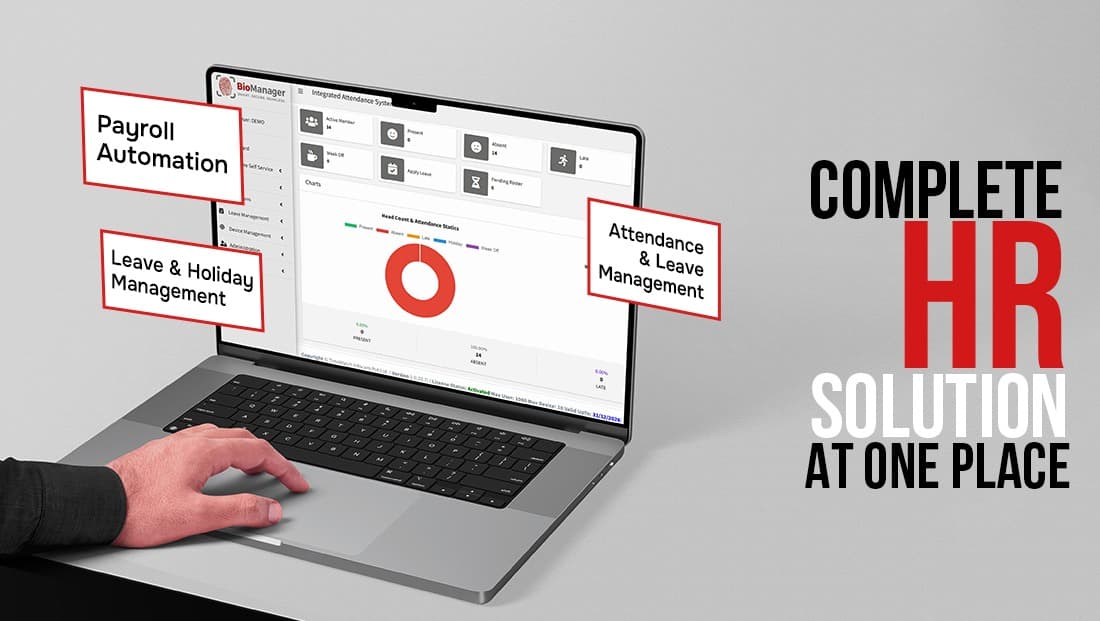
A policy is only as good as the system enforcing it. TimeWatch BioManager lets you configure shifts, grace time, late mark conversions, half day thresholds, leave types and multi level approvals exactly as written, with employees raising leave, out duty and regularisation requests from the app. iAS Desktop offers shift roster and leave management for businesses that prefer on premise software, and both connect to TimeWatch attendance and payroll software so the policy flows straight into salary.
Pair the software with the right biometric attendance machines for your sites. Our guide to biometric attendance in India explains how businesses across the country set this up.
Frequently asked questions
How much grace time should an attendance policy allow?
There is no single right figure. Choose a short window that reflects your commute realities and shift type, apply it consistently, and write it as a number in the policy.
Can late marks be converted into leave deductions?
Many companies convert a set number of late marks into a half day of leave or loss of pay. Make sure the rule is written down, communicated and reviewed by your compliance advisor.
What is attendance regularisation?
It is the process for correcting missed or wrong punches through a request and approval. Clear time limits and named approvers prevent misuse.
Should contract workers follow the same attendance policy?
They often follow similar recording rules, but shifts, wage terms and leave may differ. Document the differences clearly.
Next step
Bring your draft policy and let TimeWatch show you how each rule maps into BioManager. Book a walkthrough with our team and turn your written policy into automatic attendance.